
The latest on the Karen Read murder case
Sign up for our Extra newsletter to get updates from the retrial and other breaking news alerts delivered to your inbox.

On the stand Tuesday:
John O’Keefe’s skull fracture likely did not occur as a result of a collision with Karen Read’s taillight, nor were the abrasions on his arm consistent with contacting the taillight, ARCCA biomechanics expert Andrew Rentschler testified.
Expected to be the final defense witness, Rentschler began his testimony Tuesday afternoon before Judge Beverly Cannone dismissed jurors for the day. He spoke at length about his credentials and work with ARCCA, an engineering consulting firm initially hired by the Department of Justice and FBI as part of a federal probe into the state’s handling of Read’s case.
Reflecting on ARCCA’s previous contract work with the National Hockey League, defense attorney Alan Jackson asked Rentschler about the company’s use of anthropomorphic test devices, or crash test dummies.
“Did you need to use a Hybrid III that was the same size as these big, tall, 6-foot-4, 230-pound hockey players?” Jackson asked.
“No, not at all,” Rentschler replied. He explained that while there are 95th percentile male dummies available, they’re not commonly used.
“The 50th percentile male is basically the gold standard for crash test dummies,” Rentschler added, describing the practice of mathematically scaling to account for the difference in size. Special prosecutor Hank Brennan previously grilled Rentschler’s ARCCA colleague, Daniel Wolfe, about the company’s testing on a dummy arm that purportedly weighed less than O’Keefe’s arm.
Asked about ARCCA’s task when it first began looking into O’Keefe’s death, Rentschler replied, “We were kind of constrained in what we were asked to do and to review, but we were asked to evaluate whether the injuries sustained by Mr. O’Keefe were consistent with being struck by [Read’s] Lexus.”
He told jurors he reviewed medical records, photos, and information about Read’s vehicle as part of his analysis. While Wolfe’s work focused more on evaluating the force needed to produce the damage to the SUV, Rentschler’s analysis pertained to O’Keefe’s injuries and the alleged interaction between O’Keefe and the SUV.
He testified that about 1,400 to 1,600 pounds of force would be required to produce an occipital skull fracture like O’Keefe’s. After dropping a dummy head onto a taillight cover to simulate a 15 mph impact, Rentschler said he concluded “it really wasn’t possible to get a skull fracture by hitting the taillight and not sustain any other significant fractures.”
Rentschler said he ultimately determined O’Keefe’s occipital skull fracture likely didn’t occur from contact with the passenger side taillight of Read’s SUV. As for the cuts on O’Keefe’s right arm, Rentschler said those were also “inconsistent with contact to the taillight.”
He added: “You would expect additional injuries, likely fractures, to the hand and/or the forearm depending on the actual speed of the vehicle.”
Cannone dismissed the jury for the day shortly after 3:30 p.m., telling jurors to expect a full day in court Wednesday.
“I can tell you, the lawyers tell me that we’re definitely winding down,” she added.
Once jurors left the courtroom, Cannone said it seems Read’s case may be in the jury’s hands by Friday, or Monday at the latest.

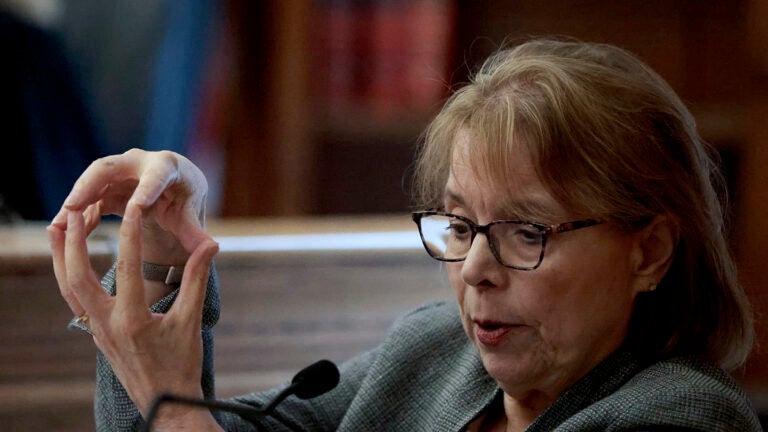
Facing questions about decades-old controversies from her time as Rhode Island’s chief medical examiner, defense forensic pathologist Dr. Elizabeth Laposata dismissed the claims as “erroneous stuff” and “not substantive.”
Following the lunch break, special prosecutor Hank Brennan turned his attention to Laposata’s qualifications and tenure with the medical examiner’s office, from which she resigned in 2005. He homed in on the higher profile cases Laposata oversaw during her time there, including the lethal 2003 Station nightclub fire.
“The Station nightclub fire — you received quite a bit of criticism on that, didn’t you?” Brennan asked.
“There was a flurry of negative press without any basis,” Laposata shot back.
Brennan pressed Laposata on her comments regarding the need for medical examiners to familiarize themselves with the scene of a death, pointing out Laposata faced criticism for her own delayed response to the scene of the nightclub fire.
“As soon as I got a call that there was that fire in the nightclub, my investigator went right to the scene and I was in constant communication with him throughout the early morning hours of that horrible accident,” Laposata testified.
She explained she went to the medical examiners office to prepare for the inundation, asserting there was no need for her to go to the scene at that time. Brennan pushed back, questioning whether Laposata caught flak for failing to visit the scene for more than 17 hours.
“It was untrue,” she replied. “I would have gone if I needed to. … It was erroneous stuff.”
According to The New York Times, a 2005 audit also revealed hundreds of incomplete autopsy reports and criticism about the office’s handling of organ and tissue donations and autopsies. Responding to a question from Brennan about the audit, Laposata acknowledged “a little flurry of stuff which was not substantive.” She explained her 2005 resignation was largely in response to anticipated budget cuts that she felt would threaten the quality of the department’s work.
As Brennan’s questions shifted back to John O’Keefe’s injuries, Laposata confirmed a cut above O’Keefe’s right eye could be consistent with not only a fist — as she testified Monday — but other types of blunt impact. Asked about a wound on O’Keefe’s nose, Laposata testified the injury could be caused by something like a thicker piece of glass.
Brennan asked whether a facial wound would “spurt” blood if a sharp object like glass were removed from someone who was already dead. He appeared to be referring to Read’s comments during an April 2024 Investigation Discovery docuseries interview, when she alleged O’Keefe had a piece of glass wedged on his nose like a splinter when she found him in the snow outside 34 Fairview Road.
“As soon as I pulled it, it just gushed blood down his face,” Read said in the clip, played for jurors on May 16.
“If you’re dead, there’s no blood pressure,” Laposata explained Tuesday. “So if you’re dead and you remove something, there may be some superficial blood, but it’s not going to have blood flow because your heart’s not pumping out of the cut ends of the blood vessels.”
Brennan embarked on a line of questioning about hypothermia and O’Keefe’s body temperature, which clocked in at 80.1 degrees Fahrenheit the morning he died. Laposata explained a dead body at room temperature will typically lose about 1.5 degrees per hour, though the cooling rate can jump to four degrees per hour in a colder environment where the body is covered in snow.
Brennan asked whether a temperature drop from 98.6 degrees to 80.1 degrees was consistent with being out in the cold for five-and-a-half hours, as prosecutors allege O’Keefe was.
“For a dead body, yes,” Laposata agreed. “That’s how a dead body would cool in a snow-covered or cold environment.”
Brennan asked whether someone’s body temperature could fall at an escalating rate during their time in the cold, depending on when they died.
“Sure,” Laposata conceded.
As he returned for redirect examination, defense attorney Alan Jackson confirmed Laposata reviewed O’Keefe’s postmortem X-rays and found no fractures or defects. He had Laposata walk jurors through the X-ray of O’Keefe’s right arm, which was wounded superficially but suffered no breaks.

Judge Beverly Cannone said she will allow prosecutors to question defense forensic pathologist Dr. Elizabeth Laposata about an audit critical of the Rhode Island medical examiners office under Laposata’s leadership.
Prosecutors may also question Laposata about her office’s handling of the deadly 2003 Station nightclub fire, which killed 100 people, Cannone ruled.
With jurors out of the courtroom, Brennan argued the 2005 audit paints a vastly different picture of Laposata’s credentials than the one offered by the defense Monday, indicating “negligence, if not malfeasance,” in her office.
According to The New York Times, the audit revealed hundreds of incomplete autopsy reports and criticism about the office’s handling of organ and tissue donations and autopsies. Laposata herself also caught flak for her response to the Station nightclub fire.
Responding to Brennan’s allegation of incomplete reports, Jackson described the matter as a “political situation” and said Laposata had merely prioritized reports based on their timeliness.
“By the way, none of the reports were ever not done,” Jackson added. “They were all completed. There were a small fraction of reports, according to the audit and according to Dr. Laposata herself, that had to take a back seat.”
He also noted the autopsies in question were performed 25 years ago. As for the nightclub fire, Jackson pointed out Laposata’s staff responded to the scene immediately, and Laposata arrived later the same day.
“Mr. Brennan himself has hired Dr. Laposata personally no fewer than four or five times. Maybe it’s three or four times,” Jackson alleged. “He knows her qualifications; he knows the quality of her work.”
But Brennan denied Jackson’s characterization.
“The reality is, I have used her a few times,” he told Cannone. Brennan further explained he wouldn’t publicly disclose the reason he stopped using Laposata as an expert, “because it would be unfair without her in the room.”
Separately, the lawyers also discussed entering the X-rays from John O’Keefe’s autopsy into evidence and reviewed a presentation from ARCCA Inc. biomechanics expert Andrew Rentschler, expected to be the final defense witness.

John O’Keefe did not die of hypothermia, and a fall onto hard ground — such as the grassy lawn outside 34 Fairview Road — would not have caused the injury to the back of his head, defense forensic pathologist Dr. Elizabeth Laposata opined Tuesday.
Laposata specifically pointed to a horizontal laceration on the back of O’Keefe’s head and “vertical scraping of the skin” on his scalp.
“If you fall back on a flat surface, … many times, the tear you get in the scalp can be more like a star, because you just hit one part and then the tears go in kind of a star pattern,” she explained.
Under questioning by defense attorney Alan Jackson, Laposata walked jurors through O’Keefe’s various injuries and discussed her observations and conclusions. Jackson displayed a photo of Karen Read’s SUV and pointed to a spoiler on the back of the vehicle, asking whether a cut above O’Keefe’s right eye was consistent with impacting that edge at speeds greater than 20 mph.
“No, that rounded, thick area would not cause that skin defect in his upper eyelid,” Laposata replied. If O’Keefe had made contact with the spoiler, she said she would expect to see a corresponding horizontal “ribbon of bruise.”
Laposata also revisited Monday’s testimony about brain stem herniation, which she described as “a harbinger of death.”
“You just die after that,” she added. “So that’s what happened to Mr. O’Keefe’s brain.”
Before an autopsy photo of O’Keefe’s brain stem was shown to the jury, Judge Beverly Cannone warned jurors the autopsy images were graphic and could be unpleasant.
O’Keefe would have been ‘immediately incapacitated,’ forensic pathologist says
Laposata testified Monday that O’Keefe’s head injuries were consistent with a coup-contrecoup injury, which results in damage not only at the point of impact, but also on the opposite side of the head. Jackson questioned how quickly someone with O’Keefe’s brain stem swelling and coup-contrecoup injury would become incapacitated.
According to Laposata, the person would fall unconscious immediately due to the energy transfer in the brain and “massive” skull fractures, with brain swelling soon following. Within 15 to 20 minutes, the brain stem would start to herniate into the area of the spinal cord, compressing the brain stem and damaging the areas that control breathing and pulse, Laposata explained.
In O’Keefe’s case, she said, “he would be immediately incapacitated with a decreased level of consciousness once he received that impact on the back of the head. He would not be able to make any purposeful movements.”
While O’Keefe might have some arm jerking or seizure activity following his injury, “he would be severely concussed, unconscious, not able to walk, not able to carry out purposeful activity,” Laposata added.
She restated her opinion that the injury to the back of O’Keefe’s head indicated he struck his head on something ridged.
“So what this injury tells me and what I would tell the investigators is that Mr. O’Keefe went back onto some object that had some sort of ridge to it to make that horizontal tear in the skin,” Laposata explained. “But that ridge also had — it wasn’t smooth. It had some little grainy things sticking up on it.”
She confirmed she examined photos of the outside of 34 Fairview Road, where O’Keefe was found unresponsive in the snow early on Jan. 29, 2022. Jackson asked Laposata whether she also saw photos of the interior of the home’s garage, but Cannone sustained an objection from prosecutors and told jurors to disregard the question.

Did O’Keefe show signs of hypothermia?
Later in her testimony, Laposata concurred with medical examiner Dr. Irini Scordi-Bello’s opinion that O’Keefe died of blunt impact injuries to the head, though she disagreed with Scordi-Bello’s secondary finding of hypothermia.
While O’Keefe’s core body temperature was 80.1 degrees Fahrenheit the morning he died, Laposata noted his body could have cooled after death. She said she often looks for Wischnewski ulcers — superficial hemorrhagic spots in the stomach lining — when determining whether someone died from hypothermia.
As Jackson displayed a photo of O’Keefe’s dissected stomach, Laposata told jurors, “there’s no ulcerations here, so the diagnosis of death due to hypothermia is not appropriate in his case.” Likewise, she said she observed no signs of frostbite.
Laposata: O’Keefe’s arm injuries ‘very much’ consistent with animal bite or claw marks
Jackson pivoted to O’Keefe’s right arm injuries, asking Laposata whether she’s ever seen patterned wounds from animal bites or claw marks. Laposata confirmed she has and said claws can produce parallel scrapes, while teeth can leave “dot-like” imprints.
“Most mammals, animals that attack or get in contact with a body have canines … that make paired marks,” she explained. O’Keefe’s arm wounds “were inflicted prior to death,” Laposata added.
Jackson asked the forensic pathologist for her opinion on whether the pattern of wounds on O’Keefe’s right arm was consistent with animal bite or claw marks.
“Yes, it is,” she replied. “Very much.”
During a subsequent line of inquiry, Jackson peppered Laposata with questions about the injuries she would expect to see if a pedestrian were struck at speeds greater than 20 mph. Laposata explained crushed tissue at the point of impact would result in bruising.
Jackson attempted to ask Laposata whether she agreed with prosecutors’ theory that O’Keefe’s arm was injured during a collision with the taillight on Read’s SUV, but Cannone struck that question from the record.
Trying again, he asked whether the pattern injuries on O’Keefe’s right arm corresponded with injuries that could have come from contact with irregular, fractured pieces of plastic. Investigators have said Read’s taillight was shattered and missing much of its plastic lens when police took the SUV into custody.
“No, not at all,” Laposata testified. “First of all, those injuries are patterned injuries from an animal bite. We have the canines, we have the incisors—”
Cannone cut Laposata off and struck her answer, calling the lawyers to sidebar. As Jackson resumed his questioning, Laposata said she stood by her finding that O’Keefe had no bruising on his arms, torso, or legs.
Responding to a subsequent question from Jackson, Laposata confirmed X-rays are typically captured prior to a forensic examination, as they can show foreign materials and bone fractures. Prosecution accident reconstructionist Judson Welcher previously testified that it didn’t appear X-rays had been taken of O’Keefe’s right arm or hand.
Following the morning recess, however, Laposata confirmed she examined X-rays captured at the medical examiner’s office of O’Keefe’s chest, arms, and legs. Asked specifically about O’Keefe’s right hand, she said she didn’t see any bone defects, “and the tissue was normal.” Likewise, O’Keefe’s right arm showed intact bones, she said.

Prosecutors begin cross-examining forensic pathologist
As he stepped up for cross-examination, special prosecutor Hank Brennan asked Laposata whether O’Keefe’s head injuries were caused by being “thrust” backward.
“Yeah, the motion was upwards, down,” Laposata replied.
Possibly a fall, Brennan suggested.
“Correct,” Laposata confirmed.
Contrasting Laposata’s experience with that of prosecution expert and neurosurgeon Dr. Aizik L. Wolf, Brennan questioned whether Laposata has experience studying the brain clinically — for example, opening someone’s skull surgically to treat an injury.
“No, I’m not a neurosurgeon,” Laposata replied. “I’m not a neurologist. I’m not a neurosurgeon. I am a forensic pathologist.”
She added: “I don’t treat or diagnose living patients.”
Responding to a series of questions from Brennan, Laposata confirmed forensic pathologists will sometimes consult a neuropathologist, an expert who specializes in the pathology of the nervous system. Seemingly referring back to Wolf’s testimony, Brennan asked Laposata if she knew that about one third of coup-contrecoup patients survive with proper treatment.
“It depends on the amount of force,” Laposata replied.
Brennan questioned whether Laposata had ever read a study by Wolf on fractures to the clivus, or base of the skull, and Laposata said she hadn’t. He also challenged Laposata’s basis and criteria for concluding that O’Keefe would have died within about 15 minutes, and Laposata pointed to O’Keefe’s “massive” skull fractures and subsequent brain swelling.
Wolf previously testified that periorbital ecchymosis, or “raccoon eyes,” takes at least a couple hours to form, but Laposata told jurors Tuesday the accumulation of blood around the eyes begins immediately following a severe head injury.
Confirming O’Keefe’s wound pattern is “typical of falling backwards on a hard surface,” Brennan questioned whether frozen ground would suffice.
“Frozen ground can be hard, but it doesn’t fit the pattern in this injury,” Laposata testified. She did, however, confirm frozen ground could be hard enough to cause a skull fracture.
Returning to Laposata’s description of a “grainy” surface, Brennan asked if the forensic pathologist was aware of any rocks, impediments, or bumps in the area where O’Keefe was found unresponsive in the snow.
“It was a flat surface covered with grass,” Laposata testified, citing photos from the scene.
She acknowledged O’Keefe was wearing a baseball cap the night he died, though she said the hat would not cause the pattern of injuries she observed on O’Keefe’s scalp. At Brennan’s prompting, Laposata confirmed the area of the wounds on the back of his head could line up with a baseball cap.
In a rare moment of levity, Brennan asked Laposata if she’d agree the brain is soft, “consistent with, for example, tofu.”
“Oh, gross,” Laposata said, chuckling. “It is soft. … It depends on what kind of tofu you have.”
Later turning his attention to O’Keefe’s arm wounds, Brennan asked, “Can medical professionals disagree on opinions about wounds and causes?”
“I suppose they can,” Laposata conceded.
Brennan confirmed Laposata did not believe O’Keefe’s arm wounds were from an impact with broken plastic or glass. He also revisited Laposata’s opinion that O’Keefe would have been knocked unconscious and incapable of purposeful movement following his head injury.
“So if hypothetically, Mr. O’Keefe incurred his injury sometime around 12:32 [a.m.], is it your opinion that he never moved again until he was moved physically by somebody else?” he asked.
Laposata said she didn’t know what time O’Keefe sustained his injuries, “but after that time, he could not carry out any purposeful activity.”
Cannone sent jurors out of the courtroom for their lunch recess around 12:40 p.m. Laposata’s testimony will resume following the break.

Karen Read’s attorneys urged Judge Beverly Cannone to reconsider her ruling that defense forensic pathologist Dr. Elizabeth Laposata is not qualified to testify as an expert on dog bite wounds, arguing prosecutors opened the door during a prior cross-examination.
Defense attorney Alan Jackson alleged prosecutors have been shifting the burden to Read’s team “with cross-examation that’s laced with indications, or implications, about witnesses that may or may not be called by the defense.”
He pointed out the defense isn’t obligated to call any witnesses, and “we shouldn’t be put in a position where our hand is forced to call witnesses because of questioning by the commonwealth, which is improper.”
Jackson pointed to special prosecutor Hank Brennan’s questioning of defense dog bite expert Dr. Marie Russell, noting Brennan asked Russell about her familiarity with Laposata and any reports or opinions she offered in Read’s case. He argued Brennan gave jurors the impression that Laposata’s report would be harmful to the defense.
“That’s the only reasonable interpretation of those facts,” Jackson argued.
He asserted the wounds on John O’Keefe’s right arm were inflicted by a dog, and anything short of presenting that evidence to the jury “would be to perpetrate an intentional fraud” on jurors.
“Ms. Read is entitled to more,” Jackson argued. “She’s entitled to better. She is entitled to the evidence.”
Brennan, however, alleged the defense “uses their witnesses to vouch for their own credibility” and introduce information they know to be inadmissible. He argued Russell essentially assured the jury she was in a unique position to give an opinion on dog bite wounds, given her experience as an emergency room physician and forensic pathologist.
Cannone initially rejected the defense team’s request for her reconsideration, telling the attorneys she still would not allow Laposata to testify about dog bites.
“I just think it’s outrageous,” Jackson shot back. He asked Cannone if Laposata could at least testify that she looked at O’Keefe’s arm wounds and found them consistent with an animal bite.
“Can we at least split the baby?” he asked.
“I will do that. I’ll allow that over the commonwealth’s objection,” Cannone agreed, though she said Jackson could not display visuals of an animal jaw.
Livestream via NBC10 Boston.
Now down to the final few days of testimony, Karen Read’s murder retrial resumes Tuesday with forensic pathologist Dr. Elizabeth Laposata back on the stand.
Formerly the chief medical examiner in Rhode Island, Laposata testified Monday that Read’s boyfriend, Boston Police Officer John O’Keefe, sustained his fatal head injuries by falling backward onto “something that had a little ridge.” A laceration above O’Keefe’s right eye was also consistent with a fist or “some sort of object,” she opined.
Laposata identified the same coup-contrecoup head injury patterns as Dr. Aizik L. Wolf, a neurosurgeon and prosecution expert. However, Wolf testified O’Keefe’s head injuries would not require a fall onto a ridged surface.
Prosecutors allege O’Keefe’s head injuries were the result of Read drunkenly and deliberately ramming him with her SUV while dropping him off at an afterparty in Canton following a night of bar-hopping in January 2022. The defense, meanwhile, has suggested O’Keefe was actually beaten inside the home — owned at the time by a fellow Boston police officer — and attacked by the family’s dog before he was ultimately tossed outside in the snow. Read, they say, was framed in a massive conspiracy among law enforcement and afterparty guests.
Following a brief voir dire of Laposata Monday, Judge Beverly Cannone determined the forensic pathologist was not qualified to testify as an expert on dog bite wounds and said Laposata’s opinion that O’Keefe’s injuries were not consistent with a motor vehicle strike exceeded the scope of her expertise in some ways.
Jurors Monday also heard from private investigator John Tedeman, who was hired by Read’s team to measure the distances to the various entrances of 34 Fairview Road, the home where O’Keefe was found unresponsive in the snow. Defense attorney David Yannetti asked Tedeman whether he had an opportunity to look inside the home’s garage while taking measurements, and Tedeman said he did.
“Did you see concrete steps and a ridge there and a hard, concrete floor?” Yannetti asked.
“Yes,” Tedeman replied, though Cannone sustained an objection from prosecutors and struck Tedeman’s answer from the record.
In one of the more explosive moments of Monday’s proceedings, Read’s lawyers demanded a mistrial with prejudice after special prosecutor Hank Brennan erroneously suggested holes on the back of O’Keefe’s sweatshirt could have occurred during a collision. As defense attorney Robert Alessi noted, a state criminalist actually cut the holes while examining and testing O’Keefe’s clothing.
“This is intentional. This is irremediable. This is on the key issue of this case: whether there was any collision at all,” Alessi argued. “The commonwealth has no case. They have no collision. They are desperate and are trying to create … specters of collision where the evidence doesn’t support it.”
He added: “We’ve come to the manufacture of evidence.”
Brennan kept his remarks brief, telling Cannone, “it appears that I made a mistake” while questioning defense crash expert Daniel Wolfe. He suggested the judge offer jurors a clarification, which she opted to do. Cannone denied the defense request for a mistrial.
In a stop-and-start day with several hearings and sidebar discussions out of jurors’ earshot, Cannone repeatedly emphasized the need for efficiency and suggested she regretted giving the jury a bonus day off last week.
“We’ve done important work, but we’ve wasted an awful lot of the jurors’ time today,” Cannone told the lawyers at one point.
She added: “You can tell just by looking at this jury, they’re fed up.”


Sign up for our Extra newsletter to get updates from the retrial and other breaking news alerts delivered to your inbox.




To comment, please create a screen name in your profile
To comment, please verify your email address
Conversation
This discussion has ended. Please join elsewhere on Boston.com