
Sign up for the Today newsletter
Get everything you need to know to start your day, delivered right to your inbox every morning.
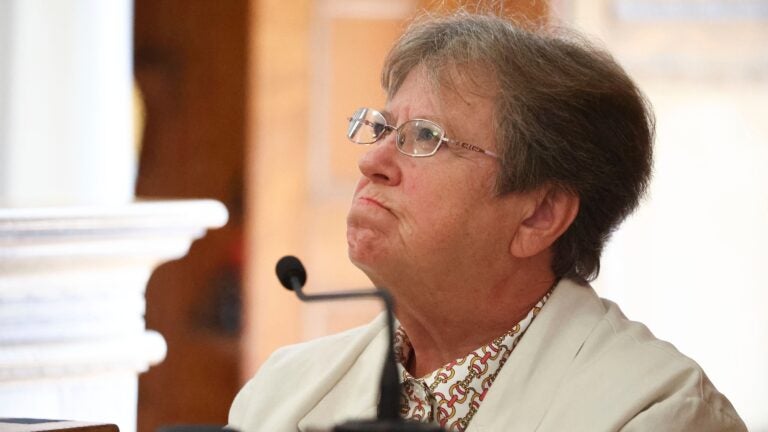
Karen Read’s dog bite expert was back in the hot seat Tuesday as prosecutors blasted her with pointed questions in an attempt to chip away at her credibility and keep her off the witness list.
Throughout hours of testimony, Dr. Marie Russell repeatedly stated her belief that wounds on the arm of Read’s boyfriend, John O’Keefe, were from a dog attack and not a collision with Read’s SUV.
“I considered various possibilities of a car accident — a pedestrian accident, I should say,” explained Russell, a retired emergency room physician and forensic pathologist from California. “And I went through many scenarios in my head, and no car accident scenario could create that configuration of wounds that’s on the arm.”
Prosecutors say the blame for O’Keefe’s injuries falls squarely on Read; the 44-year-old is accused of deliberately backing her SUV into O’Keefe, a Boston police officer, after a night of bar-hopping with friends in January 2022. Prosecutors say Read allegedly left O’Keefe to die outside the home of Brian Albert, another Boston officer who was hosting an afterparty.
Read’s lawyers claim she was framed in a coverup, suggesting O’Keefe walked into the party and was assaulted, attacked by Albert’s dog, Chloe, and ultimately dumped outside in the snow. Read’s first trial ended with a hung jury in July, and her retrial is scheduled to begin April 1.
Tuesday’s cross-examination marked the continuation of a Dec. 12 hearing to determine whether Russell should be allowed to testify the second time around. Prosecutors have asked Judge Beverly Cannone to exclude Russell, arguing the physician isn’t qualified to offer an opinion on O’Keefe’s injuries.
“In this case, Dr. Russell has never been in the business of identifying dog bite wounds; she treats them,” special prosecutor Hank Brennan argued.
Brennan zeroed in on Russell’s equivocation in her earlier testimony about the cause of O’Keefe’s injuries. Russell said she was “thinking like a doctor,” explaining physicians are taught that nothing in medicine is 100%.
However, she added, “I was certain that there was a dog.”
Brennan turned his attention to the methodology Russell uses when evaluating wounds.
“You have personal experience where you’ve treated dog wounds, and you look at it and you’re simply deciding whether or not to you this looks similar,” Brennan said. “You’re giving your personal aside, aren’t you?”
“I actually find that offensive,” Russell replied, disputing Brennan’s characterization. While she said she’s not aware of any official standard, she pointed to her decades of experience, as well as peer-reviewed articles that describe how to observe, evaluate, and treat dog bite wounds.
“In fact, you can’t point to one place where there is a readily accepted standard in the dog bite community for identifying dog bites,” Brennan shot back. “You can’t point to one article, journal, book?”
“That’s correct,” Russell answered.
“And so because there is no methodology or standard for you to look at, it involves a great deal of your subjective opinion based on your experience treating dog wounds, doesn’t it?” Brennan charged.
“With all due respect, Mr. Brennan, I’m not somebody that just came in off the street,” Russell said. “I have at least 30 years as a physician, and I use that information in helping me form my opinions about wounds.”
During Read’s first trial, jurors heard testimony that the University of California, Davis Veterinary Genetics Laboratory Forensic Unit found no signs of canine DNA on swabs taken from O’Keefe’s shirt.
“Do you think that … somehow challenges your opinion, that there’s no dog DNA?” Brennan asked.
No, Russell replied, later adding: “The absence of the evidence is not as remarkable as the presence of the evidence.”
Brennan projected a photo of O’Keefe’s wounded arm, challenging Russell as she offered her thoughts on the injuries. At one point, he asked Russell whether she might be confusing O’Keefe’s birthmarks for round puncture or punctate wounds.
“Do you think that what you’re describing as dog puncture wounds, you could be mistaking for just his skin and the different types of marks on his skin, like freckles or moles?” he asked.
“I don’t believe so, particularly since they’re right where those wounds are, the abrasions are,” Russell replied.
During his cross-examination, Brennan also revealed that the U.S. Attorney’s Office, which launched a federal probe into Read’s case, enlisted a deputy medical examiner to look at O’Keefe’s wounds. According to Brennan, the deputy medical examiner commented that “the injuries do not photographically appear to be nor are described as puncture bite wounds and thus are highly unlikely to be the result of an animal bite attack.”
Russell said she did not receive a copy of the deputy medical examiner’s findings, but added, “Not very many medical examiners … have experience with dog bites, seeing hundreds and thousands of dog bites and treating them, and not very many medical examiners have even autopsied a case with dog bites.”
“You have no peer endorsement for any of your opinions, do you?” Brennan asked.
“I didn’t think I was allowed to show these pictures to anyone,” she replied.
Brennan also said authorities visited Chloe, since rehomed to Vermont, and took molds and measurements of her teeth and paws.
“Now that you know that Chloe’s available, wouldn’t those molds be helpful? Wouldn’t you want to look at them and compare them to the distances on the abrasions on Mr. O’Keefe’s arm?” Brennan asked.
“I don’t think it’s necessary for many reasons,” Russell replied.
“If the distance of Chloe’s canines is significantly different than these abrasions in this picture, you would agree that the abrasions on Mr. O’Keefe’s arm could not have been caused by Chloe. Would you agree?” he asked.
“No, I wouldn’t agree to that statement,” Russell said, citing factors like skin elasticity and shrinkage.
Responding to a later question from defense attorney Robert Alessi, Russell confirmed her opinions on the case have strengthened since her initial testimony.
“Between then and now, my opinions have been challenged, and as any good doctor would do, they go back and reevaluate what they base their opinions on,” she explained. “And I did that. I reevaluated, I looked at the pictures again, the evidence again. I looked at peer-reviewed studies, and I was convinced that I was correct.”
Brennan argued Russell’s methodology was lacking, casting doubt on her pattern recognition analysis.
“It’s empty phrasing unless you can identify and articulate what is the specificity, what is the standard,” he told the court. “And we still don’t know. After all this testimony, we don’t know.”
Brennan added: “She has done no due diligence, and she can’t describe any methodology because there is none.”
Alessi pushed back, asserting Russell offered a thorough explanation of her process.
“I submit that if you ran an artificial intelligence program, you couldn’t come up with a more perfect witness for the subject matter of this testimony,” Alessi said.
Appealing to Cannone, he added: “Shouldn’t the jury be able to hear the alternative theory of the defense? Shouldn’t the jury have that information so that justice can be served, so that the best decision can be made about whose theory about these injuries is right?”
Cannone did not immediately rule on prosecutors’ request.
Russell is one of several defense experts the Norfolk County District Attorney’s Office has challenged ahead of Read’s retrial. Last week, prosecutors asked Cannone to exclude testimony from Richard Green, a digital expert who maintained that witness Jennifer McCabe Googled “hos long to die in cold” long before O’Keefe was found in the snow.
In a Tuesday court filing, prosecutors said they also want to block Daniel Wolfe and Andrew Rentschler, two crash reconstructionists who testified for the defense in Read’s first trial. At the time, Wolfe told the court his company, ARCCA Inc., was retained by the Department of Justice and FBI to look into the case.
“The history and complexity of the ARCCA witness’s [sic] employment and directives are muddled and unnecessary to recount for the purposes of this notice,” prosecutors wrote in Tuesday’s filing. “Rather, it is expected that if the defense attempts to proffer either or both potential witnesses, it will be unable to comply with Rule 14 obligations.”
Rule 14 concerns pretrial discovery, the evidence both sides are required to share before a case goes to trial.
“The Commonwealth does not allege that the defense will be negligent or unwilling to comply, rather, it is expected that given the handling and employment of these witnesses the defense will simply be unable to meet its obligation,” prosecutors wrote.
Read’s case is back in court Jan. 31.
Livestream via NBC 10 WJAR.

Get everything you need to know to start your day, delivered right to your inbox every morning.




To comment, please create a screen name in your profile
To comment, please verify your email address
Conversation
This discussion has ended. Please join elsewhere on Boston.com