
Sign up for the Today newsletter
Get everything you need to know to start your day, delivered right to your inbox every morning.
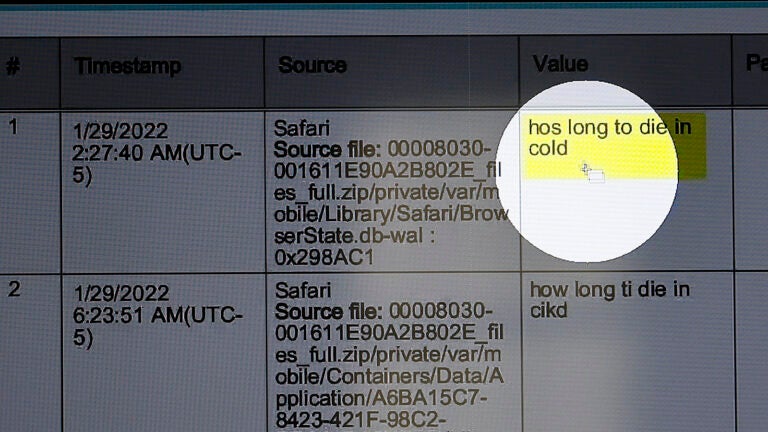
Prosecutors in the Karen Read murder case are asking a judge to exclude testimony from a defense digital expert who was adamant that witness Jennifer McCabe Googled “hos long to die in cold” hours before John O’Keefe was found unresponsive in the snow.
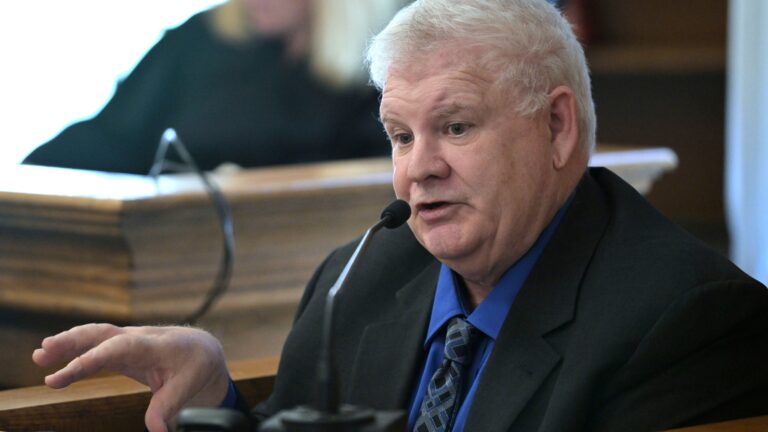
During Read’s first trial, United States Forensics owner Richard Green offered a 2:27 a.m. timestamp for McCabe’s hotly disputed search and testified about finding “a lot” of user-deleted artifacts in McCabe’s cellphone data from the morning O’Keefe died.
But in a new motion filed Tuesday, prosecutors argued both of those claims “lack any evidentiary support” and can’t be made in good faith, citing rival testimony from two prosecution experts who said McCabe’s Google search actually came hours later.
“Richard Green’s debunked opinions are not an example of a ‘battle of the experts’ best left to be resolved by the factfinder, but instead, an attempt to infect the jury with an inadmissible opinion that is not premised on reliable digital forensics,” prosecutors wrote.
They asked Judge Beverly Cannone to exclude Green’s testimony on the timing of McCabe’s Google searches and the search data she allegedly deleted, or to bring Green in for a hearing to determine whether he should be allowed to testify at Read’s retrial. Boston.com has reached out to Read’s attorneys for comment.
Prosecutors say Read, 44, drunkenly and intentionally backed her SUV into O’Keefe — her boyfriend of two years — while dropping him off at a house party in Canton after midnight on Jan. 29, 2022. Read, McCabe, and another woman found O’Keefe unresponsive outside the Fairview Road home around 6 a.m.
Read’s first trial ended with a hung jury in July, and she’s due to stand trial again later this year.
Her lawyers say she was framed in a widespread coverup, alleging O’Keefe entered the party and was beaten, attacked by the family’s dog, and left outside in a blizzard. McCabe’s sister and brother-in-law owned the Fairview Road home at the time, and she attended the party after drinking with Read, O’Keefe, and others earlier in the night.
She previously testified that she made Google searches for “hos long to die in cold” and “how long ti die in cikd” at Read’s insistence after they found O’Keefe.
Read “grabbed my hands, and she said, ‘Google hypothermia. Google how long it takes to die in the cold,’” McCabe recalled. “And so I had my phone out and it was cold, and my hands were frozen, and I have [multiple sclerosis], and I took my phone out while she was screaming and shaking my arm, and I attempted to Google, ‘How long does it take to die in the cold.’”
Digital forensics experts Jessica Hyde and Ian Whiffin both opined that McCabe made those Google searches shortly after 6:20 a.m. on the 29th. They also explained that the 2:27 a.m. timestamp indicated when McCabe first opened the Safari tab she used.
Prosecutors said Whiffin, a senior digital intelligence expert with Cellebrite, which provides the leading forensic data extraction software, debunked Green’s disputed claims through a “comprehensive analysis.” Green previously testified that one of the programs he used was ArtEx, a tool Whiffin created.
“The basis for Mr. Green’s contested opinions has been refuted not only by the Commonwealth’s independent experts but by Cellebrite itself, [which] has removed the type of timestamp relied on by Mr. Green from Cellebrite’s Decoding Engine,” prosecutors noted.
Analysis through the latest version of Cellebrite confirms the 6:24 a.m. timestamp for McCabe’s “hos long” search, they asserted.
“Clearly, the methodology or theory underlying Mr. Green’s testimony is not sufficiently reliable to be presented for the jury’s consideration,” prosecutors wrote. “A jury should not be permitted to consider baseless claims.”
Read’s case returns to court Jan. 7, and the defense team’s dog bite expert is due back on the stand for additional questioning regarding her qualifications.

Get everything you need to know to start your day, delivered right to your inbox every morning.




To comment, please create a screen name in your profile
To comment, please verify your email address
Conversation
This discussion has ended. Please join elsewhere on Boston.com