

Newsletter Signup
Stay up to date on all the latest news from Boston.com

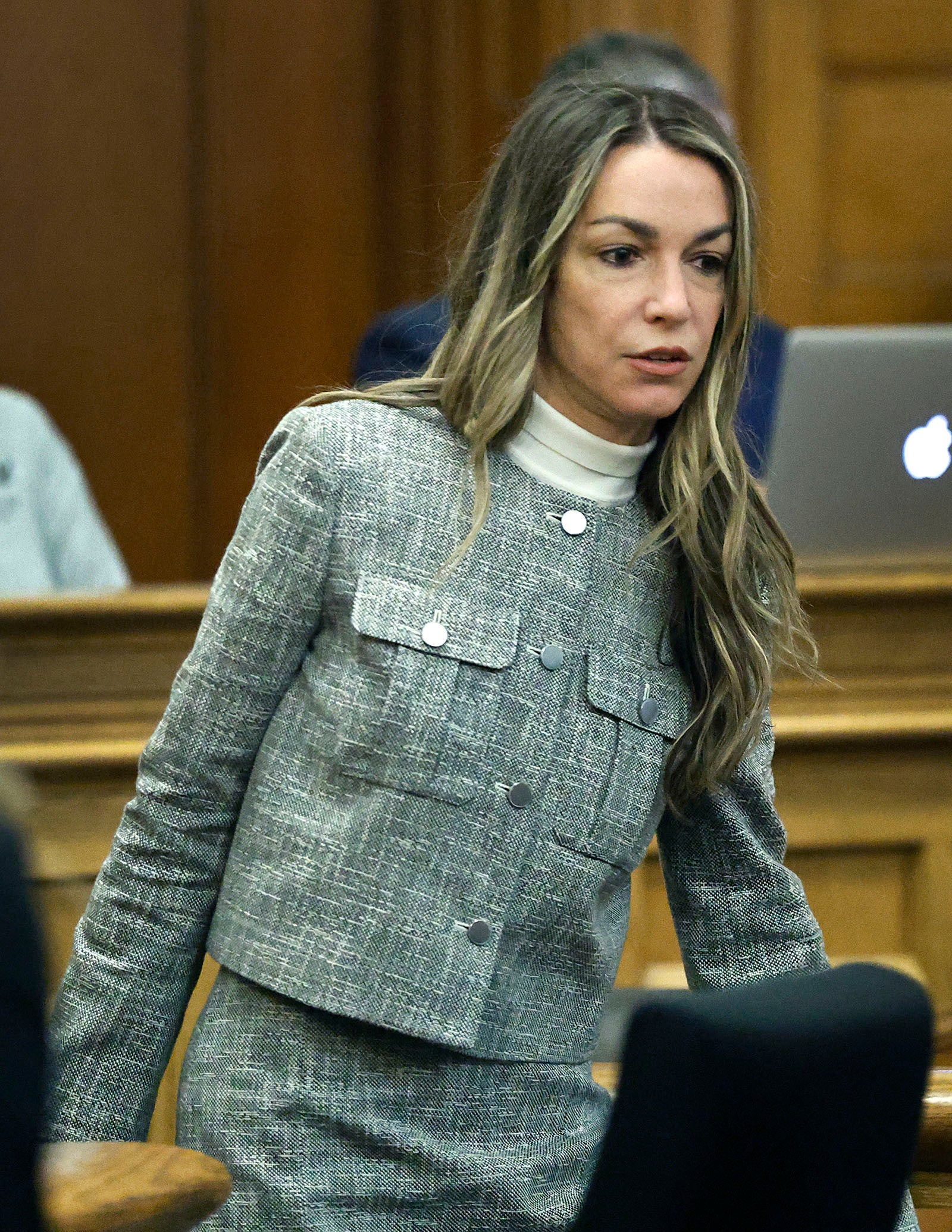
Striding into the courthouse day after day with sharp tailoring on display and her bicoastal legal team by her side, Karen Read more closely resembles a Sheryl Sandberg-esque boardroom power player than a woman on trial for murder.
In a case chock full of bombastic rhetoric and loud speculation, those following Read’s trial say the defendant’s styling choices send a firm, but unspoken, message: “I am a force to be reckoned with.”
Read tends to favor more structured silhouettes and often wears darker colors to court, which might signal to jurors that she is “powerful, unafraid,” said Andrew Caple-Shaw, who leads a team of trial consultants as managing partner of the firm ACT of Communication.
“The defense strategy seems to be that there’s a conspiracy, and ‘we’re positioning ourselves to fight the conspiracy,’” he said. “That’s the only rationale I can find for the approach that she’s taking in terms of the way she’s dressing and carrying herself, is that she’s framing herself as some kind of hero taking on a conspiracy.”

Read’s facial expressions during her trial and assertive engagement with the media also feed into that narrative, Caple-Shaw said.
“There’s an overall persona that she’s very much pushing that is not what one would normally do in a case like this,” he added.
Of course, “unusual” is the watchword when it comes to Read’s case. The 44-year-old is accused of backing her SUV into Boston Police Officer John O’Keefe, her boyfriend of two years, on Jan. 29, 2022. Prosecutors allege the Mansfield woman was driving drunk following a night out with friends and left O’Keefe to die in the snow outside a fellow Boston police officer’s home in Canton.
Read’s lawyers have pushed another story, suggesting that O’Keefe entered the home for an afterparty and was beaten, attacked by the family’s pet dog, and dumped outside. Read, they say, was framed in a massive coverup among witnesses and law enforcement.
As the fervor surrounding Read’s case turned her into something of a local folk hero — or villain, depending on your stance — the defendant’s clothing, facial expressions, and courtroom conduct were ripe for online dissection.
The research surrounding defendant appearance goes back decades; one 1978 study in Law and Human Behavior explored the bias effects of a defendant’s dress on their verdict and sentencing, focusing specifically on personal attire versus institutional uniforms. And in 2010, researchers at Cornell University found that unattractive defendants often face harsher sentences — 22 months longer in prison, on average.
In both civil and criminal cases, the jury ends up spending a lot of time looking at the parties in a case and noticing how they carry themselves, Caple-Shaw said. Attire and styling are part of that nonverbal dialogue, he explained, but it’s less about achieving a specific look and more about keeping a person’s appearance consistent with their narrative.
“So if we’re telling the jury that this person is always punctual and their shirt’s always untucked, it’s like, ‘Well, I’m hearing one thing from the lawyers and I’m seeing a different thing with my own two eyes,’” he said.

At ACT of Communication, the emphasis is not on teaching witnesses how to act in a courtroom, but how to be authentic and compelling, Caple-Shaw explained. Likability, approachability, and openness are the cornerstones, he added.
“Essentially, that you have nothing to hide and that you’re the kind of person that is ready and willing to share,” Caple-Shaw said. “We find that generally, we’re looking towards earth tones and pastels for women, but especially earth tones.”
Softer materials and colors are generally the right move, and “you definitely want to stay away from things that are striking, bold, or powerful,” he added. That also means choosing minimalist accessories over flashy watches and jewelry.
“If I had one phrase that I would use to sum up the way we want to dress someone for court if we want the jury to like them and believe them, it is, ‘If you’re paying attention to the clothing, you’ve already lost,’” Caple-Shaw said.
Shannon Shaming, who runs the YouTube channel Mindful Crime Couture, held up A-list actress Gwyneth Paltrow as the gold standard of courtroom styling. Paltrow notably made a case for “quiet luxury” during her ski crash trial in Utah last year, showing up to the courthouse bathed in sumptuous-yet-tasteful earth tones.
“If I were on trial, or was advising a client, I’d study from the style Bible of Gwyneth,” Shaming said in an email interview.
A therapist by trade, she noted that it would normally be difficult to build a connection between jurors and a “beautiful, tall, striking” celebrity, but soft materials and colors — and a noticeable dearth of brand logos — helped bridge the gap.
“Gwyneth’s hair was very plain as well, either loose and straight or a low ponytail,” Shaming noted. “She wore her reading glasses often — I think this was a big relatability factor. Every time she looked down at a court document she grabbed those and I thought, ‘Oh Gwynnie, I’m in my 40s too girl.’”

Read, a former Fidelity Investments equities analyst and finance professor, tends to favor “middle-high to high-end corporate labels,” according to Shaming, who has tracked down some of Read’s attire.
“They are typically available at Nordstrom or Neiman Marcus — but not with a recognizable designer name like Prada, Gucci, etc.,” Shaming said, naming Veronica Beard, Theory, and Smythe as a few of Read’s favored designers.
She described Read’s general wardrobe as “business attire but feminine and stylish” and said Read’s structured silhouettes signal a few different buzzwords to jurors: “Power, stylish, classy, chic, expensive.”
Most notably, Read often bucks the trend of defendants wearing softer shades, instead opting for a structured wardrobe rich in black, gray, and navy. (She has, however, thrown some beige, white, and blue into the rotation on occasion.)
Heading into the first day of Read’s trial, “I figured the team would look to soften her look a bit,” Shaming recalled, adding, “I would’ve bet the farm they wouldn’t have had her in a blazer dress upon opening.”
While she described Read’s first-day outfit as “gorgeously tailored and very professional and striking,” she also pointed to defense attorney David Yannetti’s opening words: “Karen Read was framed.”
“Being framed is a position of vulnerability,” Shaming said. “You are not the authority if you are being framed. In contrast I thought Karen’s look … was one of power.”

Both Shaming and Caple-Shaw also noted that Read’s wardrobe closely resembles her lawyers’ attire. Two of Read’s attorneys, Alan Jackson and Elizabeth Little, are based in Los Angeles, “and Alan Jackson’s suits and tailoring per suit look to be very, very expensive,” Shaming noted. “So having Karen look like one of them may separate her from the jury seeing her as ‘one of us.’”
Caple-Shaw acknowledged that Read’s defense team may have a strategy for how they’re presenting their client to the jury. However, he noted that lawyers haven’t fared particularly well in a longstanding Gallup poll tracking trustworthiness in American professions.
Historically, “the only way that you could be less credible with the average American is to dress like a politician or a used car salesman,” Caple-Shaw said, adding, “So why in the world you would want to put on an unlikeable, untrustworthy costume to go into a credibility competition is beyond me.”
However, he conceded that Read’s legal-minded attire may feed into the defense theory of a conspiracy.
“If you ask someone who does jury [consultant] work, they will tell you that jurors right now are very susceptible to conspiracy theories,” Caple-Shaw said. “There’s a lot of mistrust in the system, and so that’s a viable angle that they might be taking.”

Still, he noted that Read’s facial expressions at times seem incongruous with the defense team’s narrative.
“She smiles a lot for someone who, you know, is on trial for the death of supposedly a man she loved very much,” Caple-Shaw said. “The jurors are gonna see that.”
Read’s behavior needs to be consistent with the portrait she and her lawyers are painting for the jury, he said. He noted that jurors tend to put themselves in the shoes of a plaintiff or defendant.
“I think one of the issues with her is that the hair, the makeup, the clothes and the expression all seem perfectly manicured, professional, and assertive,” Caple-Shaw said. “And someone who is on trial for murder and who has lost someone that they dearly love, I think there are very few people who see someone in that position … as anything other than vulnerable, scared, and grieving.”
“I’m not seeing vulnerable and grieving,” he continued. “I’m seeing polished, assertive, on the attack. It doesn’t fit, right?”
Likewise, Shaming believes Read is sending a clear message that she is not a victim, but “a strong and powerful force.”
“It could be seen as very progressive and admirable or it could be seen as something else entirely,” Shaming said.


Stay up to date on all the latest news from Boston.com





To comment, please create a screen name in your profile
To comment, please verify your email address
Conversation
This discussion has ended. Please join elsewhere on Boston.com