
Newsletter Signup
Stay up to date on all the latest news from Boston.com
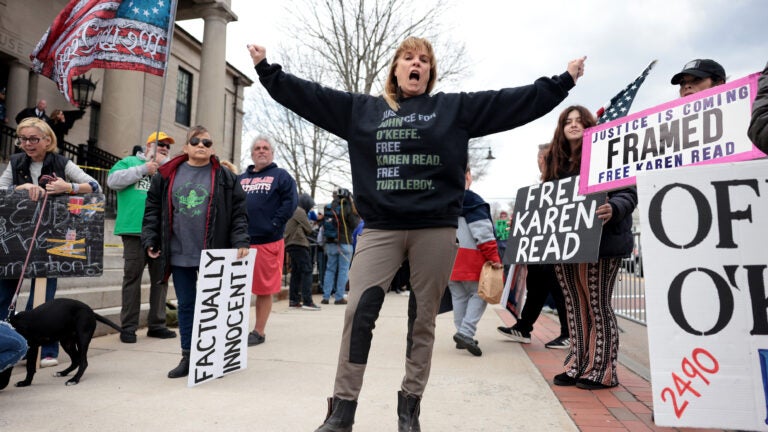
The judge overseeing the Karen Read murder case has ordered a 200-foot buffer zone to keep demonstrators away from the courthouse when Read’s trial starts later this month, citing the need to protect jurors from outside influences.
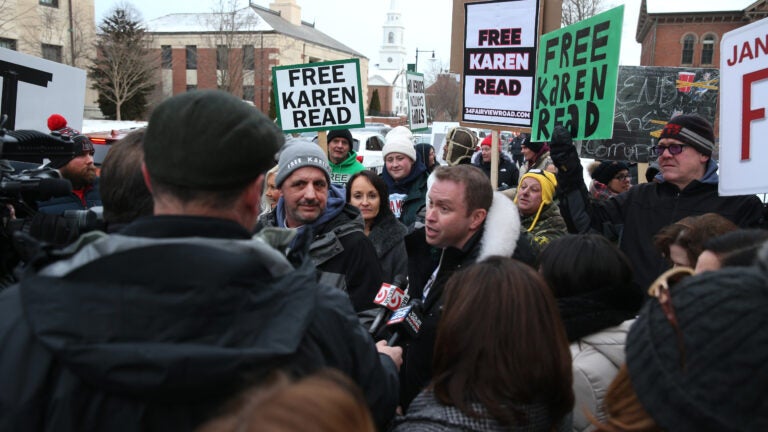
Judge Beverly Cannone acknowledged that the perpetual crowds outside Norfolk Superior Court have, in the past, shouted at witnesses in Read’s high-profile case and displayed signs or clothing proclaiming the Mansfield woman’s innocence and riffing on contested pieces of evidence.
“The defendant here is entitled to a fair trial with an impartial jury, free from outside influence, focused solely on the evidence presented in the courtroom during trial and the applicable law,” Cannone wrote in a three-page ruling Thursday. “To protect this right, this Court must reduce the risk of exposing witnesses or jurors in this case to such outside influences.”
However, the judge also found prosecutors’ proposed 500-foot setback “far too excessive,” she said during a brief hearing Thursday morning.
Read, 44, is accused of killing her boyfriend, Boston Police Officer John O’Keefe, in January 2022. Prosecutors allege she backed her SUV into O’Keefe and left him for dead outside a home in Canton following a night of drinking. Read’s lawyers say she was framed in a widespread cover-up orchestrated by law enforcement and witnesses.
Assistant District Attorney Adam Lally noted that buffer zones aren’t a new concept for Norfolk Superior Court, where a judge previously approved a 500-foot buffer in 2015 for the high-profile “Puppy Doe” animal cruelty case.
“The motion the commonwealth filed is not in essence about any sort of protesters or any sort of presence in regard to them, but more about the jurors and about the jurors’ freedom to … come and perform their civic duty free from extraneous influence,” Lally said in court Thursday. “We need in this case, obviously as the court is well aware, a fair and impartial jury.”
The buffer zone request drew pushback from several individuals who plan to demonstrate when Read’s trial begins on April 16. In a motion filed earlier this week, the “concerned free American citizens” alleged that prosecutors were trying to deny their First Amendment rights.
“Power has become so intoxicating that the Commonwealth has, in the course of prosecuting this case, gone on an unchecked bender — pursuing the additional prosecution of journalists and demonstrators alike,” their motion read. “But, like any addiction, eventually even those who love the addict must stop enabling them.”
The American Civil Liberties Union of Massachusetts also weighed in, asserting that any restrictions on free speech, expression, and assembly must be narrowly tailored.
Lally asserted that prosecutors were not seeking to limit demonstrators’ rights.
“Protesting is going to happen; that’s fine,” he said. “It’s just where it happens and how it impacts the jury in this case is what the commonwealth has concerns about.”
Read’s lawyers declined to take an official stance on the buffer zone request, with defense attorney Tanis Yannetti telling the court, “We do not control these protesters. This has been an organic movement that arose because ordinary citizens were made aware of the case and apparently agree with us that the prosecution of Karen Read is unjust.”
Yannetti added: “Our intent is and always has been that we are going to win this case inside the courtroom.”
Under Cannone’s ruling, there will be no demonstrations allowed within 200 feet of the Norfolk Superior Court complex during Read’s trial, including the parking area behind the nearby Norfolk County Registry of Deeds building. Protesters are also barred from using audio-enhancing devices such as megaphones or bullhorns.
Inside the courthouse, individuals will be banned from wearing or showing clothing, buttons, photographs, or insignia related to the case or any trial participant. Law enforcement officers attending or testifying in Read’s trial are also prohibited from wearing their department-issued uniforms or police emblems inside the courthouse.
In another update from Thursday’s hearing, Lally announced that Virginia-based Bode Laboratory was able to generate a partial DNA profile from an apparent hair discovered on Read’s car. However, he said the lab has not completed testing or compared the hair sample with O’Keefe’s DNA, leaving the timeline for a final report up in the air.
Cannone said she would consider a motion to exclude any evidence from the hair sample’s DNA testing, citing the impending trial date.

Stay up to date on all the latest news from Boston.com




To comment, please create a screen name in your profile
To comment, please verify your email address
Conversation
This discussion has ended. Please join elsewhere on Boston.com