
Newsletter Signup
Stay up to date on all the latest news from Boston.com

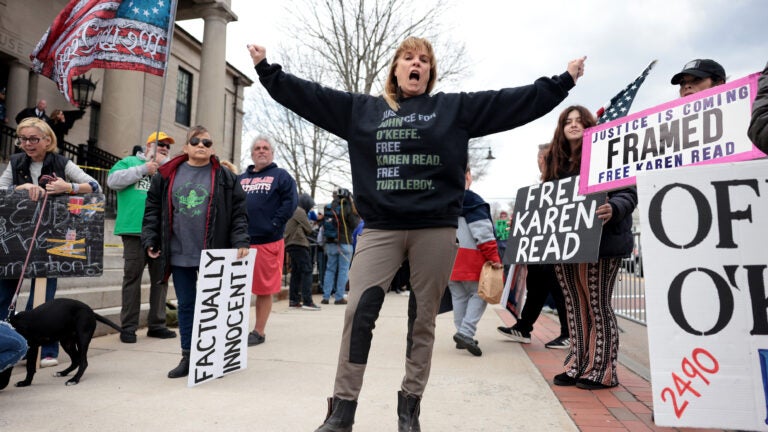
A judge on Tuesday declined to dismiss the murder charges against Karen Read, largely rejecting the defense team’s staggering claims of prosecutorial misconduct during the early stages of the high-profile legal saga.
“Given the extensive evidence supporting the indictments, to the extent that the Commonwealth improperly put before or withheld any evidence from the grand jury, it is unlikely that it affected the outcome of the proceedings,” Judge Beverly Cannone wrote in the 24-page decision.
Read’s lawyers declined to comment on the new ruling. For his part, Norfolk District Attorney Michael Morrissey said in a statement his office “look[s] forward to presenting the case to a jury as soon as possible.”
Read’s trial is set to begin April 16.
Read, 44, is accused of killing her boyfriend, Boston Police Officer John O’Keefe, after a night of bar hopping in January 2022. Prosecutors say the Mansfield woman backed her SUV into O’Keefe while dropping him off at an afterparty and left him to die outside a fellow officer’s home in Canton. Meanwhile, lawyers for Read say she is being framed, alleging a widespread cover-up among law enforcement and witnesses.
The defense alleged earlier this month that prosecutors failed to disclose investigators’ personal relationships with witnesses during grand jury proceedings, which led to Read’s indictment on murder charges.
Specifically, they asserted that Canton Police Sgt. Michael Lank and Massachusetts State Police Trooper Michael Proctor had personal ties to the family of Brian Albert, who owned the home where O’Keefe’s body was found. Read’s lawyers pointed to a 2002 incident where Lank allegedly intervened in a bar fight on behalf of Albert’s brother, a text conversation Proctor had about Albert’s sister-in-law babysitting for him, and evidence that Proctor socialized with Albert’s family.
Still, Cannone found it “unlikely” that Lank’s testimony influenced the grand jury’s decision to indict Read.
“Even if knowing that Sergeant Lank had a history of friendship with Brian Albert’s brother may have colored the grand jurors’ view of his testimony, Sergeant Lank was one of many police officers who testified before the grand jury and his role in the investigation was minimal,” the judge wrote.
Similarly, she noted that “even assuming that Trooper Proctor had a personal relationship with these witnesses, disclosure to the grand jury was not necessarily required.”
Cannone added: “Even if Trooper Proctor’s familiarity with the witnesses suggests some sort of bias in the investigation that the grand jury may have considered, to warrant dismissal, the defendant must show that the absence of the withheld evidence likely would have affected the grand jury’s decision to indict.”
Notably, the U.S. Attorney’s Office for the District of Massachusetts is conducting an inquiry into the state’s investigation around O’Keefe’s death.
Cannone said she reviewed documents from the federal investigation, and “while they reveal several examples of Trooper Proctor’s unprofessional and questionable conduct, they do not shed much light on the extent of his relationship with the witnesses and what impact, if any, the relationships had on his investigation.”
The Massachusetts State Police recently announced an internal affairs investigation into Proctor, though a State Police spokesperson declined to say whether the probe is linked to Read’s case. An attorney for Proctor said the trooper “remains steadfast in the integrity of the work he performed investigating the death of Mr. John O’Keefe.”
The defense team’s motion for dismissal also focused on a highly contested Google search Jennifer McCabe, Albert’s sister-in-law, made for “ho[w] long to die in cold.”
The defense alleges that McCabe — who attended the afterparty at Albert’s house — made the search at 2:27 a.m., hours before O’Keefe’s body was found outside in the snow. Prosecutors, however, have argued that the 2:27 a.m. timestamp is based on misinterpreted phone data.
A report obtained during the federal investigation “provides the web history of the phone including the aforementioned Google search at 2:27 a.m. and a search for ‘how long ti (sic) die in cikd (sic)’ at 6:23 a.m. and 6:24 a.m.,” Cannone noted, acknowledging that the timestamp “is a hotly disputed issue.”
However, she said there is no evidence that the more recent report was available to prosecutors during state grand jury proceedings.
“Because the Commonwealth could not have withheld information it did not have and was not aware existed at the time of the grand jury, the defendant has not established that the Commonwealth withheld exculpatory evidence from the grand jury for the purpose of obtaining the indictment,” Cannone wrote.
Read’s next court date is April 12.
Judge Cannone Denial on Karen Read Motion to Dismiss

Stay up to date on all the latest news from Boston.com




To comment, please create a screen name in your profile
To comment, please verify your email address
Conversation
This discussion has ended. Please join elsewhere on Boston.com