
Newsletter Signup
Stay up to date on all the latest news from Boston.com
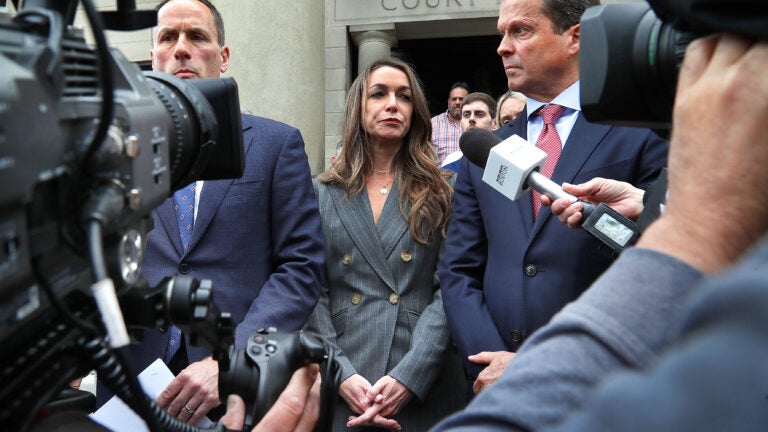
Prosecutors in Norfolk County are asking a judge to bar attorneys for Karen Read — the Mansfield woman accused of killing her Boston police officer boyfriend — from speaking about certain aspects of the case outside the courtroom.
In a motion filed Friday, Assistant District Attorneys Adam C. Lally and Laura A. McLaughlin argued that the defense team’s tactics have fueled an invasion of witnesses’ privacy.
“As part of their ‘trial by media’ strategy, the defendant has sought to target the witnesses’ credibility and character through the use of the media and has encouraged the unwarranted invasion of witnesses’ personal privacy,” the motion reads.
The motion seeks to block Read’s lawyers — David Yannetti, Ian Henchy, Alan Jackson, and Elizabeth Little — from “making extrajudicial statements to the media that could be seen as prejudicial to the criminal proceedings,” a policy in line with the Massachusetts rules of professional conduct for attorneys.
Lally and McLaughlin asserted that restraints on lawyers’ comments outside the courtroom may be warranted in certain cases to “protect the integrity and fairness of the judicial system.” Lawyers and law enforcement witnesses for the prosecution also agreed to follow the proposed order.
Yannetti told Boston.com in an email that the defense team plans to oppose the DA’s motion in court.
Read is accused of striking John O’Keefe with her car on Jan. 29, 2022, while dropping him off at a fellow Boston police officer’s home in Canton following a night of drinking. She has pleaded not guilty to charges of second-degree murder, motor vehicle manslaughter while driving under the influence, and leaving the scene of a collision causing injury and death.
In a defense strategy that has already drawn considerable news coverage and attention on social media, Read’s lawyers have argued that the 43-year-old was framed for killing O’Keefe, suggesting that guests at the afterparty were really to blame.
The lawyers have pointed to phone data they claim indicates not only that O’Keefe entered the home in Canton that night, but that the homeowner’s sister-in-law searched “ho[w] long to die in cold” at 2:27 a.m. — hours before Read found O’Keefe’s body outside in the snow.
Prosecutors, meanwhile, have noted that O’Keefe’s phone data also shows him walking around hours after he’d been declared dead, further arguing that the defense team misinterpreted data and produced a faulty timestamp for the Google search.
In Friday’s motion, Lally and McLaughlin argued that the defense team’s statements outside the courtroom “go further than zealous representation; they are unsubstantiated proclamations, supported only by self-serving speculation and conjecture, likely not to be admissible at trial and done with the intent of materially prejudicing the criminal proceedings by risking the impartiality of potential jurors.”
Prosecutors also accused Read’s attorneys of encouraging media outlets to contact witnesses with “inflammatory” questions, and of filing motions that contained witnesses’ names, dates of birth, social security information, addresses, and phone numbers.
“In response to defense counsels’ call to action, witnesses have suffered unwarranted invasion of privacy as they have been receiving repeated and harassing phone calls, family members of witnesses have been contacted and harassed, and the victim’s family has suffered emotional harm due to the public dissemination of … [post-mortem] photographs,” the motion reads.

Lally and McLaughlin proposed a set of restrictions that would apply to lawyers on both sides, as well as law enforcement witnesses. The motion notably does not seek to restrain Read, media outlets, or non-law enforcement witnesses.
The proposed order would bar attorneys on the case from sharing information that they know or should know will have “a substantial likelihood of materially prejudicing potential trial jurors or witnesses or will have a substantial likelihood of heightening public condemnation of the accused or law enforcement.”
The suggested restrictions also look to block attorneys from making or releasing extrajudicial statements on certain subject matters related to the case, including:
Read is due back in court on July 25.
Recent court hearings have been marked by heated debate over evidence, and prosecutors said in Friday’s motion that they’ve provided Read’s team with a “substantial” amount of discovery.
“This evidence establishes that the defendant, while intoxicated, in a snowstorm, operated her motor vehicle in reverse for a period of time, before striking the victim at a high rate of speed,” the motion asserts.
But Yannetti, one of Read’s lawyers, told Boston.com the defense attorneys “dispute the prosecution’s arguments about what they think might have happened.”
He added: “They are wrong.”

Stay up to date on all the latest news from Boston.com




To comment, please create a screen name in your profile
To comment, please verify your email address
Conversation
This discussion has ended. Please join elsewhere on Boston.com