
Newsletter Signup
Stay up to date on all the latest news from Boston.com
Boston police have received 73 reports so far this year from people who believe their drink was spiked, drugged, or in some way contaminated while out at one of the city’s restaurants or bars, a police lieutenant told city councilors on Friday.
Still, in only three cases were authorities able to confirm a drink tested positive for opioids, according to the lieutenant, Richard Driscoll. A fourth case was “reportedly the result of an unknown date rape drug,” he said.
The numbers are the few that are easily accessible to help assess alleged instances of drugged drinks, which authorities, city officials, colleges, and patrons of the city’s nightlife scene say, anecdotally speaking, are on the rise.
Earlier this year, Boston police received almost a dozen allegations of spiked drinks at watering holes across the city in a nearly two-month period, as accounts of disturbing experiences from patrons made their way onto social media. And at least three times this year, authorities have released messages warning the public to be vigilant when taking in a night out.
Just this week, three women told WCVB their drinks were spiked while attending concerts at the new MGM Music Hall at Fenway. A police spokesperson said the department did not receive reports of these incidents, but the agency nonetheless issued the latest warning as a proactive measure in addressing the problem.
(MGM Music Hall addressed the reports in a statement to Boston.com Friday: “We are taking many proactive measures to help safeguard beverages served in our venue. This includes making drink lids available at all points of sale and posting signage throughout the venue to share safety tips with our attendees. We are grateful to BPD for educating the community on this issue.”)
The perceived uptick is the driving force behind why City Councilors Gabriela Coletta and Ruthzee Louijeune called for the council’s public safety committee to convene on Friday to dive into what exactly is happening in the city’s nightlife scene.
“Increasingly too many patrons, especially women, are feeling unsafe because of the rising issue of contaminated drinks,” Louijeune said. “The BPD received 57 allegations of drink spiking in Boston between January 1 and July 31. But we know that this is most likely an undercount because so much of this goes on unreported.”
Indeed, authorities and experts alike told officials it’s not easy to get a quantitative grasp on the issue — a challenge in part fueled by lack of reporting from hesitant-to-report survivors and exacerbated by challenges around collecting evidence in these cases.
“As Lt. Driscoll mentioned, that dark figure of crime is so true because the reality is that the number of people who consumed contaminated beverages is likely far higher (than 73) since we know that many survivors are hesitant to come forward due to feelings of shame, fear of retribution, trauma, and a variety of other reasons,” said Ilana Turko, chief strategy officer for New York City-based Leda Health, a female-led health care company created by and for survivors of sexual assault.
In testimony, Driscoll said police see the troubling phenomenon happening in two arenas: at bars and restaurants, yes, but also among college students. Notably, the 73 cases he mentioned did not include cases that occurred outside of licensed bars and restaurants in places like private residences.
According to Driscoll, the department does not have an easy way to track trends of drink spiking or drugged drink-related sexual assaults, as those are not automatically grouped in the department’s data software.
In response to a request for the number of cases in prior years, Sgt. Det. John Boyle, a Boston police spokesperson, told Boston.com Friday afternoon the department began a running tally of these cases just this year, as the issue became seemingly more prevalent.
He confirmed the department has records of all cases reported to police in prior years. But those files are not neatly organized into one category, so year-over-year comparisons would be difficult — officers would have to search for past cases individually, he said.
“It’s a tough one,” Boyle said. “We have seen an increase this year. We can’t compare it to years gone by, but we see it as a problem.”
Data collection and reporting is a widespread challenge not exclusive to Boston, as drugs used in these cases are sometimes difficult to detect, according to Turko, who said she is a sexual assault survivor herself.
But cases of contaminated drinks — and subsequent assaults — are prevalent: Turko cited analysis from one rape treatment center in San Francisco that estimated a third of all sexual assault cases involve date-rape drugs.
Aside from the hesitancy for survivors to report cases, providing evidence for investigators is another roadblock in recording allegations, several people who testified before councilors said Friday.
Of the 73 cases recorded at licensed establishments in the city, eight of the establishments where the alleged drink spiking took place have gone before the city’s Licensing Board, according to Kathleen Joyce, the board chair.
None of those bars or restaurants were issued a violatoin, however, because the board was unable to prove someone’s drink was drugged or that the license holder was responsible, Joyce said.
“Short of videos of someone placing a substance into a drink, that drink being tested, and that person going to the hospital and getting tested, we wouldn’t be able to find liability on the part of the licensed premise,” Joyce said.
(As for the vast majority of cases where the board has not yet held a hearing, Joyce said the board often waits for police to finish an investigation before proceeding.)
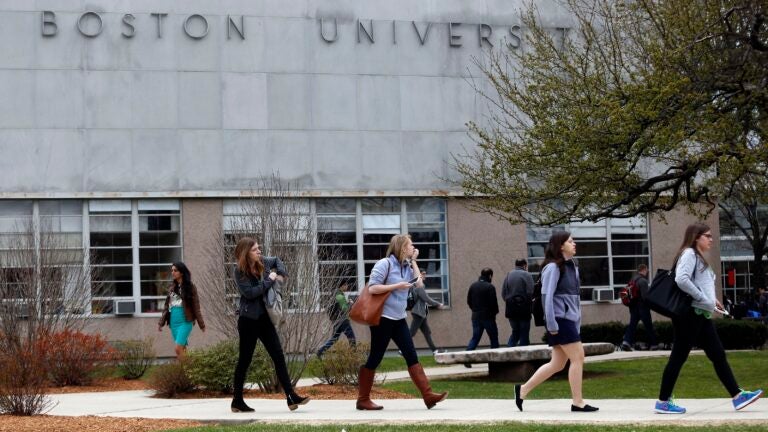
At Boston University, student health officials are hearing increasing concerns from students around incidents they believe involved a drugged drink, said Dr. Judy Platt, chief health officer and executive director of the university’s Student Health Services.
The problem is not new, but school officials have observed a “noticeable uptick, even from the summer,” she said.
At least one of those cases made headlines: Last month, university officials said they were investigating after a student alleged their drink was drugged while they were off campus.
“The challenge is … we don’t know the extent of it, and it’s not something that we typically track,” Platt said of the problem. “A student may come to the primary care office in Student Health Services and say, ‘I think I might have been drugged over the weekend.’ A conversation ensues, (and) we let them know about resources. But it’s not codified anywhere in the medical record.”
However, if a student goes to the university’s Sexual Assault Response and Prevention Center, there is a mechanism to track reports, Platt said.
“It depends on which department a student might present (the report),” she said. “And while that may sound terrible to say, it’s just not something that we spent a lot of time tracking because we didn’t hear about it to a great extent, previous to the past several months in 2022.”
David Rini, of the Boston Area Rape Crisis Center, said experts know, at least anecdotally, the number of sexual assault cases across the country spike at the beginning of each academic year when colleges are back in session.
The trend is so widely known that advocates have dubbed the period between mid-August and Thanksgiving break as the “red zone,” a time when more than 50 percent of campus sexual assault incidents happen.
Platt, from Boston University, said she’s also hearing about more reported cases this school year from her counterparts at higher education institutions around the city.
“We’re hearing more about this, but we can’t quantify it,” she said.
“But everyone is really aligned with (the idea that) something is going on,” she added.
Resources for survivors of sexual assault are available through the Boston Area Rape Crisis Center at barcc.org or through a 24/7 hotline, 800-841-8371.
Stay up to date on all the latest news from Boston.com





To comment, please create a screen name in your profile
To comment, please verify your email address
Conversation
This discussion has ended. Please join elsewhere on Boston.com