
3 Tacoma police officers charged in the killing of a Black man
Prosecutors in Washington State said that Manuel Ellis had pleaded, “I can’t breathe,” after police officers punched him, squeezed his neck, pressed on his back and placed a spit hood over his head.
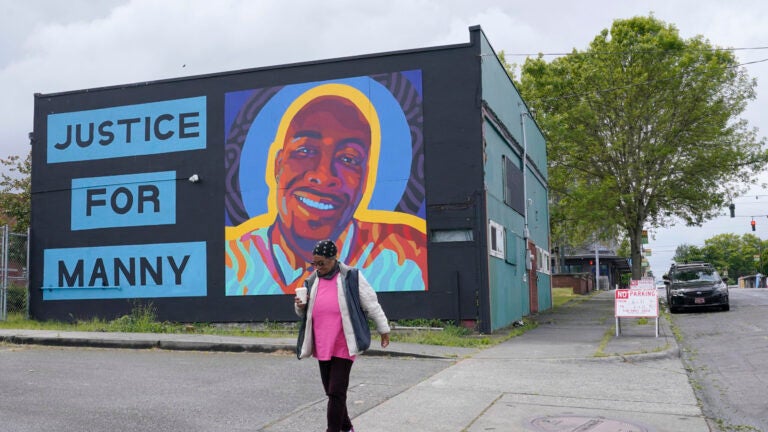
Three police officers in Tacoma, Washington, were charged Thursday in the killing of a Black man who had pleaded, “I can’t breathe,” after they punched him, squeezed his neck, pressed on his back and placed a spit hood over his head, prosecutors said.
Two of the officers, Christopher Burbank and Matthew Collins, were charged with second-degree murder, and the third, Timothy Rankine, was charged with first-degree manslaughter in the death of Manuel Ellis on March 3, 2020, Washington’s attorney general said.
The Attorney General’s Office said the announcement marked the second time that homicide charges had been filed in the state against law enforcement officers since the passage of Initiative 940 in 2018. The voter-approved initiative redefined when deadly force is justified, making it clear that there should be an increased role for juries in determining whether such force constitutes a crime.
The charges were also the latest to be brought as police violence has come under more intense scrutiny since George Floyd was murdered in Minneapolis on May 25, 2020, less than three months after Ellis was killed. Floyd, who was Black, had also pleaded, “I can’t breathe,” as a white police officer knelt on his neck for more than nine minutes.
Family members said Ellis, 33, was the father of an 11-year-old son and an 18-month-old daughter. A talented musician at his church, he had played drums with the worship band earlier on the night he was killed, the Attorney General’s Office said.
Later, Ellis was walking home after getting a late-night snack at a 7-Eleven when he came upon Burbank, 35, and Collins, 38, both of whom are white, sitting in their police car, prosecutors said. Ellis stopped and spoke briefly to the officers in an encounter that witnesses described as peaceful and respectful, prosecutors said. Ellis then began to walk away, prosecutors said.
According to witnesses, Burbank swung open the passenger door, hitting Ellis from behind and knocking him to his knees.
Burbank then got on top of Ellis, prosecutors said. Bystander videos, a doorbell camera with audio and video, and dispatch radio traffic captured what happened next, prosecutors said.
Burbank wrapped his arms around Ellis, lifted him into the air and drove him down onto the pavement, hitting him with one of his fists, prosecutors said. Collins then moved toward Ellis and brought his weight down on him, prosecutors said.
With Ellis underneath him, Collins — a 215-pound SWAT team member and Army veteran trained in martial arts — began hitting Ellis’ head with his fist, prosecutors said. Collins can be seen on one video hitting Ellis’ head four times as Ellis screamed, prosecutors said.
“Hey! Stop!” one bystander screamed, according to prosecutors. “Oh, my God, stop hitting him! Stop hitting him! Just arrest him.”
Collins then wrapped his arm around the front of Ellis’ neck and locked his hands together while squeezing, applying a “lateral vascular neck restraint,” prosecutors said.
Ellis was not fighting back, prosecutors said. Three witnesses said they never saw Ellis hit the officers. “He wasn’t even defending himself,” one said, according to prosecutors, adding that video evidence corroborated that account.
Burbank fired a Taser at Ellis while Collins continued to squeeze his neck, prosecutors said.
“Hey, y’all in the wrong right now,” another witness said.
After Ellis was jolted for five seconds, Collins released his grip on Ellis’ neck and Ellis’ head fell limply toward the pavement, prosecutors said. Collins then pushed his arm onto the back of Ellis’ head or neck, pressing his face into the pavement, prosecutors said.
As Ellis began to scream and writhe, the officers held his arms behind his back and pressed down on his body, and Burbank jolted Ellis again with the Taser, prosecutors said.
According to a recording captured by a Vivint doorbell camera on a house across the street, prosecutors said, Ellis clearly said, “Can’t breathe, sir. Can’t breathe!” Fewer than 15 seconds later, he can again be heard pleading with the officers, saying either “Breathe, sir?” or “Please, sir?”, prosecutors said.
Rankine, who is 32 and Asian, was among a group of officers who responded as backup. Prosecutors said Rankine started pressing on Ellis’ back, getting on top of Ellis almost as if he were in a “seated position.”
Ellis can be heard saying again, “I can’t breathe,” and pleading, “Can’t breathe. Can’t breathe, sir,” prosecutors said.
Rankine later recalled, according to prosecutors, hearing Ellis say “in a very calm, normal voice” that he could not breathe and responding that “if you’re talking to me, you can breathe just fine.”
An officer put a spit hood on Ellis’ head, while he was hogtied on his stomach and while Rankine was applying pressure to his back, prosecutors said. The brand of spit hood includes instructions that specifically state that it should not be used on anyone “having difficulty breathing,” prosecutors said.
Prosecutors said Ellis remained under Rankine, hogtied and facedown, for six to nine minutes until the fire department arrived. Ellis’ last known words were the same ones he had repeated throughout the attack, prosecutors said: “Can’t breathe.”
He was declared dead at the scene, prosecutors said.
The Pierce County medical examiner at the time, Dr. Thomas Clark, determined that the cause of death was “hypoxia,” or a lack of oxygen, “due to physical restraint,” prosecutors said.
Clark said that although blood collected from Ellis showed the presence of methamphetamine, his death was probably not caused by methamphetamine intoxication, prosecutors said.
Prosecutors said that several officers on the scene had recalled hearing Burbank and Collins say they had seen Ellis trying to get into a car and then hit their police car, prosecutors said. That account, however, was contradicted by three witnesses, none of whom saw Ellis hit the police car or the officers at any point, prosecutors said.
It was not immediately clear if Burbank, Rankine and Collins had lawyers.
The Tacoma Police Union defended the officers, saying, “We are disappointed that facts were ignored in favor of what appears to be a politically motivated witch hunt.”
“We look forward to trial,” the union said. “An unbiased jury will find that the officers broke no laws and, in fact, acted in accordance with the law, their training and Tacoma Police Department policies. An unbiased jury will not allow these fine public servants to be sacrificed at the altar of public sentiment.”



To comment, please create a screen name in your profile
To comment, please verify your email address
Conversation
This discussion has ended. Please join elsewhere on Boston.com