
Newsletter Signup
Stay up to date on all the latest news from Boston.com
As the omicron wave has receded and many municipalities have dropped pandemic restrictions like masking and capacity limits, large gatherings have made their return to society. With them has come concerns over COVID safety from some, writes Dr. Jeremy Faust in his most recent Inside Medicine post.
The Boston physician and public health researcher explored the intricacies and complexities of the “individual risk tolerance” mindset that says each person can decide what events they feel safe attending from a COVID perspective.
Faust says the main issue with that mindset is that it assumes people understand their own risks — something he says the vast majority of people don’t.
“At both extremes of the cautious-to-eff-it spectrum, my sense is that nobody has a good handle on what their individual risks truly are,” Faust wrote. “How could they? As I’ll describe, the math is remarkably complicated. We can’t expect people, even experts, to do this on the daily. That makes the ‘leave it all up to individuals’ approach pretty unworkable at the moment.”
In his post on Inside Medicine, he explores the differences between two recent, comparable events in Washington, D.C.: the State of the Union Address March 1 and the Gridiron Dinner April 3.
The day of the State of the Union, four members of Congress tested positive and didn’t attend the event; in the two weeks following the gathering seven members of Congress came down with COVID, according to Faust.
By contrast, 53 attendees of the Gridiron Dinner have reported infections since the dinner.
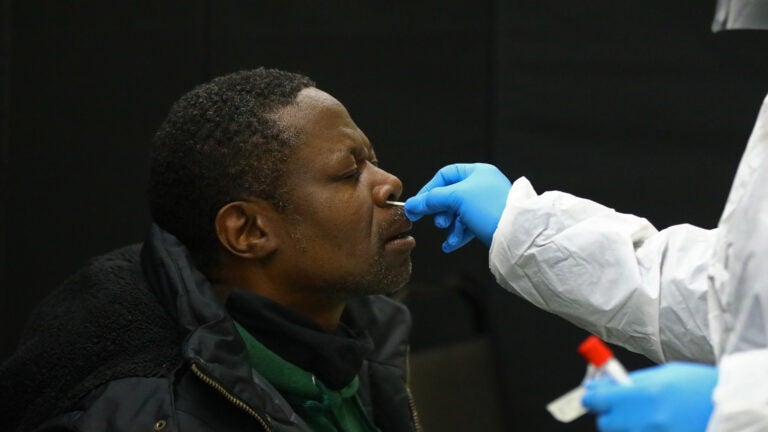
The difference in the two events, according to Faust, comes down to testing. The State of the Union required a negative PCR test and the Gridiron didn’t.
“The Gridiron event was a risk tsunami in comparison to the State of the Union, even given relatively low case counts in the area,” Faust wrote.
The math behind risk of infection is very complicated (Faust digs into it more in his post) — it involves estimating how many infected people are contagious and the rate of infection after exposure.
“Even knowing that we miss perhaps 75% of infections in our public reporting, the odds of a contagious person attending the Gridiron event were, according to my math, likely above 33%,” Faust wrote. “That’s astoundingly high.”
We know very little about what makes a superspreader event, Faust said, and the risk calculations he is doing account for any spread, not massive spread.
“It’s likely that in large gatherings, a few people do in fact pick up infections routinely these days,” Faust wrote. “Sadly, infections are now so common that we simply no longer notice, unless it’s a high-profile situation and dozens of people are infected.”
Right now, Faust wrote, he would not attend a large indoor gathering with no mask requirement or testing rule. This, he said, is because he has a nearly 4-year-old who is not yet eligible to be vaccinated.
“We’ve actually run the numbers and our personal choices are driven by data. But not everyone can do this. This is what I do for a living, and honestly, the math is not easy!” Faust wrote.
The State of the Union was probably safe, according to Faust, due to the universal testing requirements. The Gridiron Dinner, on the other hand, Faust said, was less safe if your priority is avoiding infection to keep vulnerable people from being exposed.
Faust said he doubts people can correctly calculate their own risk levels, and he is a proponent of continued testing and masking for large gatherings until everyone can be vaccinated and access to prophylactic medications and therapeutics is improved.
“How can we expect people to behave in ways that reflect their risk thresholds when they don’t have a prayer at accurately staking what the risks are?” Faust wrote.
In response to Faust’s piece, Dr. Megan Ranney, the academic dean at the Brown University School of Public Health, reinforced the idea in a Twitter thread that even if the risk for severe infection is low for those who are boosted, balancing risks is still important. Here is her thread:
Stay up to date on all the latest news from Boston.com




To comment, please create a screen name in your profile
To comment, please verify your email address
Conversation
This discussion has ended. Please join elsewhere on Boston.com