
Newsletter Signup
Stay up to date on all the latest news from Boston.com
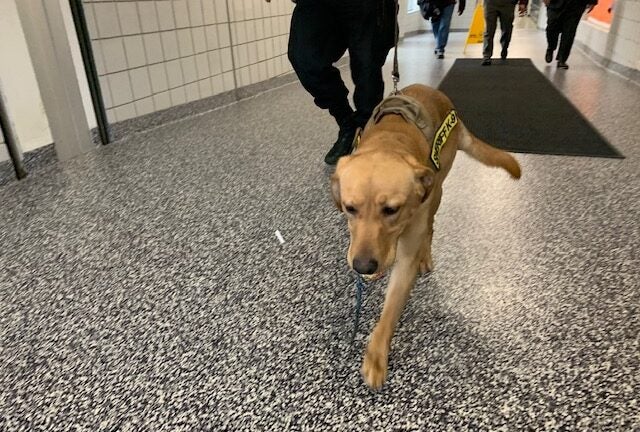
The Bristol County Sheriff’s Office is starting a new program to help stop the spread of COVID-19 that relies on some four-legged recruits as virus cases continue to rise around Massachusetts.
Two trained 1-year-old labradors are being used to detect COVID-19 in schools, with the sheriff’s office hoping that sniffing out the virus in the buildings will assist in preventing transmission of the disease.
Jonathan Darling, the public information officer for the Bristol County Sheriff’s Office, told Boston.com the program was developed with scientists from Florida International University.
“These scientists developed this program where they trained dogs that detect COVID,” Darling said.
Starting Wednesday, the two dogs, Huntah and Duke, will be working in the Freetown, Lakeville, and Norton school districts. The program is currently deployed to around 15 schools across the districts, with about two to three schools being smelled by the pups every day.
Both dogs are the first law enforcement K-9s in the United States to be trained in the detection of COVID-19’s scent, according to the sheriff’s office. Although humans cannot smell coronavirus, dogs’ noses are able to.
Although other COVID-sniffing dog programs have screened people entering events or airports, Darling said these K-9s will solely be used to scan areas and surfaces.
“Dogs are sniffing around areas where the school’s leaders need, such as gymnasiums, cafeterias, could be classrooms,” he said. “Think of places where people congregate, where there’s a lot of hands touching surfaces, things that are highly touched a lot.”
Darling did not rule out the possibility of more dogs being added to the program in the future, especially if more school districts requested the service.
“We view this as a public safety program and it’s available for free,” Darling said. “If this program expands more, where there’s more demand, we could absolutely be talking about expanding it to add another dog or another handler.”
Stay up to date on all the latest news from Boston.com




To comment, please create a screen name in your profile
To comment, please verify your email address
Conversation
This discussion has ended. Please join elsewhere on Boston.com