
Boston to require masks in indoor public places
"If you are inside a building that is open to the public, wear your mask. If you are not eating or drinking, wear your mask."
COVID-19 in Boston
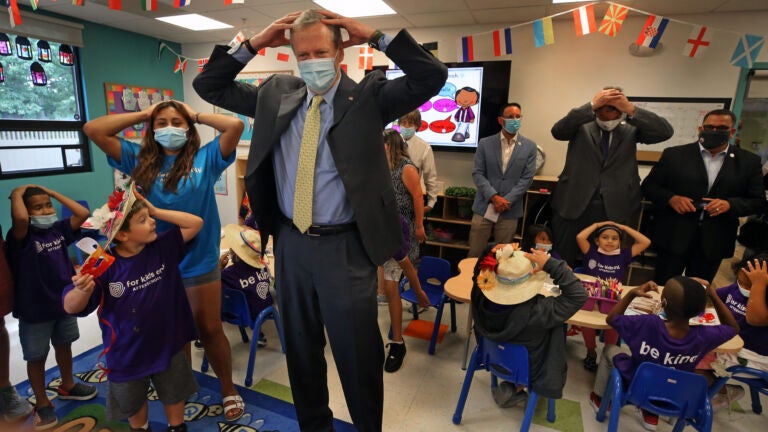
Acting Mayor Kim Janey announced on Friday that masks will be required at indoor public places in Boston beginning on Aug. 27, as COVID-19 cases trend upward again and the contagious delta variant spreads.
“This new public health order makes wearing a mask simple, clear, and consistent across the city,” Janey said during a press conference at City Hall. “If you are inside a building that is open to the public, wear your mask. If you are not eating or drinking, wear your mask.”
Janey framed the new regulation as the latest step the city has taken in recent weeks to combat rising cases, including a vaccine mandate for public employees and a mask requirement in Boston Public Schools this fall.
All measures are especially needed as the fall presents shifting demographics in Boston, with the return of college students from around the world and the potential, post-Labor Day return of more office workers who have worked remotely for much of the past year-and-a-half, Janey said.
The U.S. Centers for Disease Control and Prevention has also recommended indoor mask wearing in Suffolk County and across Massachusetts.
“We must do all we can to protect Boston residents with strong preventative measures, and masks work best when everyone wears them,” Janey said. “They protect those who wear them and those who are around them, including people who are most vulnerable.”
The mask mandate reinstatement arrived a day after Somerville announced a similar measure, with certain exceptions granted, such as for medical reasons or for people with hearing impairments for whom wearing a mask would impede communication.
Earlier this week, Gov. Charlie Baker said he is refraining from instituting a statewide mask policy primarily because Massachusetts has one of the highest vaccination rates in the country, with over 75 percent of adults fully vaccinated and 85 percent with at least one shot.
And while cases are rising, they remain relatively low. A New York Times survey of state health data shows Massachusetts has the eighth-lowest rate of COVID-19 cases per capita nationwide and the third-lowest per-capita hospitalization rate.
“We pay a lot of attention to the data associated with case counts, and with hospitalizations, and the tragedies associated with the loss of life,” Baker said Monday. “But you can’t look at the commonwealth of Massachusetts — and look at our vaccination rate, our hospitalization rate — and compare it to where the rest of the country is.”
In Boston, Janey said that while the city’s positivity rate has increased, virus-related hospitalizations are “still well below the threshold, well below what they were even when reopened the city last May.”
“What we know will happen though is an influx of people into our city: 50,000 college students from across the world, our own 50,000 students going back into the classroom, different people coming back into the workplace after Labor Day,” Janey said. “And we want to do all we can with this delta variant that we know is much more easy to transmit from person to person.”
The city’s mask policy will apply to restaurants, stores, gyms and fitness centers, performance venues and theaters, museums, and cultural and historical sites, among other locations. The mandate does not apply to private properties such as offices or businesses that are not open to the public and events at private residences. It also does not apply to places of worship.
Janey has faced growing criticism from other city leaders, who say the acting mayor has not done enough to steward the city amid the latest developments in the health crisis.
On Wednesday, City Council Pro Tempore Matt O’Malley took aim at Janey, declaring the issue “deserves leadership” during a council meeting.
“The acting mayor has said we are leading in this. Boston is leading” in combatting the crisis, O’Malley, the District 6 councilor, said. “That is simply not true.”
O’Malley, as well as most of Janey’s mayoral opponents in this fall’s election, has called on Janey to require proof of vaccination — or vaccine passports — for entrance into certain crowded indoor public places — a move Janey has continuously shot down.
On GBH News this week, however, Janey said she has not ruled out a possible mandate, should the health crisis worsen.
“I will certainly do everything, using every tool in our toolbox, to protect the people of Boston,” she said.
Notably, the vaccine passports are only one avenue some of Janey’s opponents had implored her to consider: an indoor mask mandate was also on that list in recent weeks.
“City leaders need to embrace every effective solution to save lives in a moment of crisis. That means not waiting for infection rates to go up before implementing steps that will slow the spread of the virus and could rapidly increase Boston’s vaccination rate,” mayoral hopeful and City Councilor Andrea Campbell said in a statement Thursday. “I’m pushing the city to implement several steps, modeled after best practices from other major American cities, like a vaccine passport program and requiring masks in indoor public places, not to score political points but because these measures will save lives.”



To comment, please create a screen name in your profile
To comment, please verify your email address
Conversation
This discussion has ended. Please join elsewhere on Boston.com