
Newsletter Signup
Stay up to date on all the latest news from Boston.com
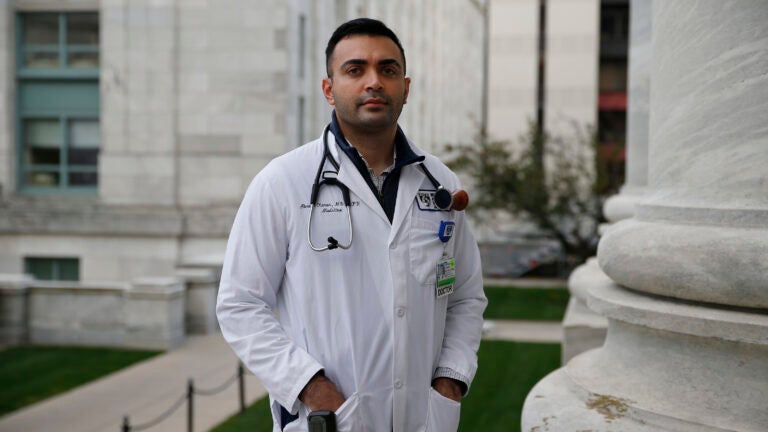
Dr. Abraar Karan has been caring for COVID-19 patients at Brigham and Women’s Hospital in Boston throughout the pandemic.
But this spring, the global health physician found himself taking on management of coronavirus cases that hit closer home, even though his patients were on the other side of the world.
In an op-ed for the Washington Post, Karan shared his experience fighting to save his uncle, who lives in India, from COVID-19 by providing advice over the phone and via text for care that could be provided at home.
“When he first became ill, I told my cousin to go to the neighborhood pharmacy and buy oral steroids,” he wrote of the experience. “I advised him on the correct dosages to start if my uncle’s oxygen levels dipped, and my uncle soon needed that treatment. For several days, my cousin and I texted back and forth or spoke on the phone as my uncle’s health deteriorated. I suggested placing him on his stomach — doctors call this “proning” — to improve his oxygen intake.”
When his uncle’s condition deteriorated, Karan’s family worked to find him a bed in a hospital.
The doctor said he knows many others have been going through similar ordeals.
“The situation I found myself in is not an unusual one for first-generation immigrants to the United States from India: We are trying desperately to keep our loved ones alive, from afar,” Karan wrote. “And we are doing this even as our own jobs in the United States give us no respite. We are still working and meeting deadlines (and sometimes missing them) while taking on these extra duties.”
His uncle has since recovered and is back home, but the Brigham and Women’s doctor noted that many have not been so fortunate, as the devastating outbreak in India continues to rage.
Karan said while his uncle survived, his family has lost other members to COVID-19.
“As a clinician, I have treated hundreds of coronavirus patients in America, mostly in Boston, over the course of this year, in well-equipped hospitals,” he wrote. “And over the past several years, I have spent time caring for patients in rural parts of India, Africa and Central America, where access to care is minimal. But I did not expect these two experiences to come crashing together like this.”
Karan wrote that he has found himself thinking about which countries around the globe “will be next” in seeing this kind of disastrous outbreak of COVID-19, especially as new strains of the virus continue to emerge.
The situation in India and other countries underscores the importance of the United States redoubling its efforts to help vaccinate people in low-income countries, he said.
“While we in the United States are celebrating the vaccination of teenagers, my family members are trying to survive this surge in India — and, of course, they are among the privileged in that population,” Karan wrote. “Poorer urban residents and rural citizens are being decimated.”

Stay up to date on all the latest news from Boston.com




To comment, please create a screen name in your profile
To comment, please verify your email address
Conversation
This discussion has ended. Please join elsewhere on Boston.com