
Charlie Baker thinks his administration is already meeting pledge to allot 20 percent of vaccine doses to hard-hit communities
"I do believe we're meeting our target."
Related Links
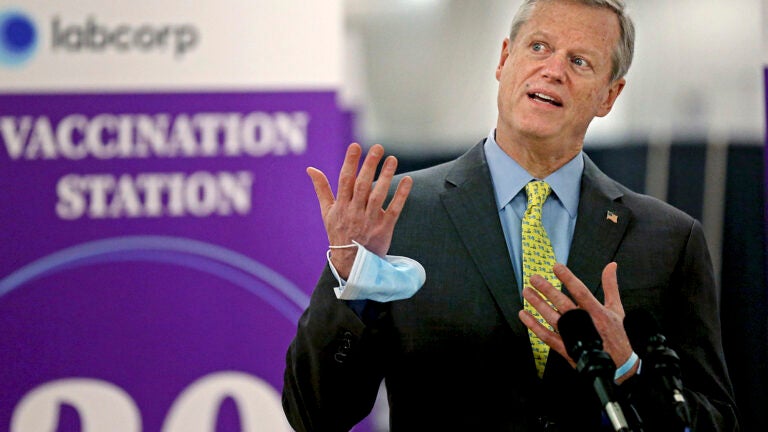
Gov. Charlie Baker suggested Wednesday that Massachusetts is already allotting 20 percent of COVID-19 vaccine doses to the communities in the state most ravaged by the pandemic, even if his administration hasn’t formally announced the policy.
“I think we’re meeting our target,” Baker said during a radio appearance Wednesday afternoon on GBH, when asked about the administration’s pledge in December to set aside 20 percent of doses for hard-hit communities beginning in Phase 2 of the vaccine rollout.
Massachusetts has been in Phase 2 since the beginning of February. And while the administration is pouring more than $33 million to support vaccine access in the state’s 20 hardest-hit communities, most of which have majority-minority populations, equity advocates and members of the state’s vaccine advisory group say it’s unclear if or when the administration plans to reserve doses for those residents.
The plan, which was first outlined in December, was part of the state’s efforts to ensure equity as a core pillar of the vaccine rollout. Baker noted that the administration’s rollout began deliberately slow, prioritizing staff and residents at congregate care sites like homeless shelters, correctional facilities, and group homes for those with developmental disabilities or mental health issues during Phase 1 of the rollout — a decision that equity advocates have praised.
The administration has yet to spell out additional dose allocations for hard-hit communities.
As of last Thursday, nearly 429,000 of the more than 1.8 million Massachusetts residents who had received at least one dose of a vaccine — or about 23.8 percent — were residents of those 20 cities and towns included in the state’s vaccine equity initiative.
However, those communities make up more than 30 percent of the overall Massachusetts population. And as The Boston Globe reported back in December, the earmarked doses was intended to be addition to hard-hit communities’ initial allotment.
While the state has worked to close racial disparities, data also has continued to show lagging vaccination rates among people of color — even in those 20 communities getting targeted support and especially among Hispanic residents — compared to the rate among white residents in Massachusetts.
“We have a long way to go,” Baker said Wednesday. “Let’s face it, every week that goes by here, you know, you got to continue to perform, and that’s part of what I’m talking about. But I do believe we’re meeting our target.”
Baker attributed some of the disparities to evidence of increased, albeit diminishing, hesitancy to get vaccinated among people of color, stemming from historic racism within the medical profession as well as misinformation and doubts about the vaccines’ safety. Baker suggested that many were simply taking a wait-and-see approach, as opposed to being outright opposed to vaccination, based on polling done by the administration and others.
“It wasn’t like people said, ‘I never want to take it,'” he said. “It was more like, ‘I just don’t want to go first, and I really want to hear from my doctor, a trusted voice in the community, a family member who got vaccinated,’ sort of like the equivalent of what happens with a lot of things that are quote-unquote new.”
According to the state’s most recent weekly vaccination report, 26 percent of white Massachusetts residents have gotten at least one dose of the COVID-19 vaccine, compared to 17 percent of Black residents and 10 percent of Hispanic residents.
Despite lagging rates, Baker noted that Massachusetts is doing better at reaching people of color than most other states. He noted that Massachusetts has the second highest rate of vaccinated Black residents in the country and “almost double the national average” among Latino residents.
“But… we have work to do,” he said.
Baker noted that the state’s equity initiative is working to support local efforts to break down barriers to vaccination in the 20 hard-hit communities, whether its addressing hesitancy, providing transportation to vaccination sites, or booking appointments. He also said that the expected increase in supply of the single-shot Johnson & Johnson would allow the state to run mobile vaccination programs at community centers, senior housing, and other multi-family sites.
“That’s exactly what we’ve been talking to many of our colleagues in local communities about, and the resource spend on this at this point is north of 30 million bucks,” Baker said. “I mean it’s a lot of money we’re putting into these places.”
Get Boston.com's browser alerts:
Enable breaking news notifications straight to your internet browser.


To comment, please create a screen name in your profile
To comment, please verify your email address
Conversation
This discussion has ended. Please join elsewhere on Boston.com