
Nurses’ union: Relaxing of ICU protocols could result in loss of life
“They really require more critical care [rather] than less."
Related Links
As hospitals continue to weather the second surge of coronavirus, some healthcare workers are worried that loosening ICU care measures in overburdened hospitals could result in loss of life.
During a Thursday press conference, Gov. Charlie Baker announced that hospitals or hospital systems over 80 percent bed capacity for more than seven days — and that have notified the state Department of Public Health that all non-essential elective, invasive procedures have stopped — can allow nurses in intensive care units to care for more patients than the ratios set by law during normal times.
State law indicates that the nurse-to-patient ratios in ICUs should be 1 to 1, or 1 to 2 depending on a patient’s stability.
“Our hospital capacity limits are being stretched to their limits,” Marylou Sudders, state secretary for Health and Human Services, said during the press conference. Prior to Thanksgiving, Gov. Charlie Baker noted that the seven-day average for new cases was 2,500, and as of Thursday that number had almost doubled to 4,800. On Thursday, there were about 80,000 active COVID-19 cases in the state, with 2,400 people hospitalized and 442 in an ICU.
But the Massachusetts Nurses Association said increasing the number of patients a nurse cares for in the ICU could be deadly.
Katie Murphy, the union’s president and an ICU nurse at Brigham and Women’s Hospital, described COVID-19 ICU patients as “so incredibly ill.”
“They really require more critical care [rather] than less,” she said in a phone interview with Boston.com on Monday. “That’s why we really disagree with this order. I can’t tell you how unstable they are, how they require continual monitoring.”
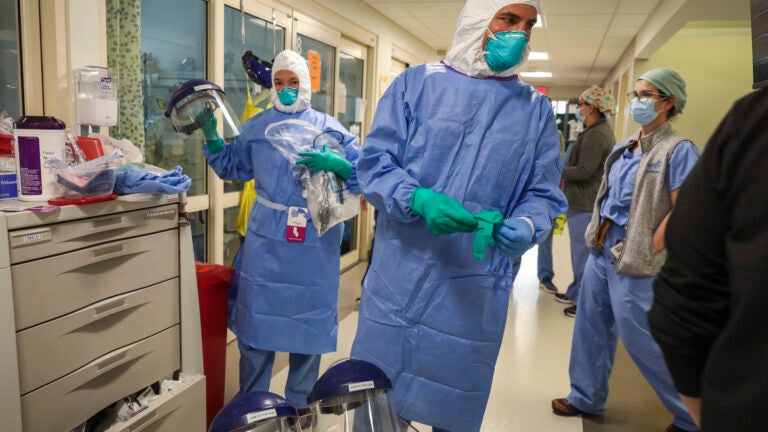
COVID-19 ICU patients are “behind closed doors,” Murphy said, and nurses and healthcare workers taking care of them have to don their personal protective equipment properly before going in to take care of them. Sometimes, a patient needs to be turned onto their stomach, a maneuver that can save their life. This alone requires five professionals, Murphy said, and can take between 20 to 30 minutes. Sometimes, workers have to do this “several times per shift.”
During the spring COVID-19 surge, Murphy said she heard of nurses in New York City taking care of five or six patients at a time; numbers, luckily, weren’t as high in Massachusetts.
“But even two can be overwhelming, and three is absolutely unsafe,” she said.
The condition of a COVID-19 patient can decline rapidly, Murphy noted; it’s something she’s seen throughout the pandemic. Intervention needs to happen quickly, but the nurse could also be caring for one or two other patients at the same time.
She’s heard stories from other nurses, describing how a patient within minutes will go from having healthy oxygen levels to rapid decline. It’s hard to pull a patient back once their oxygen has dipped below a certain level.
In general, the MNA said in a statement that it is “vehemently opposed” to increasing the ICU ratios.
“These COVID patients are among the most acutely ill patients we have ever cared for and require the level of care the ICU law was instituted to provide,” the statement said. “Why are we allowing some systems to provide a lower standard of care for these patients? If they don’t have the staffing to provide the appropriate critical care these patients require, then those patients should be transferred to a system that can provide that level of care.”
Murphy said she’s concerned that “people are becoming complacent,” especially now that the vaccine is being distributed.
“We’re just hoping so much that people are still social distancing,” she said, along with continuing other COVID-19 safety measures, like frequent hand washing and not gathering in groups.




To comment, please create a screen name in your profile
To comment, please verify your email address
Conversation
This discussion has ended. Please join elsewhere on Boston.com