
Why Charlie Baker isn’t planning to get a public vaccination like Mike Pence
The Massachusetts governor wants to wait until he qualifies — and isn't sure elected officials are the most effective officials to inspire public confidence.
Related Links
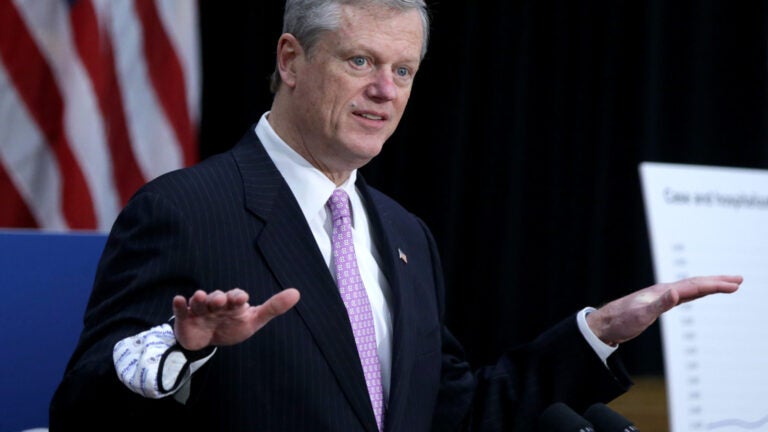
Don’t expect to see Gov. Charlie Baker on TV anytime soon getting a COVID-19 vaccine.
During a press conference Friday afternoon, Baker said his team had discussed the idea of doing a public vaccination, similar to the televised event Friday morning in which Vice President Mike Pence and others got their first shot of the vaccine. However, the Massachusetts governor said they eventually decided against it.
“I think we came to the conclusion that there are plenty of people who can do public vaccinations who would be a lot more important than me,” Baker said. “And I would argue that the folks who work in our public health hospitals, who’ve gotten vaccinated, fall into that category. The folks who work at our hospitals, generally, and in our health care system, generally, getting vaccinated is a lot more important than me — and frankly a lot more meaningful, I think, to most people.”
Pence and other congressional leaders — as well as the previous three presidents — have said they’d get the shots publicly to inspire public confidence in the vaccine, amid polls indicating that over a quarter of the country is still hesitant about getting it due to concerns about potential side effects or distrust in government. According to a Kaiser Family Foundation survey released earlier this week, vaccine hesitancy is highest among Republicans (42 percent), those ages 30-49 (36 percent), and rural residents (35 percent), as well as Black adults (35 percent), a group that has been among the hardest hit by the pandemic.
However, as Baker alluded Friday, the same survey found that elected officials were not the most trusted vaccine messengers.
According to the Kaiser survey, 85 percent of people said they trusted their own doctor or health care provider for reliable information about the vaccine. Around seven out of 10 people also said they trusted federal and local health agencies, as well as Dr. Anthony Fauci, for vaccine information.
“If the list started up here with like Dr. Fauci,” Baker said Friday, raising his hand up, before lowering it toward the floor, “elected officials were down here somewhere.”
According to the Kaiser survey, public confidence isn’t quite that low; 58 percent of respondents still said they trust state government officials about the vaccine (though, at 34 percent, the country’s top elected official, President Donald Trump, was at the bottom of the list).
During the press conference Friday, officials noted that the state’s vaccine safety and efficacy task force, a group made up of local medical experts, is independent of government.
Massachusetts began administering the vaccine this week to “COVID-facing” health care workers, as part of the state’s three-phase distribution plan. The state had expected to get 300,000 total first doses of the Pfizer and Moderna vaccines by the end of the month (though officials said Friday that the federal government had, without explanation, reduced that number by roughly 35,000).
Baker said Friday that the uptake rate amongst health care workers in Massachusetts had been “overwhelming.”
“This isn’t really surprising,” he said. “These folks know more than almost anybody else how much trouble this particular virus can cause, and these folks have been through it all and have quite a sense — more than many — about why this is such an important part of getting back to normal.”
Workers and residents in long-term care facilities and first responders will be the next groups to receive the vaccine during the first phase, followed by individuals in congregate care settings and other health care workers.
The second phase, which officials hope will begin in February, will make the vaccine available to essential workers and individuals over the age of 65.
Baker, who turned 64 last month, indicated Friday that he would rather wait until the vaccine is available to the broader public in the spring.
“I don’t really think of myself as somebody who should get vaccinated before I actually qualify as an individual,” he said Friday. “And I don’t think me getting vaccinated publicly would make any difference relative to a lot of the other people, who I think people would take far more seriously and appreciate seeing them get vaccinated first.”


To comment, please create a screen name in your profile
To comment, please verify your email address
Conversation
This discussion has ended. Please join elsewhere on Boston.com