
Harvard disease expert Barry Bloom on what’s next after the Moderna vaccine news
"This is a big deal."
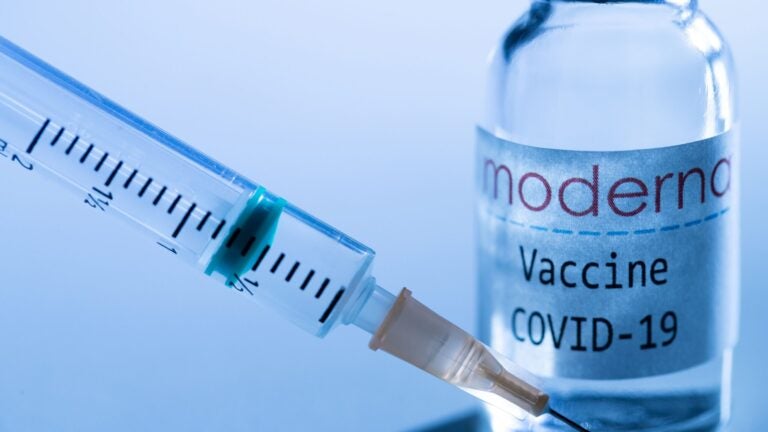
Harvard professor Barry Bloom says the news Monday that Cambridge-based Moderna’s experimental COVID-19 vaccine appears to be 95 percent effective should give people across the country reason to be optimistic.
But with fellow experts warning that the “darkest” days of the pandemic are still ahead, Bloom cautions that there’s a lot of work to be done to ensure that the Moderna vaccine, the similarly promising Pfizer vaccine, or any of the other versions coming down the pike will actually reach individuals.
“If those vaccines were available today, I am not confident we could get even the first batch of either of them organized to get out,” Bloom a professor of immunology and infectious diseases at — and the former dean of — the Harvard T.H. Chan School of Public Health, told reporters during a conference call Monday.
While companies are hoping to have their respective drugs ready by the end of the year, top health officials, like Dr. Anthony Fauci, have said they likely won’t be widely available until next spring.
Of course, the companies themselves first need to ramp up production. Moderna and Pfizer expect to combine to initially produce 70 million doses by the end of the year, which is enough for 35 million people since both vaccines require two shots.
Related Links
-
COVID-19 VACCINE
Cambridge’s Moderna says its COVID-19 vaccine appears to be 94.5% effective
-
COVID-19 VACCINE
Watch: What Dr. Ashish Jha had to say about the Moderna COVID-19 vaccine news
-
COVID-19 VACCINE
Here are the groups that get priority under the Massachusetts plan for the COVID-19 vaccine
-
COVID
‘We are entering the hardest days of the pandemic’: Doctors issue warnings about coming weeks, months for COVID-19
Then comes the arguably more complex task of actually distributing them across the country to care providers.
According to Bloom, federal officials are working to prepare the same distribution supply chains they have used for many childhood vaccines, as well as to create a registry so that the COVID-19 vaccine can be tracked and monitored for effectiveness. At the same time, a lot of the work falls on local officials to figure out how many doses they require. Both in Massachusetts and across the country, officials are planning to prioritize health care workers, individuals vulnerable to COVID-19 due to age or underlying medical conditions, and other essential workers during the first phase of vaccine availability when doses are still limited.
“Healthcare in the U.S. is crazy,” Bloom said. “It’s a state function rather than primarily a national long term, so getting 50 states to organize each of their own priorities [and] get the information to a central source … is a huge undertaking, but absolutely essential if we’re to ensure the equitable, fair, and safe distribution of the vaccines and an accountability for effectiveness and adverse effects so that people can have confidence in it. This is a big deal.”
Bloom also said that Moderna’s vaccine may have a “practical advantage,” since — unlike the Pfizer version, which requires ultra-cold storage — it can be stored in a normal freezer for up to 30 days. According to Bloom, rural areas are less likely to have the type of special freezer needed for Pfizer’s vaccine, though the Centers for Disease Control and Prevention has said it may not be necessary in some cases due to their rapid deployment plan.
“In the beginning, it’s going to be very, very challenging,” Bloom said, adding that he thinks the process will be “running smoothly” by the end of March unless there are “technical glitches.”
Yet, even after the distribution process is ironed out, Bloom says the increasing distrust of vaccines remains a big concern. While skeptics can range from conspiracy theorists to members of the Black community scarred by the long history of institutional racism, Bloom suggested the more recent politicization of the pandemic response poses the biggest challenge.
“I have a lot more confidence that we know how to fix a logistical supply chain problem than we do to change people’s attitudes for the safety and efficacy of vaccines in a highly politicized circumstance,” he said.


To comment, please create a screen name in your profile
To comment, please verify your email address
Conversation
This discussion has ended. Please join elsewhere on Boston.com