
Worcester schools outline options for bringing students back to classrooms
The preliminary plans center on two models for bringing in-person classes back at reduced capacities.
Related Links
Worcester school officials have further detailed the potential, preliminary options for bringing students back to brick-and-mortar classrooms on a limited basis this fall, offering up plans that include a blend of in-person and online learning.
The plans were unveiled during an online meeting Monday, where parents and district employees raised questions and concerns about the return to school amid the coronavirus pandemic, the Worcester Telegram & Gazette reports.
Officials say the plans do not call for conducting temperature checks on students since the measure is not mandatory under state guidelines, nor are viral and antiviral testing required either, according to WCVB.
“What about the children who are carriers (of the virus) but not showing any symptoms?” asked David Little, a resident who called into the meeting. “How do we conquer that?”
In considering how to bring students back for in-person classes, the district is putting forth two initial models: one that allows for 50 percent of students occupying a building at one time, and another that allows for one-third of the student body in a school at a given moment, plans show.
The half model would allow for in-person learning two days a week, with some students taking classes on Mondays and Tuesdays and a second group in school on Wednesdays and Thursdays. Students would be placed three to four feet apart, according to the Telegram & Gazette.
Students, in that configuration, would be in school for 73 out of the 180 total instruction days.
Under the one-third model, students would come in either on Tuesdays, Wednesdays, or Thursdays. Students, who would attend in-person classes for 37 days of the school year, would be spaced five to six feet apart, the newspaper reports.
In both scenarios, students would participate in remote learning when not in the physical classroom, according to the district’s presentation. Bringing the student body back at full capacity is not an option for Worcester schools, since state guidelines require a minimum of three-foot spacing, according to the Telegram & Gazette.
Students would be divided into two or three groups, depending on the model, in order to reduce the number of people on school grounds. Those cohorts would be decided based on several criteria such as bus ridership, bus routing, and other factors, including accounting for siblings to be in classes at the same time even in different schools, WCVB reports.
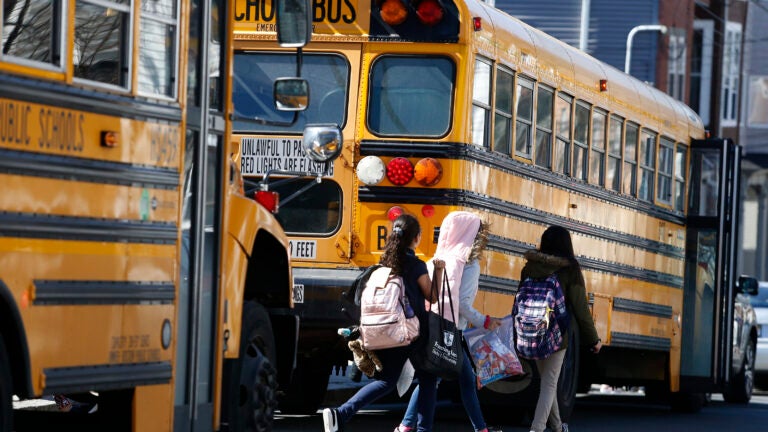
The plans also spell out bus capacity and seating charts to provide for social distancing for the 11,500 students who rely daily on public school transportation under ordinary circumstances.
A large bus that can typically hold 71 elementary students would be capped at 12 passengers, under six-foot distancing protocols, or 24 students if spacing is set at three feet apart.
Midsize buses that usually carry 16 students at full capacity would be cut down to four students under six-foot restrictions, or eight students with three-foot distancing. Wheelchair-accommodating buses would be able to carry three students spaced at three feet apart from one another, or just one student if the rules are set at six feet.
The district would provide personal protective equipment such as masks and gloves to students, and each school would have a nurse and an isolation room for students who become sick. Parents are asked to perform daily health checks before school.
Superintendent Maureen Binienda said social distancing guidelines would account for the possibility that some students could be asymptomatic carriers of the coronavirus, according to the Telegram & Gazette. Although plans list possibilities for spacing between three and six feet, Binienda said, “We’re shooting for six, not three.”
Officials say the hybrid, in-person models are flexible enough that the district could turn to full remote learning once again, should such a move be required, the Worcester newspaper reports.
Parents and others who were among the 1,000 participants of Monday’s online presentation offered skepticism about whether the plans would be feasible, according to the news outlet. Some worried how young students and children with special needs — who need more in-person learning — would handle a hybrid model of education.
“We’re basically crossing our fingers that the children in K-2 won’t fall too far behind during the most critical years of their development,” said Christina Butler.
Worcester Mayor Joseph Petty, who chairs the School Committee, emphasized the district has not finalized plans, according to the Telegram & Gazette. The school year is slated to start next month.
“This is preliminary. This is subject to change as we move forward,” Petty said. “But we want to get input now.”




To comment, please create a screen name in your profile
To comment, please verify your email address
Conversation
This discussion has ended. Please join elsewhere on Boston.com