
‘This experience might have made for an entertaining tale at a cocktail party’
From "cleverly" disguised trucks to a call to a powerful congressman, a Mass. doctor described the lengths it took to ensure a PPE order didn't get seized by the feds.
Andrew Artenstein, the chief physician executive at Baystate Health, says he “rarely gets involved” in the Springfield-based nonprofit’s supply-chain activities.
But in the nationwide free-for-all to secure personal protective equipment, Artenstein was taking no unnecessary chances.
Related Links
The coronavirus pandemic has forced governments and hospitals to scramble — sometimes in competition with each other — to replenish depleted supplies of PPE. And in a recent article in the New England Journal of Medicine, the Massachusetts doctor described the creative lengths his team went to ensure that a shipment of KN95 respirators and face masks for their frontline workers wasn’t seized by the federal government.
“Deals, some bizarre and convoluted, and many involving large sums of money, have dissolved at the last minute when we were outbid or outmuscled, sometimes by the federal government,” he wrote. “Then we got lucky, but getting the supplies was not easy.”
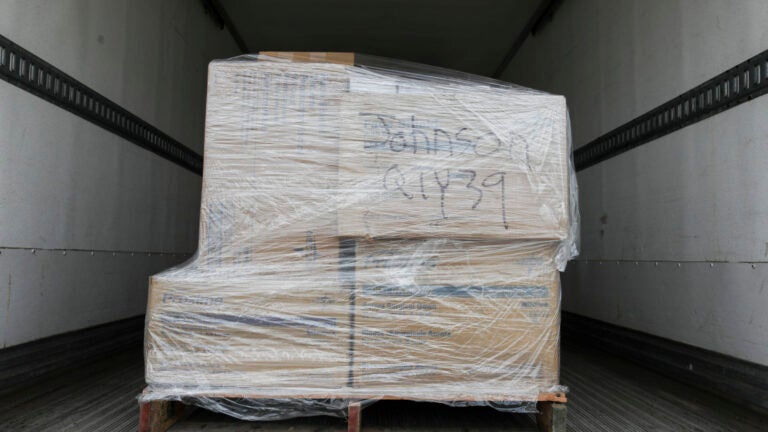
After receiving a tip from a trusted broker, Artenstein and a team of colleagues traveled to “a small airport near an industrial warehouse in the mid-Atlantic region.”
“Two semi-trailer trucks, cleverly marked as food-service vehicles, met us at the warehouse,” he wrote. “When fully loaded, the trucks would take two distinct routes back to Massachusetts to minimize the chances that their contents would be detained or redirected.”
Artenstein told WBUR that he feared the trucks could “run into trouble” crossing state lines, if they were marked as carrying PPE. From coast to coast, hospitals and local governments have reported that federal officials have seized shipments of in-demand protective gear and medical equipment to be rerouted for coronavirus response efforts in other states. For example, Massachusetts officials said that 3 million masks that they had negotiated to buy were impounded last month by the federal government in the Port of New York and New Jersey.
“We just wanted to take every possible precaution that once we obtained this equipment, that we actually got it back to our health system where it was so desperately needed,” Artenstein told WBUR in an interview.
Upon arriving at the airport, Artenstein says he and his team were “jubilant” to arrive to see pallets of respirators and masks being unloaded. However, before they could transfer the money for the order (more than fives times the usual amount for such a shipment), Artenstein says two FBI agents — apparently concerned the masks could be headed to the black market — arrived and began questioning him.
“I tried to convince them that the shipment of PPE was bound for hospitals,” Artenstein wrote in the NEJM article. “After receiving my assurances and hearing about our health system’s urgent needs, the agents let the boxes of equipment be released and loaded into the trucks.”
But they still weren’t in the clear; after several hours of waiting, Artenstein told WBUR that he learned the Department of Homeland Security was considering utilizing their option to redirect the order — forcing him to make some “quick calls” to their congressman, Rep. Richard Neal, to prevent its seizure.
“It took a number of calls and a lot of work,” Artenstein told WBUR.
Neal’s office confirmed to Boston.com that the Springfield Democrat, who chairs the powerful House Ways and Means Committee, assisted in the process.
It wasn’t until after Arteinstin had driven back to Massachusetts and gotten a call after midnight confirming that the masks were secure at their warehouse that he said his nerves abated.
“This experience might have made for an entertaining tale at a cocktail party, had the success of our mission not been so critical,” he wrote.
Artenstein told WBUR that Baystate Health’s hospitals have also been burning through disposable gowns and the smaller versions of the N95 mask as sick patients continue to come “fast and furious.” And while he called Gov. Charlie Baker’s administration “good partners” in the response to the pandemic, he said that state officials are grappling with similar issues due to the shortage in supplies.
Going forward, Artenstein expressed hope that domestic production of PPE would be “enhanced” and that supply chains could be “solidified,” so that hospitals don’t have to engage in quasi-clandestine missions to ensure their workers have essential protections.
“Did I foresee, as a health-system leader working in a rich, highly developed country with state-of-the-art science and technology and incredible talent, that my organization would ever be faced with such a set of circumstances? Of course not,” he wrote. “This is the unfortunate reality we face in the time of Covid-19.”


To comment, please create a screen name in your profile
To comment, please verify your email address
Conversation
This discussion has ended. Please join elsewhere on Boston.com