
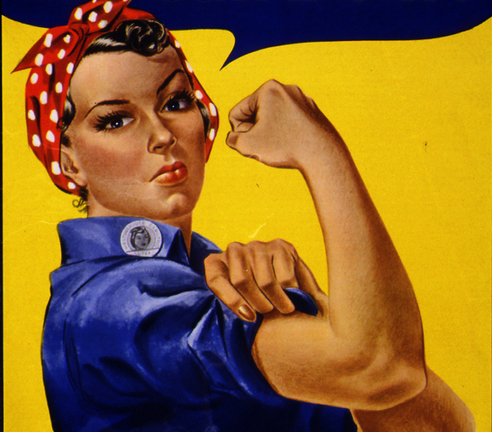
This week in, ‘I am a working woman, hear me roar’
There’s a scene in the TV show Silicon Valley when the head honcho of Hooli, the show’s parody of a Google-like corporation, presents to his board of directors. “Gentlemen of the Hooli board,’’ he says. He then points to the one woman in the room and says, “And lady.’’
I laughed and then cringed as I sat on my couch binge-watching the show Thursday night. The show’s boardroom checks out: Only 19.2% of board seats at S&P 500 companies are held by women, even though companies with more women on the board make more money.
Earlier this week, Manohla Dargis wrote an article in The New York Times<a href=”about the lack of diversity in Hollywood, where I learned that only 1.9 percent of the top-grossing movies from the past ten years were directed by women. It also coincided with <a href=”an excerpt from Mindy Kaling’s new book published in Glamour about the important role confidence plays for working women (“Work hard, know your s***, show your s***, and then feel entitled,’’ she writes).
Also this week, The Cut ran a series called “She’s the Boss.’’ I’ve devoured <a href=”every article they published, such as an interview with one of the few female CEOs of a Fortune 500 company, a piece about what a journalist has learned from her previous career failures, and an article about whether men are actually intimdated by powerful women.
The article that struck me the most was “<a href=”Why We Need Older Women in the Workplace,’’ by writer and editor Lisa Miller. I can’t get it out of my head. The art that accompanies the piece has stayed with me the most: It’s the back of woman’s head. She’s wearing her hair in a ponytail, and has two pencils stuck in it. Her hair is white.
It made me realize how few gray- or white-haired women I’ve encountered in my time spent in offices. There have been many older men at every job I’ve worked. But I’ve only held one position where one of the top dogs was a woman over 65. She is, to this day, one of the most badass people I’ve ever worked for.
Will this week’s press change things? In the short term, probably not. But by pointing out absurd statistics like Dargis did, and by giving advice like Miller’s—“First, always sound like you know what you’re talking about even if you don’t. And before you do something you know will piss someone off, arm yourself carefully with two good reasons why’’—these writers are arming working women with that more information and more tools necessary to navigate the turbulent, male-dominated waters of corporate America.
In the long term, I’m hopeful that someday we’ll have both boardrooms and TV shows filled with white-haired, female CEOs of Hollywood production companies.




To comment, please create a screen name in your profile
To comment, please verify your email address
Conversation
This discussion has ended. Please join elsewhere on Boston.com