
J.Crew needs to get its act together
The company recently laid off 175 corporate employees. But that’s the least of its worries.
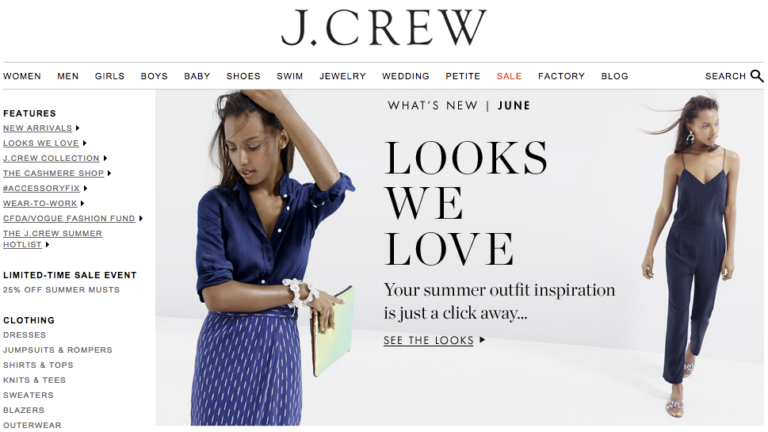
J.Crew cut 175 jobs from its corporate headquarters in New York City yesterday. This comes on the heels of the company’s first quarterly fiscal report for 2015, the results of which were less than thrilling for shareholders.
Total revenues for the J.Crew brand (the company also owns Madewell) decreased 5 percent, and total revenues were down by 2 percent.
This is not surprising. There’s been a customer uprising against J.Crew for the past few months. Women have been tweeting #revivejcrew at the urging of fashion blogger Capitol Hill Style, who says that the quality of the brand’s clothing has decreased markedly since 2010. But the most telling sign of the magnitude of the disaster the brand faces is TheWall Street Journal’s article last month titled “Dear J.Crew, What Happened to Us? We Used to Be So Close.’’
I am a J.Crew loyalist who relies on the brand to outfit me in trendy but safe articles of clothing that, while pricey, are well-made and will last for years. My closest is a testament to that. I still have clothes I bought there in high school.
But not so much anymore. Two new dresses I bought at J.Crew last month have ripped, seemingly for no reason. I’m planning to bring them back and ask for a refund, because new things that fit you correctly aren’t supposed to spontaneously slit up the middle the second time you wear them.
But these sartorial let downs hit me harder than they would’ve if I’d ripped a dress from Anthropologie.
What is it about J.Crew’s recent failings that have so many customers so upset?
Beyond design and quality, what J.Crew traded on was the idea that they knew what you wanted and that they got you. The Wall Street Journal’s headline is so cutting because, as a customer, you really did feel like the brand was your friend. Their clothes were reliable and so well-made that paying a higher price made sense given how long they’d last and how good you’d feel in them.
A lot of us buy into—or bought into—the lifestyle J.Crew was selling, which the brand marketed with creative director Jenna Lyon’s quirky style and cool-girl persona. In a Forbes profile of the company from 2010 (which we may as well start calling The Golden Years of J.Crew), Leah Bourne writes, “Perhaps J.Crew’s biggest coup is that its fans are a vocal bunch who spread the gospel of J.Crew without any direct prodding from the company.’’
But they’re losing their evangelists. It’s not just the durability of the goods that have come under attack. There’s been displeasure from shoppers about the design in recent years, as well. In 2013, CEO Mickey Drexler apologized to customers for “straying too far from the classics.’’ In trying to push bolder design, the company pushed some customers away.
The New York Timesdetailed the brand’s recent slump, saying that while much of the fashion world has been shifting prices down, J.Crew has spent too much time shifting prices up. You can currently buy a sweater for $450 from J.Crew Collection, the brand’s high-end line. The company is aware that customers want cheaper options, however, and is making moves to offer them. This year, they’re opening 21 J.Crew Factory stores, their lower-priced brand.
But it was the classic, reliable mid-range offerings that built up such a loyal fan base. And the base wants those back.
Identifying with the image a brand projects will only get a retailer so far with customers. If there’s displeasure with design and displeasure with quality, why should loyalists keep buying goods from a company that indicates it no longer gets them the way it used to?
Those recently reported sales figures indicate they’re not.
The layoffs and personnel changes signify that the brand is making changes to try to #revivejcrew. The company announced that Somsack Sikhounmuong, the current design head for Madewell, will replace Tom Mora as the head of women’s design. In a conference call last week, Drexler said, “We are, needless to say, clearly disappointed with the results. We recognize there is work to be done and we’re on it.’’
With their recent blunders, J.Crew has lost more than buttons. They’ve lost brand equity. And that, unlike a few rips and tears, is harder to piece back together.
Correction: An earlier version of this article incorrectly attributed the article “Dear J.Crew, What Happened to Us? We Used to Be So Close’’ to The Washington Post. It is from The Wall Street Journal.
A spring guide to Boston:
[bdc-gallery id=”465975″]




To comment, please create a screen name in your profile
To comment, please verify your email address
Conversation
This discussion has ended. Please join elsewhere on Boston.com