
Volvo Ocean Race showcases extreme aspects of sailing
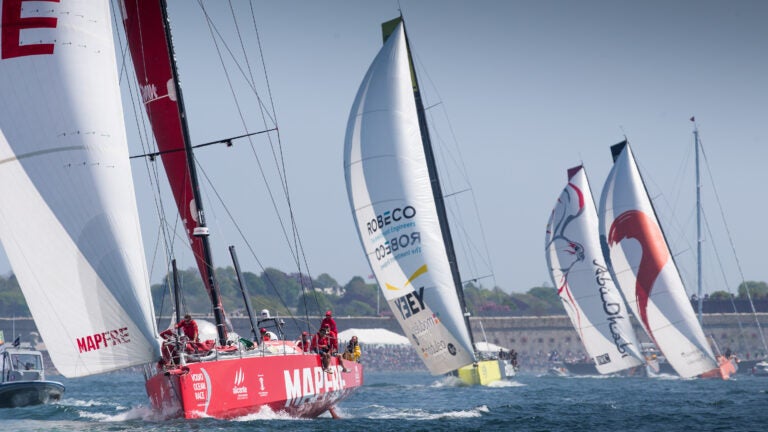
When you think of sailing, you assume frosty-haired males, dressed in white linen pants, blue blazers and a captain’s hat you probably also wore during some Halloween party. Pipe optional.
Or you might think of the hour-long lessons you had taken while away at summer camp. You don’t quite remember the mechanics of it all, but you do remember one or more of the following terms: port, boom, star-board and jibby (you think).
What you don’t think of is athletic men and women who are highly skilled at making up to 27,500-plus pounds of carbon fiber cruise through the water at speeds up to 40 knots. For you land lovers, that’s about 46 mph of pure Mother Nature fueling these boats. Add rogue waves, unpredictable winds, and temperatures ranging from 23 to 104 degrees, and this isn’t your typical Memorial Day raft up.
This mental and physical test of endurance is typical though, for the sailors of the Volvo Ocean Race. Starting very early on May 6 and ending May 17, the six Volvo Ocean Race teams stopped in Newport, Rhode Island to decompress and strategize for the next leg. This stopover marked the sixth leg of the 39,000 nautical mile race. To give some perspective on the distance traveled: in total, the length of this race would be like driving from coast to coast (think Boston to Los Angeles) about 17 times.
The legs differ in length, but each is counted in the overall race score. Like golf, this race is determined based on a low points system. The team to accumulate the lowest amount of points (or finishes) after nine legs is the overall winner.
Unlike in previous years, the boats this year have all been designed to be exactly alike. Previously, the teams were given parameters to work within (length, width) but not restricted to design one type of boat.. Now, with all boats being equal (think footballs and Deflategate…too soon?), this year’s race boiled down to sailing ability.
Volvo Ocean Race in Photos
[bdc-gallery id=”331176″]
Volvo Ocean Race sailors face some treacherous conditions you might not think of: cargo carriers, wild animals, squalls from out of nowhere. Waves as high as 16 feet can grow unknowingly fast during a night period, leaving the sailors not “on’’ in a restless sleep. Sailors keep their legs always facing toward the bow. As the boat moves from one wave into the next, the extreme force causes your knees to bend in the same direction. If a boat were to suddenly hit a piece of unanticipated rock (slight navigational mishap) you’d be pretty damn glad you didn’t fall asleep with your head and neck facing the wrong way.
Even daily food intake can become an ordeal. Meals are prepared from a freeze-dried food ration. Crew members heat desalinated water from an onboard tank on two small propane burners, then dump the boiling water into a cooler and bring the food on deck. Once, when one of the crews two coolers was knocked into the ocean, Team Alvimedica’s onboard reporter Amory Ross pulled a Macguyver, using his camera bag as as a cooler. When you’re at the infamous “Point Nemo,’’ the furthest point geographically away from land on all sides, you get pretty resourceful.
After sometimes 20-plus days on open water, setting foot on a dock brings a sigh of relief. But reality snaps in when the sailors step into a public world of lights, camera, and action. The stopover in Newport alone drove over 100,000 visitors over the 12-day period. Prior to Newport, over 1.46 million people visited a Volvo race village stopover. The sailors are given a few days of dedicated time off, but even so the days are filled with interviews, fans, and loved ones vying for time.
For the few American sailors entered in the race, Newport did feel a bit more like home, being a highly-coveted sailing town. Over 400 volunteers helped to make Newport more comfortable. During the 2008-09 race, Boston played the North American host, but the final spectator count was not nearly as grand as Newport’s. We may be a big sports town, but the epic Volvo Ocean Race just hasn’t quite made NESN’s instant replay. Knut Frostad, the race’s CEO and a former Volvo sailor himself, gave an unofficial thumbs up to having Newport as next race’s North American stopover once again during a racer-week press conference. Maybe by then, the Volvo will have earned a little more street cred.





To comment, please create a screen name in your profile
To comment, please verify your email address
Conversation
This discussion has ended. Please join elsewhere on Boston.com