
Tsarnaev Is Guilty. What Do We Do Now?
Nearly two years after the events at the 2013 Boston Marathon, Dzhokhar Tsarnaev has been found guilty on all 30 of the charges brought against him.
For me, watching the verdicts roll in was a weird kind of high.
I was in New Brunswick, New Jersey, sitting in my Rutgers University dorm room, studying for a final and racking my brain for an excuse to call out of my call center job. My roommate rushed in and asked me if my friends back home were okay, as he knew how close I’d come to buying a bus ticket and meeting up with friends to drink and watch the marathon in person. I didn’t know what he was getting at, since I was studying with the television off and my phone on silent.
I turned on the TV and saw the chaos unfold. I dropped what I was doing, turned my phone on, and reached out to friends who I knew were there. I got no answer. So I texted. And the messages weren’t being delivered. So I panicked and screamed at the TV before I unplugged it. I didn’t plug it back in until they caught him. And I drank and cried and prayed. I figured that would be the end of any emotional investment in the case. I was wrong. Weeks and months later, I felt so much.

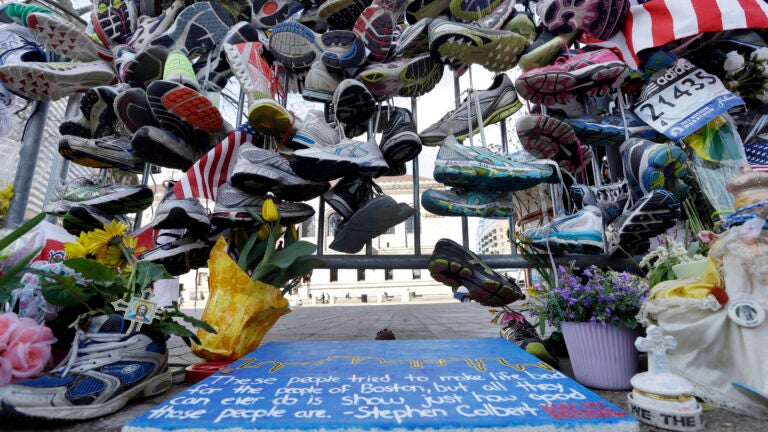
A woman wipes a tear at a memorial for the victims of the Boston Marathon bombing on Boylston Street near the race finish line.
I felt ashamed that I was hundreds of miles away from a city that has given more memories to me than any place probably ever will. It wasn’t like I could have done anything. But I could have been present. I felt angry that some kid younger than me made my mother express genuine fear when we spoke over the phone. And I wondered what, if anything, would change about the place I love.
A few days shy of the two year anniversary of the bombing, I’ve resolved those feelings somewhat. But, to be honest, I never expected this day to come. At least not as quickly as it has.
Boston has a way of forgetting insane things that happen here. We still don’t know where those paintings are, egregious murders have gone unsolved, and Whitey Bulger was MIA for more than three quarters of my life before his capture. None of those things happened in front of cameras broadcasting a sporting event for the world to see, and none of them were as frenzied and instantaneous as the bombing. Still, I figured we’d add another notch to our belt for another endlessly long saga stemming from one heinous act.
And now, we’re here.
Before April 2013, I spent 90 percent of my time in the Tri-State area, fending off mostly playful barbs after telling folks I was from Boston. I’d field questions about our accent, Bobby Brown, the Red Sox, and lobster rolls. I’d play along. Now? Those still come, but the frequency of questions and remarks about the bombing outstrip them all.
And in those moments, I am furious. Not at the person behind the question, but at Dzhokhar and Tamerlan Tsarnaev, who hijacked an entire city’s narrative for themselves.
Whenever I’m at Pour House on Boylston, or Lolita on Dartmouth, April 2013 is the furthest thing from my mind. When I buy sneakers on Clearway, or records on Centre Street, I’m not thinking about an act of terror. But when I mention Boston on South Street in Philadelphia, they are. And that’s a shame.
Dzhokhar Tsarnaev is a man who saw young children and still placed a homemade bomb on a crowded street. He doesn’t deserve to remain in the forefront of our collective memory. Boston is a city with a laundry list of accomplishments, not least among them the people that call it home now.
With the verdict out of the way, I have no doubt Boston will continue to add to its list of accolades. I look forward to the day one of those accomplishments supplants the bombing in the hearts and minds of outsiders.





To comment, please create a screen name in your profile
To comment, please verify your email address
Conversation
This discussion has ended. Please join elsewhere on Boston.com