
#BlueLivesMatter as NYPD Seeks Apologies
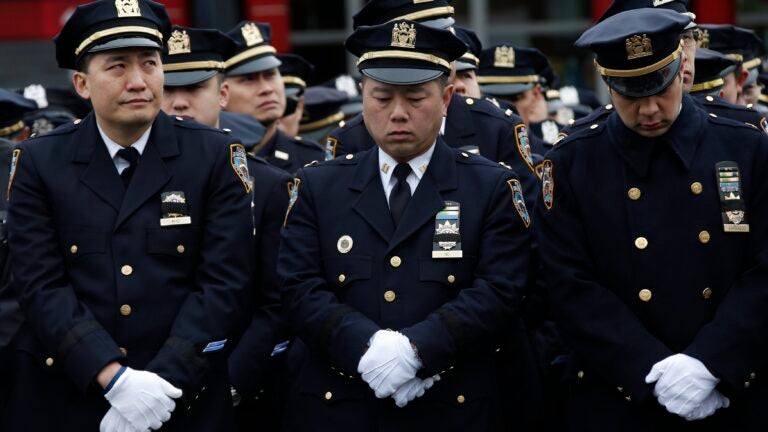
In New York, the NYPD has decided to use a recent tragedy to cast itself as the victim of recent protests. But the dissonance of their words and actions has further exposed the department’s hypocrisy.
On December 20, in Brooklyn, NY, NYPD officers Wenjian Liu and Rafael Ramos were ambushed in their squad car, killed by 28-year-old Ismaaiyl Brinsley. Brinsley, who had shot his 29-year-old on-again, off-again girlfriend Shaneka Thompson the day before, killed himself after gunning down the two officers.
Murder is reprehensible, regardless of the occupation of the victim. The murder of an immigrant who worked menial jobs is just as heinous as the death of a rookie police officer. Our hearts go out to the loved ones left behind.
But the aftermath of the events of December 20––the vilification of an entire movement, dangerous hyperbole, and pettiness exhibited by individuals in positions of leadership––might sow the seeds for something far worse.
Since the murder of officers Ramos and Liu, it seems the NYPD has made plain its desire to be held to a different set of standards.
First, Brinsley was not a part of any of the protests that sprung up in response to decisions not to indict police officers who killed black men. He, along with thousands of others, was a bystander at the protest in Union Square two days before. This fact did not stop Mayor De Blasio from calling for a halt to protests, and commissioner Bill Bratton from calling the events of December 20 a “direct spinoff of this issue of these demonstrations.’’
The NYPD has put forth that the actions of a lone madman should be enough evidence to halt organized protests. And while the department also rightly forced out the officers responsible for killing Sean Bell, its rush to dismiss the legitimate actions of many in the face of the actions of one, the NYPD has all but issue a press release calling the protests criminal. The same protests that have sought to highlight the fact that the actions of some NYPD officers render their officers illegitimate in the eyes of the people they’ve been tasked to serve and protect.
NYPD Union head Patrick Lynch’swords of blood being on the “hands of many’’ is indeed accurate. No one on either side has argued the innocence of Brinsley. But Bratton has halted his indictment of the events leading to the deaths of Ramos and Liu at the protests. In doing so, he has ignored that these protests––like nearly all sustained American protest––is the result of a failure to correct longstanding greivances. Bratton is the commissioner of the police department responsible for two of the deaths that mobilized protesters. Neither officer has been indicted.
The protest organizers are not employed by any organization or institution. Before this recent spree of deaths at the hands of police, they were relative unknowns. Yet Bratton and the NYPD have held them to a standard fit for an institution. The NYPD on the other hand is employed by the taxpayer. When faced with the opportunity to own up to its part in the erosion of its relationship with civilians, it chose instead to hold civilians to institutional standards.
The NYPD’s hemming and hawing over protests––at a time like this––rings hollow from the confines of its glass house.
Not to be outdone, former Mayor Rudolph Giuliani joined the fray with his claim that “we’ve had four months of propaganda, starting with the president, that everybody should hate the police.’’ The president, well aware of his duty to speak to the concerns of an entire nation, has said about all he can say on the subject of extrajudicial killings of black men and women. But, for what he could or couldn’t, none of what he said was hateful.
Giuliani saw a black issue highlighted by seas of black faces. He saw a black president and a black madman take the lives of two officers. Giuliani, like Bratton, took the opportunity to paint black organization against a societal ill as black hatred for individuals in uniform. What other reason could there be for including a sitting president in the imagined vilification of our police, when the people who are likely to have voted for him feel his remarks on recent events have been too conciliatory?
The NYPD, after calling on organizers to speak out against the actions of a lone madman, moved nary a muscle to speak out against a lone former governor’s decision to tilt at windmills.
Still, having decided to obscure the issues that have spurred thousands to protest, we’ve yet to drill down to an important truth. Consider that JetBlue offered free tickets to police who wished to attend the funeral service this past week. Consider that the New York Yankees offered to pay college tuition for the children of one of the slain officers. And consider that those connected to the recent protests were quick to denounce the actions of Brinsley, while police have historically bristled at the assertion that there may be bad police among them. The notion of black bodies organizing in streets and from state to state flies in the face of the American social contract. The idea that a police officer can shoot, choke, rape, and steal with impunity, however, does not.
Though black lives may matter, the NYPD’s actions seek to convince us that #BlueLivesMatter most of all.
*An earlier version of this article attributed a quote to New York Police Commissioner Bill Bratton. The quote belongs to NYPD Union head Patrick Lynch. We regret the error.



To comment, please create a screen name in your profile
To comment, please verify your email address
Conversation
This discussion has ended. Please join elsewhere on Boston.com