

Sign up for the Today newsletter
Get everything you need to know to start your day, delivered right to your inbox every morning.
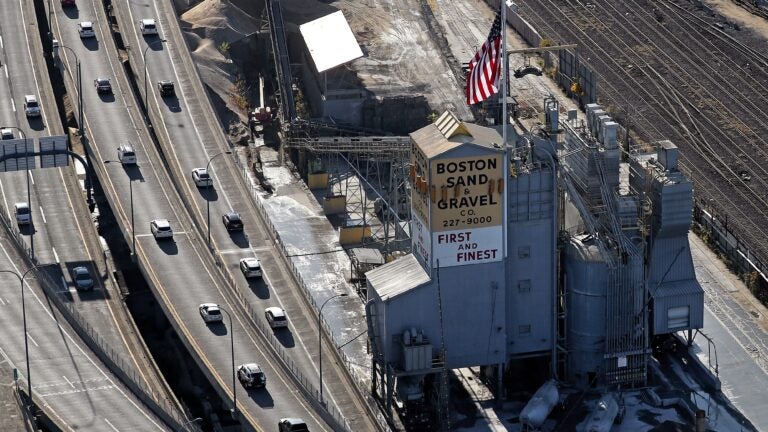
Boston Sand & Gravel is suing the developer working to build a large apartment complex near its Charlestown plant, warning that mixing foot traffic and semi-trucks on an adjacent maintenance road will make pedestrian deaths “inevitable.”
Filed last week in Suffolk Superior Court, the lawsuit seeks to halt Trinity Financial’s plans to turn a pair of city-owned parking lots into a 705-unit residential development along a maintenance road at New Rutherford Avenue and Austin Street. Boston Sand & Gravel, which has long held special rights to the maintenance road, alleges Trinity failed to consider the hundreds of semis and concrete mixers that pass through daily.
“Our trucks and operations are not inherently dangerous, but a development that intermingles pedestrians, bicyclists and passenger vehicles with the passage of these trucks via our access rights, creates an unnecessary and elevated risk,” the company said in a statement. “BS&G and our drivers take seriously the responsibility to operate our vehicles safely.”
A Trinity representative did not respond to requests for comment.
According to city filings, the company’s redevelopment plans include four mixed-use buildings, an early childhood education center, arts and culture space, and athletic fields, among other amenities.
Boston planning officials approved the first phase of Trinity’s redevelopment last fall, clearing a major hurdle for construction of a 123-unit affordable housing site dubbed “Building B.” However, Boston Sand & Gravel argues the new building will give hundreds of pedestrians and cyclists “unlimited” access to the maintenance road, “creating an inevitable situation of repeated accidents” between the company’s trucks and “pedestrians including children.”
And while Trinity has said it will make “sidewalk and streetscape improvements” to boost safety for those walking or biking nearby, Boston Sand & Gravel claims those plans include trees that could dangerously obscure pedestrians’ or drivers’ view of the road.
“Throughout the permitting process, Boston Sand & Gravel has consistently raised concerns that the current design of the Trinity development creates unnecessary conflict points and avoidable safety risks for both residents and workers,” the company said in its statement.

Per its lawsuit, Boston Sand & Gravel suggested Trinity instead allow new access roads near Gilmore Bridge and the Millers River Littoral Way, but Trinity “categorically rejected” that pitch because it would have cut into redevelopment plans.
“During the permitting phase, we reviewed and presented other options that focused on maintaining a safe environment for both the community and our employees,” Boston Sand & Gravel said. “We consistently expressed a willingness to work collaboratively to achieve that result; unfortunately, Trinity refused to do so.”
The company’s lawsuit seeks to pause work on Building B, pending modifications like a pedestrian footbridge. It also asks a judge to find that Trinity’s use of the land goes against a 2006 easement that laid out Boston Sand & Gravel’s use of the maintenance road.
“Taken together,” the company alleges, the redevelopment “will cause entirely foreseeable frequent injuries and deaths” and pose “great harm to the public.”
Brittany Comak, a spokesperson for Boston’s Planning Department, said developers and city officials have offered “several practical solutions” to keep stakeholders safe and will continue taking safety concerns into account when finalizing the site plan.
“This lawsuit aims to stop the development of several acres of prime public land right next to the Orange Line that has gone through years of community engagement to arrive at a plan to deliver much-needed housing to residents,” she said in a statement. “The real issue here isn’t about safety — it’s whether some parties are willing to adjust their operations so that we can build hundreds of new transit-oriented homes.”

Get everything you need to know to start your day, delivered right to your inbox every morning.




To comment, please create a screen name in your profile
To comment, please verify your email address
Conversation
This discussion has ended. Please join elsewhere on Boston.com