
Sign up for the Today newsletter
Get everything you need to know to start your day, delivered right to your inbox every morning.

Massachusetts business confidence climbed in November as steady consumer spending and firm investment eased employer fears over tariffs and rising operating costs. But despite the improvement, the state’s confidence index remained stuck in pessimistic territory for the ninth straight month.
The index found that inflation remains a sticky pocket of weakness, with price pressures easing from their post-pandemic highs but remaining above the Federal Reserve’s preferred level of 2%.
“The US economy enters 2026 with a mix of solid fundamentals and notable risks, balancing strong private-sector momentum against inflation concerns,” said Sara Johnson, chair of the AIM Board of Economic Advisors, in a statement.
She continued, “Though policy uncertainty continues to weigh on business planning, investment in artificial intelligence and advanced technologies remains a bright spot, driving capital expenditures and boosting productivity in key sectors.”
Businesses that took part in the survey offered mixed outlooks — some reported stalling sales on the South Shore, even dropping closer to Boston, while others said demand remains strong.
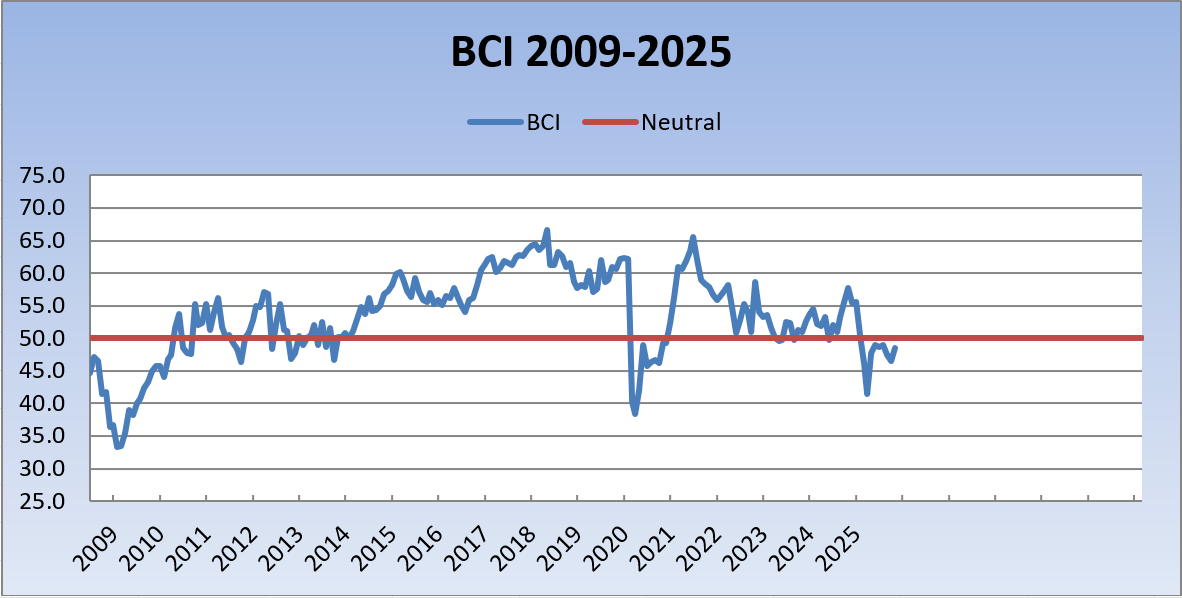
The AIM Index is a survey of more than 140 Massachusetts employers that has run since 1991. It is calculated on a 100-point scale, with 50 as neutral; a reading above 50 is positive, while below 50 is negative. The state’s November rating was 48.5, up from 46.5 in October.
The index also found that larger companies were more confident about their business conditions than medium-sized and smaller companies.
Ryan Hanna, senior vice president and chief investment officer at Cambridge Wealth Management, a Division of Eastern Bank, and a BEA member, said the rapidly changing economy has left him “uncomfortably bullish.”
“The U.S. economy continues to defy pessimistic sentiment,” he continued in a statement. “Underlying demand has remained resilient despite the economic turmoil this year. Adjusted retail sales remain robust, and the labor market, while slowing, remains historically tight with the unemployment rate at 4.4% and wages growing at 3.9%, well above the pace of inflation.”

Get everything you need to know to start your day, delivered right to your inbox every morning.




To comment, please create a screen name in your profile
To comment, please verify your email address
Conversation
This discussion has ended. Please join elsewhere on Boston.com