
The middle class doesn’t have to keep shrinking, Globe Summit speakers tell audience
Speakers say middle class jobs need to be in the state to stimulate the economy
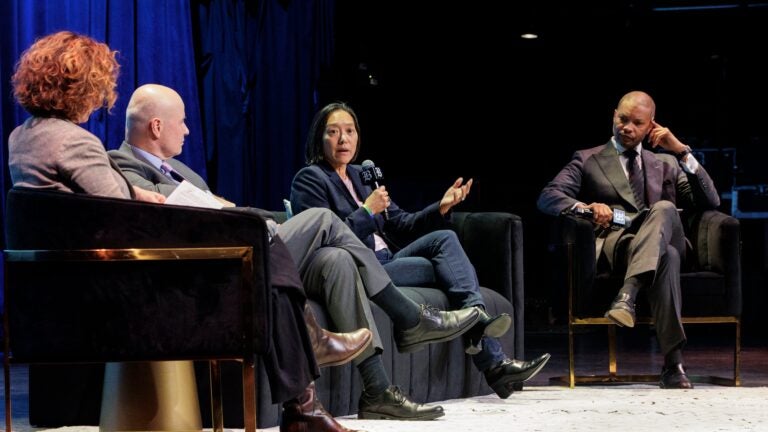
While the gap between the middle class and wealthy widens, Massachusetts must focus on keeping good paying jobs accessible for middle class residents, experts said Wednesday at the Boston Globe Summit.
“If you look at our economy, we’ve done very well with very high income jobs, but there are so many companies who need people who may not have college degrees, but are still really talented and have great upside,” said Yvonne Hao, a former state secretary of economic development for the Healey administration. “A lot of those middle-class jobs went to other states because we weren’t intentional about keeping them here.”
Hao. now a general partner at Flagship Pioneering, a life science enterprise, joined Turahn Dorsey, chief executive of the Eastern Bank Charitable Foundation and Christian E. Weller, a professor of public policy at UMass Boston, for a discussion moderated by the Globe’s Katie Johnston at the House of Blues in Boston.
The discussion followed a series by the Money, Power and Inequality at the Globe called “Squeezed” about the disappearing middle class in Massachusetts. Johnston, who worked on the series, discussed how sources for the story felt financially insecure and had trouble making ends meet, often a source of shame.
Weller, also a senior fellow at the Center for American Progress, said that the middle class refers to income as well as financial security.
“[People] all of a sudden focus so much on the today and do not take the risks of starting a business, switching careers on all of the things that we need in a tech heavy knowledge economy, heavy state like Massachusetts, but all around the country,” Weller said. “People then, [are] not just ashamed, they lack that peace of mind.”
Hao said the state must focus on starting and growing companies here to increase job opportunities statewide.
“One of the pushes that we’ve been working on is how do we get companies to start, but then expand the footprint,” she said. “It’s way better to drive an hour to Worcester or less than an hour to Worcester than to get on a plane and fly to North Carolina. And so how do we use the whole footprint of the state, North Shore, South Shore, Western Mass?”
Weller also emphasized that the resources of the whole state, not just job-rich Boston and Cambridge, should be utilized.
“When it comes to industry and occupations, let a thousand flowers bloom. Let’s not just simply say like, this all has to [be] Kendall Square and MIT. This has to be the whole state and the whole city,” he said.
When it comes to state solutions said that a partnership between public and private sectors will allow the state to support those most in need and employers should lift up their employees.
“The state may need to cover the folks who can least afford to pay for that access, but employers may have to say, ‘We’ll take care of the folks who work for us to make sure that they have access to this too.’ So I think we’re going to have to figure out the blending of that capital,” he said.





To comment, please create a screen name in your profile
To comment, please verify your email address
Conversation
This discussion has ended. Please join elsewhere on Boston.com