
Sign up for the Today newsletter
Get everything you need to know to start your day, delivered right to your inbox every morning.
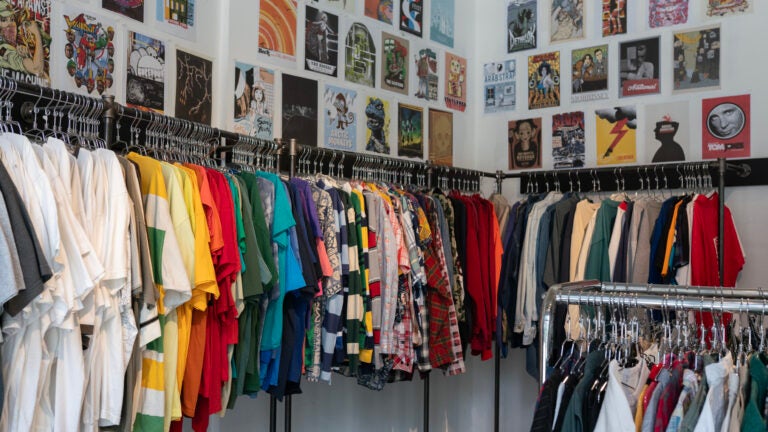
Secondhand stores in Greater Boston are grappling with maintaining the perfect balance between sustainable secondhand clothing and trending merchandise.
Covet, a consignment store with four Boston locations, and Found Boston, two side-by-side vintage clothing stores in Cambridge’s Central Square, sell a combination of secondhand clothing and new accessories to create that balance.
Covet and Found curate their selections by buying what styles, designs, and sometimes brands are popular now from consignors, unlike traditional thrift stores, like Goodwill, that primarily sell donated items.
“I look for classic styles, which are also very relevant today — older pieces that you can still find in high-street stores,” says the co-founder of Found, Rob Singh. He opened the store in 2023 after seeing a need for a “dedicated vintage” seller when hosting the weekly Fenway Flea markets beginning in 2022.
“Trends and style [have] changed so much over the years, where uniqueness is a lot more important and the best way of finding unique and interesting pieces is through resale,” said Hanadi Hamzeh, who founded Covet in 2013 after a year of reselling on eBay.


In January, Found began offering a make-your-own necklace and bracelet charm bar to “add the DIY-aspect” to its stores. “A lot of the necklace charms are new,” Singh said, “but we also carry a good line of vintage charms as well as vintage jewelry.”
Covet sells new jewelry, accessories, and giftable items, making each location a “one-stop shop” in its neighborhood, Hamzeh said. “It keeps the store a little bit fresher and trendier so it just makes the store more attractive to the average person coming in,” she said, including “buyers that aren’t typically into resale.”
Covet takes trendiness beyond its merchandise and into its decor as well. “When you walk in, there’s like a modern, trendy feel to the stores that you don’t find in a lot of secondhand stores,” Hamzeh said.

One of the reasons secondhand stores, like any other business, keep up with trends is to stay competitive. And the competition between secondhand sellers is becoming tougher as the popularity of the secondhand shopping market rises.
Secondhand shopping’s popularity is growing three times faster than the fashion industry and “is predicted to outstrip the fast fashion segment by 2030,” One Planet Capital reported.
In the U.S., the secondhand market is set to reach $56 billion this year and $74 billion by 2029 with an annual increase of 9% on average, according to a report by the online thrift store ThredUp. Across the globe, the secondhand market “is expected to reach $367 billion by 2029,” and in 2024, the market grew 15%, ThredUp reported.
The popularity of secondhand shopping is due to affordability, sustainability, “better” deals, “one-of-a-kind looks,” and the “thrill of the hunt,” according to ThredUp.
At Found, Singh has found that customers shop secondhand based on “a combination of sustainability and style,” he said. “Consumers are realizing that the garment industry is one of the biggest polluters right now. It’s also become super in fashion.”
According to One Planet Capital, “Each second hand clothing purchase displaces” around 17.6 pounds of carbon dioxide and “reduces emissions relative to a new garment by 82%.”
With new merchandise making up 10% of Covet’s sales, “I consider us vegetarians where overall it’s better for the environment” to have a mix of new and secondhand items, “[and] it’s a lot more palatable to a bigger audience,” Hamzeh said.
Covet keeps items on their racks for 45 days before the consignor can take it back or have the store donate it. Due to the high volume of donations the stores were making, Hamzeh started a monthly bin sale where all unsold items are priced at $5 for one day only and all the proceeds are donated to local charities.

While sustainability is important for Hamzeh as a business owner, she said, “I really do think that generally speaking that consumers do not shop based on sustainability, they shop based on price and value.”
In terms of value, “Even at the highest end, I don’t think the quality nowadays is the same as it used to be … a vintage piece is kind of always going to be a little better,” Hamzeh said.
She believes that secondhand shopping’s popularity truly stems from the emotional aspect and the “fun” of it.
Secondhand shopping is “treasure hunting.” Hamzeh continued, “If you want to shop in person, it’s a little bit more of an activity than just going to a regular store [where] you can find the exact stuff online.”
Get everything you need to know to start your day, delivered right to your inbox every morning.



To comment, please create a screen name in your profile
To comment, please verify your email address
Conversation
This discussion has ended. Please join elsewhere on Boston.com