
With soccer stadium, Lynch and Kraft are on opposite sides again
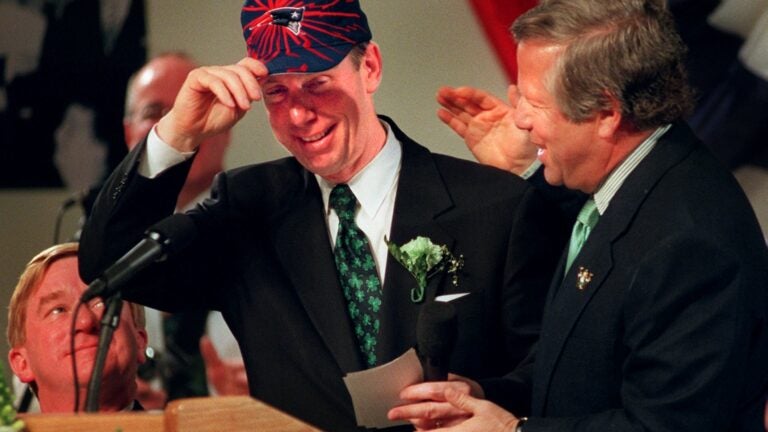
Robert Kraft, owner of the New England Patriots and New England Revolution, is running into a familiar foe as he floats the idea of building a soccer stadium in Dorchester. His name is U.S. Congressman Stephen Lynch.
Lynch has come out forcefully against the plan, which would see a stadium built on the Bayside Expo Center site now owned by UMass Boston.
Lynch told The Dorchester Reporter in a statement that he opposed the idea “because of the massive traffic choke point it would create in the Dorchester and South Boston neighborhoods.”
“The situation is getting progressively worse as the South Boston waterfront development has greatly increased the volume of traffic along the Morrissey Boulevard corridor,” he said, before punctuating his thought without subtlety: “So basically it’s a bad idea.”
Kraft has hoped for a decade to build a 20,000-plus-seat soccer stadium in or near Boston and along public transit, better connecting the Revolution to the millennial and immigrant populations in the city. It’s not his first time trying to bring a team to Boston.
About 20 years ago, Kraft sought to build a larger, 65,000-seat stadium for the New England Patriots along the South Boston waterfront, about three miles from the Dorchester site he’s eyeing now. The plan led to heated debate that pitted Kraft against the neighborhood and several elected officials, and ultimately saw Kraft — after flirting with moving the Patriots out of Massachusetts — build Foxborough’s Gillette Stadium, where both the Patriots and Revolution play today.
Lynch, who was a state representative as the football stadium was first pitched and became a state senator as the plan advanced, was one of the most vocal critics at the time, with traffic again a major concern.
“They’ve picked an impossible site,” Lynch said in 1995, according to Boston Globe archives. “That area is a peninsula bounded on three sides by water. The one side with access is through a residential area.”
Lynch also spoke at neighborhood meetings opposing the stadium. Posters publicizing one meeting read: “Show your neighborhood pride as we give Bob Kraft and his South Boston stadium proposal the drop kick.”
Just weeks after Kraft gave up on Southie and the football stadium plan dwindled, he attended and spoke at the neighborhood’s annual St. Patrick’s Day breakfast, for which politicians prepare jokes for months. Kraft gained some goodwill for finding humor in the situation.
“I’ll tell you when I knew it was time to pull out. I woke up in bed, and next to me was the Patriots’ mascot’s head,” he said. He also begged the audience’s pardon for being late by scratching the scab of Lynch’s traffic concerns: “I had trouble getting a parking space, and I want to know: Do you always have this much traffic on Sundays?”
Lynch emceed the event and was impressed with Kraft’s performance: “He’s receiving rave reviews, even from people who were adamantly opposed to the stadium idea,” he said. “He was a good man to come.”
Lynch, whose office did not respond to a request for comment before this article was published, was far from the only politician who opposed the football stadium. Among other opponents was his predecessor in Congress, Rep. Joe Moakley. Nor is he the only politician today expressing skepticism for the soccer stadium; those include Linda Dorcena Forry, who now holds Lynch’s old state Senate seat.
In the spring of 1997, shortly after he claimed victory over Kraft, Lynch was profiled in a Globe article. “The next pushy stadium vendor (hello, Bob Kraft) … who thinks state Senator Stephen F. Lynch is a pushover might want to look back 20 years.”
At the time, that look back would provide insight into Lynch’s early career as an iron worker. Two decades later, the advice seems even more prescient now.



To comment, please create a screen name in your profile
To comment, please verify your email address
Conversation
This discussion has ended. Please join elsewhere on Boston.com