
Meet the Boston woman who runs Uber’s biggest East Coast cities
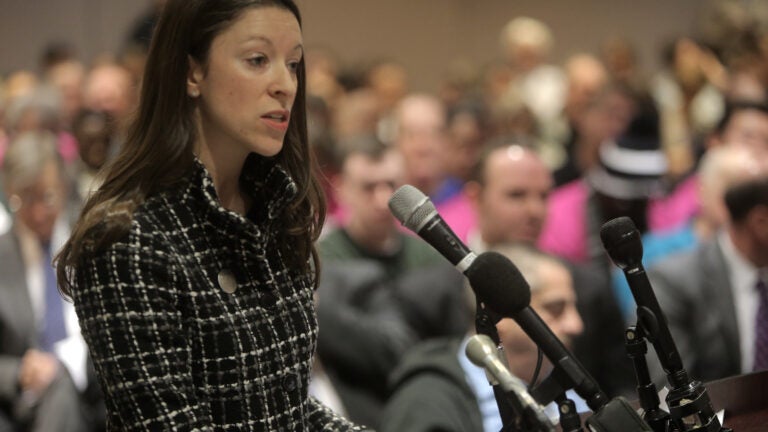
When Meghan Joyce graduated from Harvard with an MBA, she knew she wanted to do something that dealt with technology, policy, and a big idea.
“I found it to be really interesting how communities adapt to new technology and integrate it into their policy system, which has often been around for decades if not centuries longer than that new type of innovation, that new technology,’’ Joyce said.
She got an opportunity along those lines in mid-2013, when she joined the already fast-growing San Francisco-based transportation technology company, Uber, as the general manager of its Boston office.
At the time, the local office had five employees. Today, it has more than 50. And Joyce, while still based out of Boston, has evolved in the role as well. Since becoming one of the company’s two East Coast general managers in May, she oversees Uber in the Boston, Philadelphia, Pittsburgh, Washington, D.C., Baltimore, Nashville, and Atlanta markets.
Over the last couple of years, as ride-hailing services like Uber and its top competitor Lyft have faced regulatory scrutiny in the Boston area, Joyce has become a familiar face to those who follow the issue. She’s spoken on behalf of the company in front of the Boston City Council, Cambridge’s licensing commission, and others. On Tuesday, she will speak at the State House, at a legislative hearing to explore statewide regulations on for-hire transportation apps.
While Uber has been supportive of bringing some regulation to its industry, it has resisted other forms, arguing certain rules would restrict its ability to operate. At the Boston-area public hearings Joyce has appeared, she’s spoken with Uber supporters at her back. The company has a history of using online petitions and emails to rally its users—drivers and riders alike—against regulations the company considers stifling.
“It’s an exciting process to see how people have really gotten involved to speak out in favor of a development that they find to be essential for their experience in their city,’’ Joyce said.
Joyce’s interest in how policy and innovation interact—and sometimes clash—dates back to her time as a Harvard undergraduate, she said, when she studied the history of science. Much of her education focused on changes in healthcare and technology policy over time, she said.
After college, Joyce, a Massachusetts native who grew up on the South Shore, worked as a business consultant for Bain & Company; memorable work included a stint in a factory with a candy company, she said. Later, she moved into private equity, joining Bain Capital.
She then went to Harvard to pursue an MBA, where she took on an internship at the U.S. Treasury. She stuck around an extra year, deferring for a bit on the MBA, as the Treasury grappled with economic policy in the fall-out from the recession.
While in Washington, Joyce said she saw the now-familiar dynamic of Uber rallying its users to prevent or guide legislative efforts from another perspective.
Uber launched in the capital while she was there, she said, and she became a user. During a regulatory bout, she received an email encouraging her to call her city councilor and voice her support for the service. She did.
“It’s an exciting process to see how people have really gotten involved to speak out in favor of a development that they find to be essential for their experience in their city,’’ she said.
Now she’s on the other end of those emails, not just in Boston but in several other cities. In her new position, Joyce oversees what the company considers large, mature markets: cities of a certain size that have access to Uber’s UberX platform, the scrutinized system that allows everyday car owners to become for-hire drivers. In some of the cities Joyce oversees, including Boston, UberX has been around for more than two years.
Joyce reports to Rachel Holt, who oversees the entire East Coast for Uber, including newer markets, while Joyce focuses on the mature markets. Joyce’s position was created in May, after she filled Holt’s position on an interim basis while Holt was on maternity leave.
The point of the new position, Joyce said, is to put similar markets facing similar issues under the same leadership. She said the structure should make it easier for different offices to collaborate on solutions to potential problems, and to learn from one another as new Uber services such as food delivery roll out on a city-by-city basis.
“It’s a rare amount of cities that have [had UberX] around for two-plus years. They require a slightly different approach than a new launch city,’’ she said. “How do we continue to offer more affordable, more reliable products to an ever-increasing number of people? How do we expand to beyond the early adopters? … These are the kinds of challenges that are more common to these more mature ride-sharing cities.’’
One difference between the markets Joyce oversees: Some of them have clear regulations already in place, others do not. Massachusetts and Pennsylvania are both in the process of considering laws for these sorts of companies, while others have already arrived at rules the company finds favorable.
In general, the debate about regulations for Uber and Lyft revolve around two things: the service’s effects on the taxi industry and issues of passenger safety.
Safety concerns have often focused on problems with sexual assault. Uber has faced that exactly in Boston, especially after authorities last year said a driver for the company assaulted a woman who had called for a ride.
The alleged attacker, Alejandro Done of Boston, had not been assigned to pick the woman up, but he was a registered Uber driver. Done was later accused of having committed several sexual crimes on Boston women over the last 10 years. Done had not previously been arrested, and he passed a background check to work for the company.
As a woman who both works for and regularly uses Uber, Joyce said passenger safety concerns are a priority to her. She referenced Uber’s “Share my ETA’’ feature, which allows users to tell friends where they are, as one relatively recent passenger safety function, and she said other types of safety features are in the works.
New England’s history of inventions:
[bdc-gallery id=”110251″]




To comment, please create a screen name in your profile
To comment, please verify your email address
Conversation
This discussion has ended. Please join elsewhere on Boston.com