
The Chinese company building new Red and Orange Line cars has U.S. ambitions
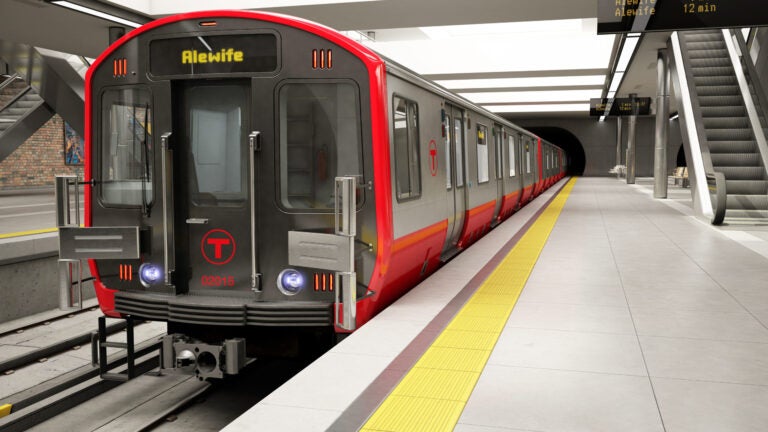
When ground breaks Thursday on a $60 million Springfield factory where new MBTA Red and Orange Line cars will be built, it could represent a major opportunity for the Chinese company behind it.
The $566 million contract to build 284 new cars is the first foray into North America for China Railway Rolling Stock Corp. And CRRC doesn’t want the Massachusetts gig to be its last on the continent.
“It’s the first project in the U.S. What we’re completely focused on next is to get it right,’’ Weiping Yu, a CRRC vice president who runs its overseas operations, told Boston.com through a translator.
“This will be an experiment—but also we want to make it a real good example for us, for our future development in the U.S.,’’ he added.
When CRRC won the MBTA contract last year, it was called CRN. Since then, the company, owned by the Chinese government, merged with another top rail provider in China, reportedly to bolster its position in seeking international contracts. The merger created a company that dominates China, with 80 percent of the country’s rail vehicles tracing back to CRRC, according to the Associated Press.
The company also already has a vast international footprint, with more than 40 subsidiaries having done work in about 100 countries, according to Yu.
But never in North America. The Springfield factory, which is expected to employ 150 local workers, will also serve as the company’s North America headquarters.
For the last 60-odd years, U.S. infrastructure has largely focused on automobiles. But Yu said he sees that dynamic as an opportunity for rail manufacturers. Because of the long-time focus on cars, he expects transit needs to eventually bubble again to the forefront.
“Infrastructure in the U.S. is not great, and is not leading in the world,’’ he said. He said he has had a “wobbly’’ experience on Amtrak, and also pointed to his company’s first U.S. client—the MBTA—as an example.
“When I went to speak at Harvard, I took the train—the subway—and it was noisy, it was not the best experience,’’ he said. “It’s a great time for us to seek opportunities here to try and help. … Once we deliver the new cars for these two lines, I can guarantee you, commuters can enjoy their music through their headphones.’’
Augustine Ubaldi, a railroad engineering expert for consulting firm Robson Forensic, said he predicts many opportunities to arise in the U.S. transit market.
“Suddenly we became a network of highways,’’ he said. “And now it’s kind of circled back around, we can’t just keep building more and more highways, so why don’t we go back to transit?’’
David Clarke, the director of the Center for Transportation Research at the University of Tennessee, said he is skeptical any new entrant can have much success focusing on subway or commuter rail work. While transit needs in the U.S. could grow, it’s unlikely it would grow fast enough to keep anybody too busy, he said.
“There is a demand in the U.S. for this type of equipment, but not enough of a demand,’’ he said.
Clarke said CRRC’s best play may be to get into the U.S. to establish a foothold, with an eye toward bidding on future high-speed rail projects here. He said the company may be at an advantage for that kind of work, because of the success of high-speed rail in China.
As CRRC seeks other work in North America, it will likely find itself competing against a number of different global companies. Some of them—including Bombardier of Canada, Hyundai Rotem of South Korea, and Kawasaki of Japan—bid on the MBTA contract, losing out to CRRC. Other major international players include Siemens of Germany and Alstom of France.
Yu said he believes the company will be competitive in the North American market because it can keep costs low—it was the lowest bidder for the MBTA contract—and because of its track record overseas and in China.
With the MBTA’s backlog of repairs to achieve good working condition now up to $7.3 billion, Yu said the company would have interest in exploring further work with the beleaguered transit system. He said he followed the news throughout the winter, as repeated snowstorms delayed and canceled service.
The first Orange Line cars are expected to be delivered out of the Springfield plant by 2018, with the first Red Line cars following the next year. The project is expected to be completed by 2023. The new cars on the Orange Line will replace cars that are more than 30 years old, and the new Red Line cars will replace vehicles older than 40.
In the meantime, the company could seek other work in North America, Yu said. But a big part of finding those other opportunities is to perform well in Massachusetts, he said.
“By focusing on getting the Springfield project right, we definitely will also look into other opportunities to get [into] the U.S. market,’’ Yu said. “But that is not our priority. Our priority is to get this thing done really solidly, get it done well.’’
That starts Thursday, with the Springfield factory groundbreaking.
Here’s what the MBTA used to look like
[bdc-gallery id=”56566″]




To comment, please create a screen name in your profile
To comment, please verify your email address
Conversation
This discussion has ended. Please join elsewhere on Boston.com