
They dreamed of a Boston Olympics. Then things went downhill.
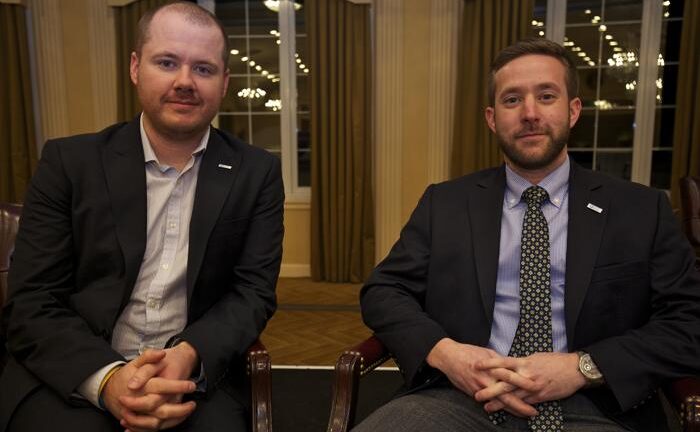
Long before Boston’s business and political higher-ups took on the task of bidding for the Olympics, the idea gained early traction under the direction of two young professionals.
Now that the bid has been dropped, and the dust has settled, they’re pretty disappointed with how things turned out.
“It wasn’t the best news,’’ said Corey Dinopoulos, who began pushing for a Boston Olympic bid in 2012. “It all came pretty suddenly, too.’’
“It’s been a long process,’’ added Eric Reddy, who met up with Dinopoulos that year and helped push the process along. “It was three years, non-stop. … It’s a breakup. It sucks.’’
In separate interviews, the two said they are both trying to take a positive approach in reflecting on the fate of the bid.
They cited connections and friendships they’ve made, pride that their idea made it as far as it did, and a hope that some of the ideas tied to the Olympics could still become a part of the city’s long-term planning efforts.
But they also have their regrets over how things went. For one, they both said, the request from the United States Olympic Committee to not involve the public in the national bidding process last year created an immediate uphill battle and trust issues with the public.
“You’re asking this organization which is semi-private, semi-public, to withhold a bunch of information to the public,’’ Dinopoulos said. “That wasn’t a good start. People had just lost the trust from the beginning.’’
They also regret that the idea of sports and spectacle were lost to the discussion, which instead focused on development, money, and politics. But they also said it was inevitable that these sorts of issues would come front and center for many people.
“The community thought talking about the excitement around the Olympic Games was distracting from the meat and potatoes—who’s paying for it? How am I going to get to work?’’ said Dinopoulos. “All of those things were at the forefront. A lot of the community issues brought up huge, huge social issues, of people not being able to afford housing. These are important things that cities need to talk about. So what’s the right balance?’’

An early Olympics venue plan put forward by Dinopoulos and Reddy’s group.
When Dinopoulos and Reddy were beginning to move their idea forward with state leaders, they held open community meetings with others who shared the goal of bringing the Olympics to Boston.
Among them was a sports marketing professional named Jake Duhaime. Duhaime holds a more critical perspective on the bidding process, and laid the blame for its failure at the feet of local bidding group Boston 2024.
Duhaime said he predicted as far back as early this year that decisions from Boston 2024, such as to pay former Gov. Deval Patrick $7,500 per day for consulting work, would hurt its credibility with the public. He also complained that nobody was held accountable for the poor start to the bid. He said Boston 2024 should have focused on building a staff full of Olympic and sports professionals rather than local politicos, and positioned itself more as a philanthropic, rather than economic development, plan.
“At some point, it became a very political game,’’ Duhaime said. “The USOC got duped into a very political game. In turn, the bid lost its soul.’’
Duhaime said he felt Boston 2024 should have focused more on Dinopoulos and Reddy, its grassroots founders.
“I call it a hijacking,’’ Duhaime said. “I’ll say what other people don’t want to say.’’
Dinopoulos and Reddy each distanced themselves from Duhaime’s comments, saying they felt sufficiently involved in Boston 2024’s plans. Reddy had a seat on Boston 2024’s board of directors and Dinopoulos provided freelance design work. They said the bid could not have gone as far as it did without the involvement of Boston’s power structure.
“Getting [former Boston 2024 Chairman and Suffolk Construction CEO] John Fish on board opened doors and led to conversations that had to happen,’’ Reddy said. “Conversations that would have taken us six months to get they could get in half an hour.’’
Dinopoulos, however, said it may have been beneficial to have more Olympics experience toward the top.
“I think going back to the inexperience in bidding for the Olympics, people didn’t always have the answer, and maybe it wasn’t the right way,’’ he said. “But I don’t think there is perfect way.’’
Since the bid was dropped, Dinopoulos has tweeted critically about the financial guarantee required by the International Olympic Committee, which holds host cities responsible for any Olympics cost overruns. The requirement became the primary criticism of the bid in Boston, and ultimately spelled its downfall.
The guarantee was a major criticism of No Boston Olympics, the opposition group—also led by young professionals—that took a prominent role in the city’s debate about the bid. Dinopoulos and Reddy hope to get drinks at some point with No Boston Olympics, who also argued that hosting the Summer Games were not the best route for solving some of the region’s problems.
“I’d love to hear some of their solutions to things,’’ Dinopoulos said.
[fragment number=0]
The major players in Boston’s Olympic bid
[bdc-gallery id=”107972″]


To comment, please create a screen name in your profile
To comment, please verify your email address
Conversation
This discussion has ended. Please join elsewhere on Boston.com