
They don’t need the Olympics…but they really want its most obscure venue
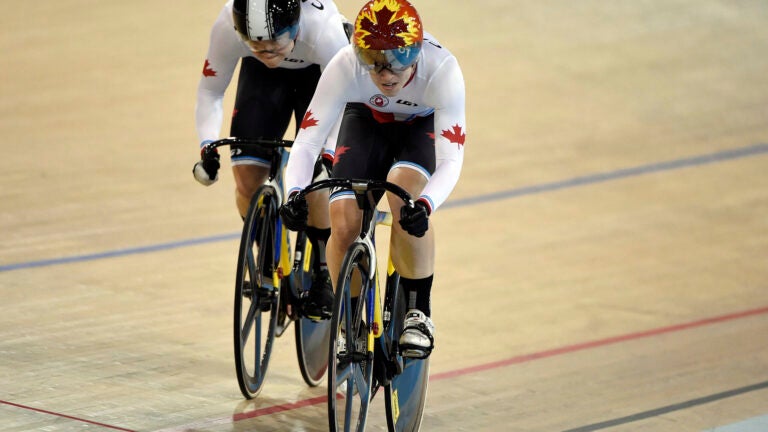
Opponents of Boston’s Olympic often point to the velodrome, a large indoor venue with a slanted track for cycle racing, as a silly and unnecessary project that emphasizes the difference between the needs of the International Olympic Committee and its prospective host cities.
It doesn’t help that bidding group Boston 2024 hasn’t figured out where to put the thing. Its original plan—to build a velodrome across the Mystic River, at Somerville’s flourishing mixed-use Assembly Square development—was nixed by that city’s mayor in January. Boston 2024 hasn’t found a new site yet.
The velodrome has been both a lightning rod in the city’s Olympics discussion and a challenge for Boston 2024. But there are actually people besides Boston 2024’s leaders who would want one—and who plan to pursue the idea, even if the Olympic bid goes nowhere.
“Our mission is to bring track racing back to New England,’’ said Pam Fernandes, founder of a group called New England Velodrome and Sports Complex, which aims to make a velodrome a reality. “Our project is going forward regardless of whether Boston would win the Olympic bid.’’
The plans are in the very early stages, Fernandes said. She and other cyclists have long wanted a velodrome, but the group only began meeting earlier this year. She said the Boston Olympic bid served as an impetus to get organized.
“It was a good time to do it, with the conversation about the Olympic Games,’’ Fernandes said.
Fernandes, a former Paralympic cyclist, said she has spoken once with Boston 2024. She said that if Boston winds up hosting the Olympics, it would probably make sense for the two organizations to try and work together.
“But there’s lots of ifs involved in that scenario,’’ she said. “We’re not planning on that happening, because regardless, we think a velodrome in the Boston area makes a lot of sense.’’
Instead, her group is focused on reaching out to the cycling community to grow support. They have filed for nonprofit status, and hope to begin fundraising relatively soon. As a nonprofit, they plan to eventually seek donations and grant money, and corporate underwriters, Fernandes said.
The plans are ambitious: Fernandes estimates that the cost of building an indoor velodrome would fall between $40 and $50 million. Indoor velodromes are more expensive, but Fernandes said an outdoor version would limit its use to the summer in New England. (Any velodrome built for the 2024 Olympics would also have to be indoor, to meet Olympic requirements.)
For comparison’s sake, Boston 2024 has projected costs of a velodrome at $68 million, wherever it may wind up. A newly built velodrome in Toronto cost $56 million for this summer’s Pan Am Games. For the 2012 Summer Games in London, the venue cost closer to $150 million.
Fernandes’s timeline is ambitious, too. She’d like to see a velodrome project started within five years. Her group is in the process of drafting up a five-year plan, she said.
At this point, the group hasn’t talked about possible locations. Massachusetts would be the first choice, Fernandes said, and Greater Boston would be ideal because of its public transit access. The first step is to engage the cycling community about the project, and early meetings drew about 50 cyclists to talk about the idea, she said.
Adam Myerson, a professional cycling racer and coach unaffiliated with Fernandes’s group, has some experience in trying to set up a velodrome in Massachusetts—albeit at a much smaller scale.
About 10 years ago, he sought to open a velodrome in Western Massachusetts, and led a group that bought a portable structure for cycling racing. However, he was unable to find a property on which to put it, or a person to run it. After a few years, the idea fizzled out.
Myerson thinks it’s crucial that an Olympic-sized velodrome project, in contrast to his smaller effort out west, be located in the Boston area to sustain itself with a larger population. He envisions a track that can be put to use by locals and for community cycling programs.
An outdoor New Hampshire cycling track converted from a former go-kart track, closed a couple years ago. It’s the closest thing New England cyclists have had to a velodrome for many years. AJ Moran, another Boston-based professional cyclist who would like to see a regional track, said its distance from Boston likely helped lead to its demise.
But advocates think that if a velodrome is built closer to the city, it could have commercial success—especially if it’s up to international standards.
Moran said it could have significant tourism value, allowing the region to host major cycling races, drawing both athletes and spectators. These are niche crowds, to be sure, but the United States boasts few professional quality cycling tracks. One here could draw on that niche at a national and global level, he said.
Moran said a velodrome could also make money outside of cycle racing, through concerts and other events, or from renting retail space at the ground level.
In London, the velodrome has become the centerpiece of a larger cycling complex, a “velopark’’ complete with mountain bike trails and the Olympic BMX course.
Boston 2024’s original plan for Somerville seemed to put a similar spin on making the velodrome a key fixture of a cycling hub, as its early bid read: “A permanent velodrome and BMX track will be the anchor for an evolving path of bike trails on the banks of the Mystic River that will soon stretch from the Berkshires to Boston Harbor.’’
At this point, though, the Olympic bid is of secondary concern for those interested in bringing a velodrome to Boston.
Myerson said he even has concerns about Boston 2024’s approach to the cycle track quandary. Boston 2024 has suggested it could ultimately go with a temporary velodrome, or convert the track into something else after the games. To Myerson, that would be a disappointment.
“We need a track for after the Olympics,’’ he said.
While he’s still hopeful Boston 2024 could be a “lever’’ to create the velodrome, Myerson said he understands and even shares some of the concerns of bid critics.
“There are a lot of strong arguments for why we might not want to host an Olympics in Boston,’’ Myerson said.
But he wants the opponents to leave the velodrome out of it.
“This is something we want to do, Olympics or not,’’ he said.
Boston before and after the Olympics
[bdc-gallery id=”115186″]




To comment, please create a screen name in your profile
To comment, please verify your email address
Conversation
This discussion has ended. Please join elsewhere on Boston.com