
Remembering those who gave a gift, after they died
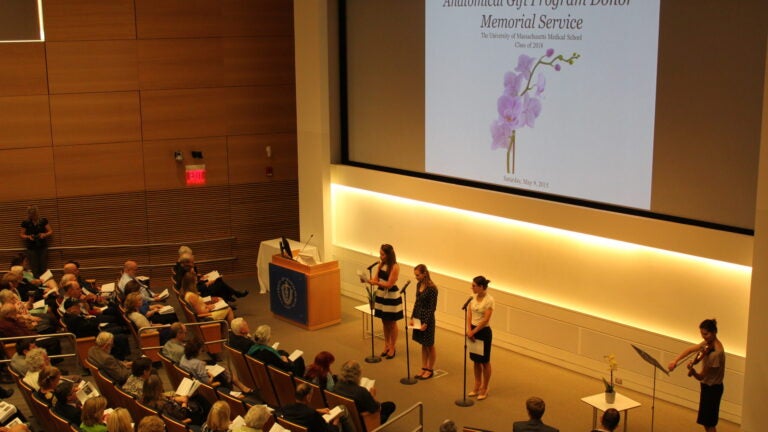
Peter Grose took to a podium the second weekend of May to remember his dad. He recalled Robert Grose, body part by body part.
First came Robert’s lungs, which “enabled him to hold his breath underwater.’’ That, his son said, “impressed my mother.’’
He talked about his dad’s strong shoulders, which “carried around giggling children.’’ And his arms, which “dispensed hugs of joy and consolation.’’
His hands gave out candy, and his legs “took him on hikes big and small.’’ His gastrointestinal system “took on quite a variety of foods,’’ and his brain could complete crossword puzzles without seeing them—he just needed to be told the clues and the number of letters.
Finally, his mouth was the source of “encouraging words and lots of good questions,’’ and toward the end, when Robert was suffering from dementia, it was how he was “redeemed by smiles.’’
Grose was one of several speakers at the service. And his father—who died a year prior—was one of more than 130 to be remembered on May 9 by the class of 2018 at the University of Massachusetts Medical School. The service was held in memory of the anatomical donors whose cadavers had been explored, piece by piece, over the last several months in anatomy class.
Lab work on a dead body is considered a rite of passage for medical students, and it brings its share of emotional, mental, and physical challenges. Terence Flotte, dean of the school of medicine, referred to the donors as the students’ “first patients.’’
UMass medical students remember their donors each year, a tradition that dates back to 1970, according to a spokesperson. The service is held the spring after students take anatomy, which this year ran from late September to the end of February. For both the students and the families who attend, it’s an opportunity to reflect on the decision the donor made to give his or her body to science.
“I doubt I will ever have a patient who believes in me more,’’ Yevin Roh, a member of the class of 2018, said during the service. Roh said he would try to remember the donor he had studied during difficult points in his career, telling him, “’I believe in you. … That’s why I donated my body to you.’’’
The memorial service drew more than 350 family members and loved ones of donors to an auditorium at UMass Medical’s Albert Sherman Center. At the end of the service, as the family members filed out of the auditorium, the 125 members of the class of 2018 met them at the door with applause.
During the ceremony, Dr. Lawrence Whiting recalled the enthusiasm his wife Laura, who worked as a nurse before she died, had expressed for donating her body. “She loved that after 43 years in the medical field, she would at last go to medical school,’’ he said to laughter.

A man leaves the UMass service with a centerpiece offered by the school.
The joke was fitting at a service where the tone was more celebratory than sad. However, it was not without its tears, and for some, it served as another step in the grieving process.
“There are some sorrowful feelings,’’ said Anne Hazzard of Amherst, whose mother Jean Hazzard donated her body after dying in 2013.
Hazzard and her sister Ruth, who also attended the service, remembered their mother when she died, and experienced another moment of closure upon receiving her ashes from the medical school earlier in the year. After the anatomy course concluded, donors were cremated, and their remains were given to families well in advance of the service.
The memorial service offered another opportunity for the sisters to say goodbye.
“There are pros and cons to drawing it out,’’ Hazzard said. “Grieving doesn’t stop at a certain point. It’s helpful, with different steps, different ceremonies.’’
John Peters was another attendee at the service. His partner of 29 years, also named John, had decided before they met that he would donate his body to science once he died.
Like the Hazzards, Peters, who is from Worcester, said the service gave him a sense of further closure. But he said it had another effect on him. Peters isn’t quite sure what he plans to do with his own body when he dies, but the ceremony “moved me along in my own personal decision making.’’ He hasn’t made a decision, but he said he’s now “closer than I was a week ago’’ toward going the medical donation route.
Corinne Ainsworth, a member of the class of 2018 who was the lead organizer for this year’s service, said planning began in March, shortly after the anatomy course ended. While students had some support from the school’s faculty and staff, they were responsible for arranging the service.
Ainsworth echoed other students in saying she was struck during the year by the amount of trust donors and their families put in anonymous medical students.
“We do a lot to the bodies,’’ she said. “We explore every inch of the body. … It’s such a privilege that these people have put this trust in us.’’
The anonymity goes both ways. At the start of the course, students are told their donor’s first name, last initial, and cause of death, Ainsworth said. They are not told much more.
Families, meanwhile, are not told which students are working on their bodies. In fact, because students are assigned in groups of four or five per body, not every donation is put to use during the anatomy class, Ainsworth said.
Some families managed to connect with the students who had worked on the bodies of their loved ones at a reception following this year’s ceremony. Ainsworth described those interactions as “really positive.’’ Students also learned a little more about their donors ahead of the service through biographies and pictures, which most families submitted for inclusion in a printed program.
Well before that, though, Ainsworth said students formed an “intangible connection’’ with the donors during lab work that is “really hard to describe.’’
UMass is not the only school to hold a ceremony for donors. The state’s other medical schools—Tufts, Harvard, and Boston University—also hold annual memorials, as do many medical schools across the country. Jessie Paull, a student at Tufts, tried to zero in on the intangibles mentioned by Ainsworth.
“It’s very powerful,’’ Paull said. “I don’t consider myself a spiritual person, but you can feel the human condition looking at these people. Indentations where wedding rings used to be, scars, tattoos, painted nails.’’
Peter Grose, who spoke at the UMass service, said in an interview that students and donors’ families may have a similar mindset during the process. If students, he said, are interested in learning more about donors’ lives, family members are equally interested in sharing the information. “We’re reaching out on parallel tracks,’’ he said.
The donor’s life and death separate those tracks, but they don’t run far apart. Before he left the podium at UMass, Grose thanked his father “for putting that good mind, body, and spirit to use—for all of us.’’

Students applaud in gratitude to family members as they leave the memorial service.


To comment, please create a screen name in your profile
To comment, please verify your email address
Conversation
This discussion has ended. Please join elsewhere on Boston.com