
They Call Him the Priest of Sin
Few people know the gambling industry like Rev. Richard McGowan.
In El Salvador, where he travels a few times a year for missionary work, Rev. Richard McGowan is called “Padre Pecado’’—or, the Priest of Sin.
Don’t get the wrong idea: McGowan isn’t Nathaniel Hawthorne’s Rev. Dimmesdale. But as a leading expert on the economics of tobacco, alcohol, and especially gambling, the Jesuit priest and professor at Boston College puts much of his time into the study of vice.
McGowan can be regularly found in the middle or closing paragraphs of newspaper articles, both local and national, offering perspective about the casino industry and public gambling policy.
He’s served as a consultant to help states explore casino and lottery regulations, with his pay for the work going to the Jesuits at BC and in El Salvador. “I did take a vow of poverty,’’ he said. (McGowan sits on the board of the Massachusetts Council on Compulsive Gambling. He has not done any work with the Massachusetts Gaming Commission, according to a commission spokesperson.)
He’s also a regular at big gaming conferences, though he doesn’t always love the setting. “I hate Vegas,’’ he said.
That sort of colors McGowan’s perspective on gambling in general. “I like studying why people gamble,’’ he said. “But I myself am bored to death [by gambling].’’
That’s not a strictly religious thing. While the Catholic Church tends to be anti-casino, arguing the industry can have adverse effects on casinos’ host communities, its position on the actual act of gambling is a bit more nuanced. (Hey, it’s Catholicism after all.) Look no further than basement bingo at a local parish to understand that the church considers gambling an OK thing to do in moderation, which is similar to its position on alcohol.
When it comes to studying gambling, alcohol, tobacco, and the like, McGowan considers himself an “observationist.’’ He acknowledges that there’s some irony in studying things that, even if not decidedly sinful by the church’s standard, are generally seen as opposed to its values. But that’s part of the point of the Jesuits’ scholarly mission, he said.
“We’re men of the church, but we’re expected to be on the margins of the church,’’ he said. “Do I wish we didn’t have to have casinos? Probably. But to be realistic, they’re going to be here.’’
McGowan tracks the gaming industry and has a lot of thoughts about the nascent Massachusetts casinos. “I don’t see the sense of [a southeastern Massachusetts casino],’’ he said. He added: “The thing about Steve Wynn [who is licensed to build a casino in Everett] is that he always delivers.’’
Most of his work—on gambling and other vices—has centered on how public policy and the relevant industries interact, such as how cities and towns benefit from state revenue derived from the lottery, or the economic effect of excise taxes.
He is also interested in questions with less tangible answers, such as how states deal with potential consequences from the vice industries, like addiction. “The real problem for policy makers are the social costs,’’ he said. “How do you measure them?’’
Aside from his research, McGowan has dual public speaking roles as both a teacher and a priest.
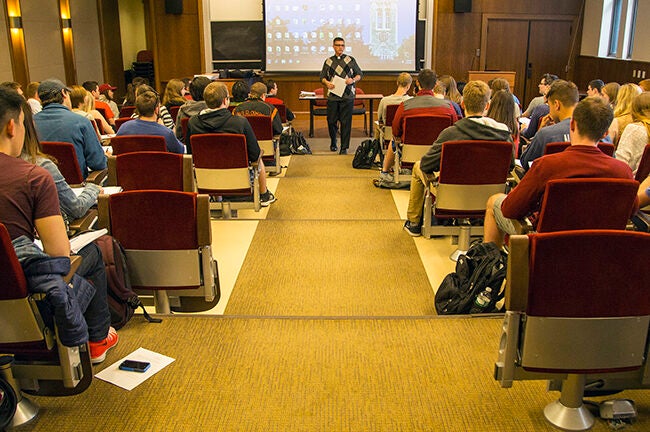
At BC, he’s a chalk-and-chalkboard type of professor who distributes printed worksheets at the start of class. In one course this semester, he peppered statistics students with mathematical word problems, many of which were about marijuana, alcohol, or gambling. Prior to the class, he and a student chatted about legalized recreational marijuana. “It’s interesting. Legal pot in Colorado—just to get high,’’ McGowan said. A few minutes later, after class had begun, McGowan’s lesson turned toward gambling. “In a casino game, the odds are always stacked against you,’’ he told the class.
Outside of the classroom, McGowan says a daily Mass at St. Mary’s Parish in Winchester. He’s said it for more than 15 years, and he recognizes most of the 40 to 50 faces who speckle the pews daily at 6:45 a.m. He can knock the Mass out in under 20 minutes, complete with a two-minute homily. “It’s a to-the-point liturgy, thank you very much,’’ he said. That’s to his benefit, he said, as traffic back to BC on a weekday morning can be brutal, especially if he has class. Still, he values the time away from academia. “It’s a good way to start the day,’’ he said.
His missionary work brings him three times a year to El Salvador. It focuses on microfinance projects, which help locals secure funding to start small businesses such as chicken or cocoa farms. He also teaches in stints at a university in El Salvador. Locals who have gotten to know him, and who are familiar with his research, anointed him with the “Padre Pecado’’ nickname.
McGowan was born in 1952 and was raised near Philadelphia. “I knew I wanted to be in the church, and I knew I wanted to teach,’’ he said. His Jesuit high school experience, at St. Joseph’s Preparatory School in Philadelphia, further cemented that. “This is a good combination for me,’’ he said.
The economics path was a little less foreseeable, he said. A big Philadelphia sports fan, McGowan played baseball as a kid. “I was a halfway decent player until I saw a curveball,’’ he said. The game also helped to build on his interest in math. However, “I knew I didn’t want to do proofs the rest of my life,’’ he said. Economics allowed him to marry an interest in public policy and history with his appreciation for numbers.
McGowan started down his road of vice research in the 1980s, while teaching for a summer at Georgetown. He was considering ideas for his own dissertation. Wandering in Washington, D.C., he entered the federal Bureau of Alcohol, Tobacco, Firearms, and Explosives (ATF) and pulled data on cigarette sales by brand over a 20-year period. That served as the bedrock for a dissertation—which later turned into a book—about public policy and the tobacco industry.
McGowan received his doctorate in 1988 from BC’s cross-town rival, Boston University. He has taught and lived on campus at BC since that year, at the direction of the Jesuits.
After getting to BC, McGowan moved on to similar work about the alcohol industry. In the early ‘90s, he began researching the Massachusetts lottery and eventually the broader gambling industry.
He said legalized marijuana would make sense as another avenue to explore, and that he will do so in a chapter of an upcoming book. His early opinion is that if states are going to legalize it, they should sell it directly, similar to lottery games.
What other vice industries might he delve into?
Some things are off-limits—such as prostitution. “I draw the line there,’’ he said. “There, I agree with Mother Church 100 percent.’’
But even setting morality aside, there would be another issue with that line of economic inquiry, he said: “Where the hell am I going to get data?’’




To comment, please create a screen name in your profile
To comment, please verify your email address
Conversation
This discussion has ended. Please join elsewhere on Boston.com