
Neighborhood Concerns Raised at Back-to-Back Boston Olympic Meetings
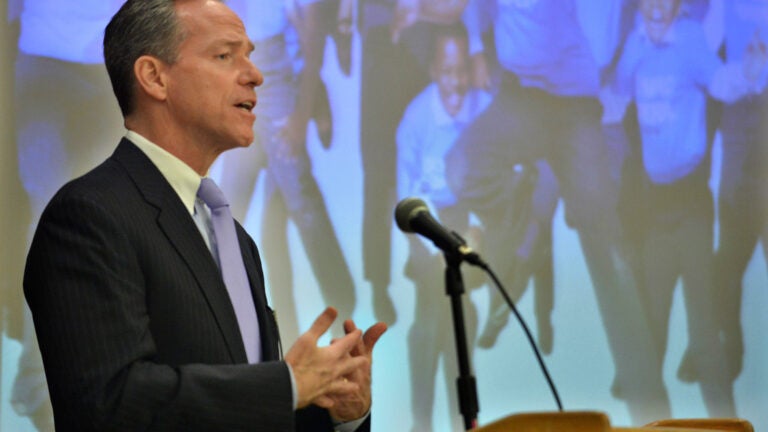
Boston’s Olympic bid was the subject of back-to-back public meetings Monday and Tuesday: the first in Roxbury, the second in South Boston. Through the prism of the Olympics, the two neighborhoods play very different roles in the plans. Boston 2024’s bidding documents use the term “South Boston’’ 109 times. “Roxbury’’ doesn’t appear once.
But residents from both neighborhoods came to this week’s meetings with a similar question: How would this plan affect our neighborhood?
South Boston has been touted as a focal point of the proposed 2024 games. Though plans are subject to change, as things stand now, the neighborhood would host the Olympic stadium site—which would later be transitioned into a mixed-use development—at Widett Circle. It would also see new construction in the Fort Point area for media and broadcast centers. Dorchester Avenue would serve as an “Olympic Boulevard’’ near the stadium. And just over the Dorchester line, an Olympic Village would be built at Columbia Point. Meanwhile, multiple competitions would be held at the Boston Convention and Exhibition Center, and sailing would be staged out of Castle Island.
Roxbury, meanwhile, has far less of a role in the plans. A few events would be held between White Stadium and the rest of Franklin Park, which is bordered by Roxbury, Jamaica Plain, Mattapan, and Dorchester. Boston 2024, the private group organizing the city’s bid, has said the park will be in for a big makeover as a result of the hosting the Olympics, but has otherwise offered little in how the games would affect Roxbury.
During Monday’s meeting, several Roxbury residents pressed Boston 2024 officials about what the community could expect to see. One resident said that other big events in the city rarely focus much on Roxbury. “It seems like we’re always left out,’’ he said.
Boston 2024 CEO Rich Davey said there would be opportunities to involve Roxbury in the Cultural Olympiad, a series of arts-based events connected to the Olympics; that any new development that springs from the games could ultimately help to lower property taxes across the city; and that many of the housing units at the proposed Olympic Village are being thought of as modular, with the ability to be moved to other parts of the city after the games. Boston 2024 chair John Fish piped in to say there would be more than 100,000 jobs and volunteer positions associated with the Olympics.
Another Roxbury resident, Benjamin Jackson, classified Boston 2024’s answers as “nice words’’ absent of “significance,’’ and asked for ’’solid statements’’ about how the community would benefit. For example, he asked, how many jobs would be paid? Davey said he couldn’t offer a breakdown at this point. Jackson also pushed for a guarantee that construction jobs would be union positions, to which Fish said thiswas the “intent.’’
Others at the Roxbury meeting pushed for ways to involve youth athletic programs in the plans and efforts to involve small businesses in the bidding process. One woman pointed to printouts that are being used by Boston 2024 at the meetings and asked whether any consideration was given to using a local or minority-owned business to handle the printing. Another resident reminded the Boston 2024 panel that Roxbury is close to the geographic center of the city.
The next night in South Boston, residents pointed to all of the proposed Olympics-related construction in the neighborhood and voiced their own concerns.
Would building the new broadcast and media centers near the Boston Convention and Exhibition Center hurt housing and other development initiatives in the area? (“This is a conversation we’ll be having over the next year and a half,’’ said John FitzGerald of the Boston Redevelopment Authority, speaking to the broad discussion of how the bid meshes with the city’s long-term plans.) Who will own the land around the stadium once the games are over? (To be determined, FitzGerald said.) Will jobs at the New Boston Food Market in Widett Circle be lost if the companies that make up the co-op are moved, so a temporary stadium can be built there? (No, the businesses would be moved to a new site, Davey said.) Would Olympic House of Pizza on Broadway need to change its name due to trademark issues? (We haven’t considered that issue but don’t think so, Davey said.)
Other Southie residents took note of how the plans are heavily concentrated in the neighborhood. “Boston will be the host, but really South Boston will be the host community,’’ one woman said. “What would be the long-term benefits for South Boston?’’
“It’s all South Boston,’’ another man said. “We want to be mitigated.’’ He went on, alluding to the neighborhood’s fight to prevent Robert Kraft—who is involved in the Olympics bid—from building a New England Patriots stadium in South Boston. “We spent 25 years fighting a stadium. … If they were putting that stadium at Suffolk Downs, it wouldn’t bother me,’’ he said.
Boston 2024 is handling most questions about venue locations by saying it is in a proof of concept phase, and that the input from these meetings will ultimately inform its full bid. However, Davey has said that venues like the stadium and the athlete housing are “preferred’’ options that would be more difficult to move than other parts of the plan.
The two meetings this week were similar in format. Boston 2024 gave a presentation about its plans, then opened it up for questions and answers. (Monday’s meeting was hosted by Boston 2024 and Tuesday’s by the city, but that is a distinction with a limited amount of difference: While the mayor and city officials are not present for the Boston 2024 meetings, Boston 2024 officials present their plans and handle many of the questions at the city meetings.)
About 100 people showed up for the Roxbury meeting, and more than 300 came out in South Boston. Each meeting was open to the broader public and featured some questions that extended beyond community-specific issues. They each had their share of Olympic bid enthusiasts. Some at the Roxbury meeting said they hoped tickets for a Boston Olympics could be reserved for students, and the South Boston crowd, judging by reactions, seemed to feature majority support. (Massachusetts native Dave Silk, who played for the 1980 ‘Miracle on Ice’ hockey team, got a big cheer and a “USA’’ chant when he showed off his gold medal in Southie.)
But even with questions that indicated support, both meetings were heavily characterized by the concerns of the communities in which they were held, underscoring that the Boston Olympics discussion isn’t just about the fate of the city as a whole, or the region. It’s also about its neighborhoods.



To comment, please create a screen name in your profile
To comment, please verify your email address
Conversation
This discussion has ended. Please join elsewhere on Boston.com