
Lots of People Gave Money to Both Coakley and Baker—Why?
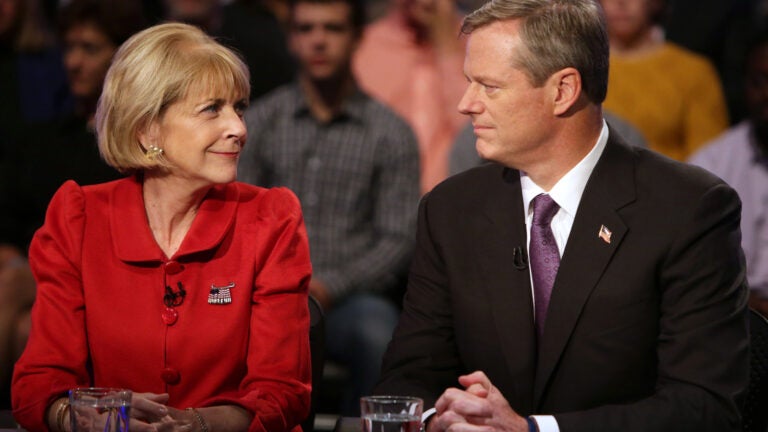
If you spend your time poring over campaign finance records for Democratic gubernatorial candidate Martha Coakley and her Republican rival Charlie Baker, you might notice something interesting: some names show up on both lists.
From executives at Associated Industries of Massachusetts, to leaders at EMC and State Street, to lawyers with major firms like Ropes & Gray, to lobbyists working with companies as vast as Verizon…the Coakley and Baker campaigns have each collected money from dozens of donors playing both sides of the field.
They aren’t particularly common, with their donations representing a tiny percentage of total funds raised on either side. We found about 50 donors who have given to both Coakley and Baker since they announced their respective bids for governor last year. That number jumps above 80 if you stretch to the start of 2013, when the two were pretty well expected to run. (Those numbers are almost certainly incomplete, because the program we used to parse the Office of Campaign and Political Financing’s databases could not pick up on some discrepancies in the two candidates’ filings. This method also only looks at campaign funds, and excludes PACs and other forms of political spending.)
So, there aren’t a ton of people giving a lot of money to both candidates. But at all levels of government, it is an election-cycle norm for a handful of donors to find themselves floating each way. For instance, some of those who have donated to both Baker and Coakley also donated to both Baker and Deval Patrick in their 2010 race. Many also donated to Steve Grossman’s campaign over the last two years, as the outgoing state treasurer vied for the governorship before losing to Coakley in the Democratic primary.
What’s the point? At its base, the reason to go both ways is obvious enough: some donors want to hedge their bets to gain a little bit of influence on Beacon Hill, regardless of who winds up elected governor. Money, after all, is plenty green on both sides of the fence.
“They don’t view it as canceling themselves out,’’ says Massachusetts politics expert Peter Ubertaccio, of Stonehill College. “They see it as an investment in the future of their own firm and own interests.’’
Ubertaccio says the tactic is one usually employed by donors who are not strongly ideological themselves, and who are going to need to work with whoever it is that winds up in the corner office.
Boston.com contacted more than a dozen people who donated to both campaigns, and almost all of them refused to discuss their political donations or did not return the call. One, however, was willing to speak on the condition of anonymity. That donor said he doesn’t much care about politics. He has connections who do, however, whom he aims to please. “Usually, if I donate, it’s because somebody’s asked me to,’’ he said.
Even with the politically connected, this line of thinking is common, says James Chisholm, a campaign veteran and former chief of staff for Boston City Councilor Ayanna Pressley, who now works for Resolute Consulting.
To your typical voter or donor, the idea of giving to both sides might seem either pointless or kind of shady. But Chisholm says that ignores the perspective of the type of donor who’s likely to do so—the attorneys, lobbyists, and execs who brush shoulders with politicians regularly, regardless of who’s in office. He calls them “professional’’ donors.
If you’re one of them, both sides are going to invite you to fundraisers and ask you to donate, and frankly, you’re going to have the cash to do so. You’re an insider, and this is a cost of doing business.
“You have to invert the way you look at it,’’ Chisholm says. “It’s more (a question of) how do you say ‘no’? … If you’re part of that world, you’re expecting to be asked.’’



To comment, please create a screen name in your profile
To comment, please verify your email address
Conversation
This discussion has ended. Please join elsewhere on Boston.com