
Made in Mass.: Cape Cod Potato Chips
-

Cape Cod has many lures: sunshine, beaches, and quaint shops. One of the top attractions on the Cape is the Cape Cod Potato Chips factory in Hyannis. The company has operated at that site for more than 30 years and receives more than 250,000 visitors per year. Cape Cod Potato Chips employs about 100 workers in Hyannis. Pictured: The latest Cape Cod Potato Chips’ brand, Chef’s Recipe, in the company store.
-

Cape Cod Potato Chips commands 60 percent of the kettle chip market in New England. How can you tell if you’re eating a kettle chip? They tend to be a thicker than the traditional chips and crunchier in texture. Cape Cod competes with Lay’s and the Kettle brand chips for the top seller spot in the nation. The brand is worth $205 million, according to plant manager Jeff Newell. “The characteristic Cape Cod potato chip is a golden chip with a nice crunch, strong potato flavor, with light salt, and low oil content,” Newell said.
-

The production facility runs all day, typically five to six days per week, depending on whether it is high season from mid-April to the middle of September. Five truckloads of potatoes arrive daily. Each one contains about 50,000 pounds of potatoes.
-

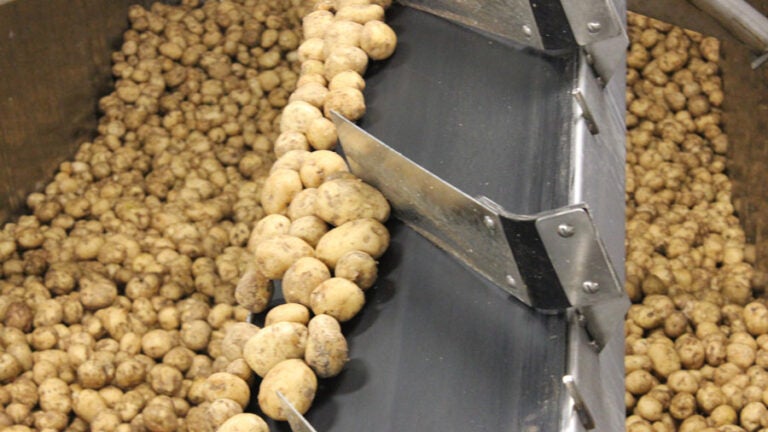
The company follows the growing cycle of the potato when purchasing spuds. This time of year, the company receives potatoes from a farm in North Carolina. Western Massachusetts and New York provide the potatoes in August and September. Their biggest supplier is from northern Maine, and they receive the storage potatoes from October through June. The Spudnik, left, potato unloader is the starting point for the chip production.
-

Potatoes are taken from the truck onto a conveyor belt and are held in storage bins. Each bin contains one truckload of potatoes.
-

The horizontal segmented peelers remove the skin of the potatoes before they are examined by Ernest Wilkerson, a pare and trim inspector. A “bad” potato could have bruises, an external green look, or are the wrong size. The optimal potatoes are around 4 inches.
-

The peeler measures the potatoes into a particular batch size. Then, the potatoes are sliced at 257 revolutions per minute.
-

Next, the conveyor brings the sliced potatoes into the kettle. Newell said all temperatures and time spent frying are automated to an extremely high temperature.
-

Cape Cod Potato Chips runs both their original and newly installed kettles to fry the potato chips. The company has used canola oil for frying their chips since the company began.
-

A close up of the potato chips sizzling in the kettle.
-

The kettle-cooked chips travel on the conveyor line as they are cooled and salted.
-

If they are to become flavored chips, topical seasoning is added in the tumbler. In the photo, the barbecue-flavored chips are seasoned. The sea salt and vineagar chips have always been the company’s most popular seasoning, Newell said. “Traditional flavors like barbecue and sea salt have been around a long time and will be around a long time,” he said.
-

Two conveyors bring the product to five high-speed packaging machines.The bagged chips are both manually and automatically packed into the shipping boxes.
-

The automatic machines package the chips into shipping boxes. The reduced fat chip is the company’s bestselling variety.
-

Customers browsed the company store after taking a tour. The tours are free and include chip samples.



To comment, please create a screen name in your profile
To comment, please verify your email address
Conversation
This discussion has ended. Please join elsewhere on Boston.com