Why do right whales keep dying off Cape Cod and Canada?
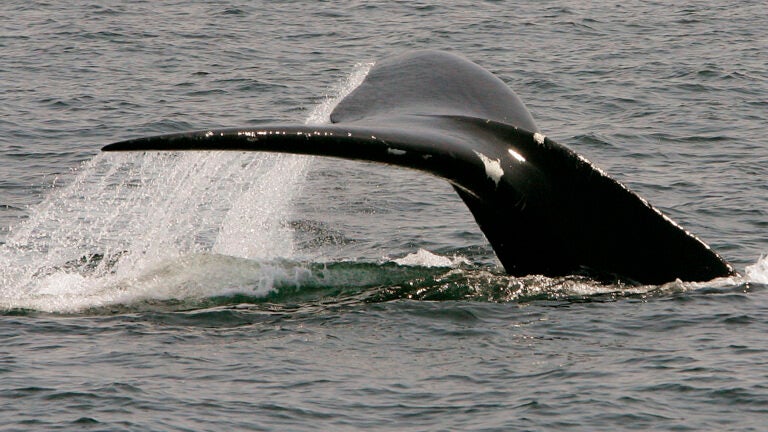
In an alarming trend for one of the most endangered large whales in the world, a North Atlantic right whale carcass was found Monday on Nashawena Island, south of Cape Cod, according to a post by the International Fund for Animal Welfare. It marked the 16th known death this year in U.S. and Canadian waters.
https://www.facebook.com/ifaw/posts/10155840116505365
“If this turns out to be yet another mortality, it is another disaster that adds to a very sad and increasingly depressing story about the right whale,” Charles “Stormy” Mayo, a right whale habitat expert at the Center for Coastal Studies in Provincetown, told the Cape Cod Times.
In the annual report from the North Atlantic Right Whale Consortium, published in October before the latest death, there were nine right whale deaths this year in Canada’s Gulf of St. Lawrence, three off Newfoundland, and three off Cape Cod. The Consortium coordinates research efforts and recommendations for right whale conservation.
Researchers estimated there were 451 living right whales as of Sept. 1. The “unprecedented” number of mortalities in 2017 represent about 3 percent of the total population.
The recent string of deaths, along with the decline in reproductive output by 40 percent since 2010, “threatens the very survival of this species,” according to the report. Entanglement — often in fishing equipment — has factored into 85 percent of known deaths since 2010, including seven of the deaths so far in 2017. Vessel strikes have been implicated in at least six deaths in Canadian and U.S. waters since May 2016.
The International Fund for Animal Welfare wrote in its post that it is working with the National Oceanic and Atmospheric Administration to determine the cause of death for the whale found this week.

Researchers examine a dead North Atlantic right whale along the Gulf of St. Lawrence in Canada in June.
Marine authorities in the U.S. and Canada declared the recent series of deaths an “unusual mortality event” in August, triggering a “focused, expert investigation” into the causes of the deaths. Strategies to protect whales include modifying fishing equipment, restricting ship speeds, and changing shipping traffic patterns.
New guidelines were introduced at two major sailing competitions in July after racers collided with whales the previous year, The Associated Press reported. Race crews were given customized information about where whales were likely to congregate along the courses.
This past summer was the worst season for right whale deaths since hunting them became illegal, biologist Regina Asmutis-Silvia of Plymouth-based Whale and Dolphin Conservation told The Associated Press in August. Populations have only rebounded slightly since they nearly became extinct during the whaling era in the 19th century.
“I just don’t know that right whales have time for people to figure it out,” she said. “They need help now.”