More bears are coming to Eastern Massachusetts. Here’s what you need to know.
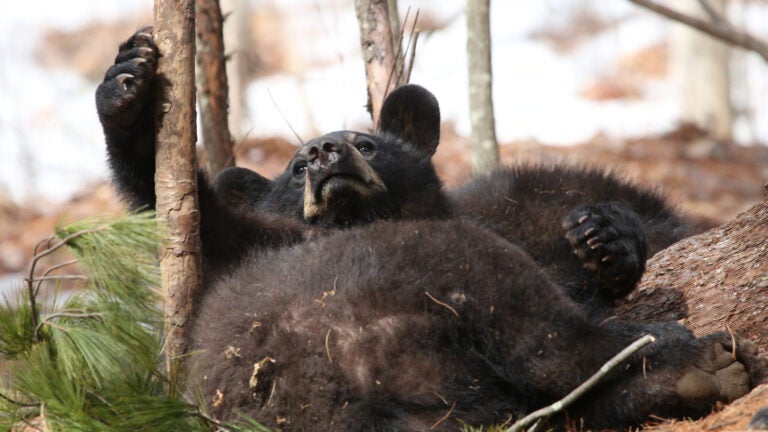
It’s not just New Hampshire.
Wildlife experts in Massachusetts say black bears are expected to become more of an issue in the more densely populated eastern half of the state.
“Bears are moving east and this problem is not going to go away,” Massachusetts Division of Wildlife and Fisheries Director Jack Buckley told the Boston Herald earlier this week, outlining new protocols the state is preparing to deal with bear attacks. Last summer, The Boston Globe reported that the black bear population in the state had increased from 100 in 1970 to an estimated 4,500 — and was expected climb even faster.
There was a time when bear encounters were only a worry to campers and residents in the most rural regions of the Bay State. That now has changed.
“The population is definitely growing,” Dave Wattles, a black bear and furbearer biologist for MassWildlife, told Boston.com, adding that suburban sightings are on the rise.
What is causing this?
According to Wattles, state officials have begun getting consistent reports of sightings in the region between I-495 and I-190, as bears continue to push eastward. This “newly established range,” he says, is simply due to the fact that the population is moving toward lower-density lands (in terms of wildlife), which can support more bears. Earlier this year, scientists in New Hampshire and Vermont reported an increase in starving cubs, partially due to a food shortage in the area.
Wattles says the outer edge of the new bear territory in Massachusetts essentially runs north and south down I-495, where most bears tend to be young males who can’t compete with mature males in the established area. The rare bear found any further east than that — for example, the one that wandered all the way to Cape Cod and Brookline in 2012 — are young males making an “exploratory run,” he said.
On multiple occasions, state officials have shot bears out of fear of potential traffic accidents. In May, police tranquilized a 100-pound, 1-year-old male that had wandered into a residential neighborhood in Lawrence.
What should residents do?
“The number one thing that we need people to do is to remove the human-associated food sources,” Wattles said. For residents, that means taking down bird feeders and securing outdoor garbage and compost.
Waddles recommends using bird baths or native flowering species as alternative means of attracting birds. In fact, MassWildlife has an entire webpage devoted to tips for how homeowners should make their neighborhoods less attractive to bears.
For businesses, it means properly managing dumpsters, which bears will eagerly climb into for a meal.
“They’re going to exploit those easy, high calorie meals whenever they can,” Wattles said.
Last weekend, New Hampshire officials trapped and relocated three bears in Hanover, who had become local mainstays — attracted to the abundance of unsecured garbage in the college town. The situation eventually escalated to the point where the bears had even entered a family’s home in search of food, which Wattles said was a sign the mother bear had taught her cubs to be unafraid of humans.
The state was planning to euthanize the emboldened bears, but ultimately decided against it amid opposition from local residents and the state’s governor.
“We don’t want to have the Dartmouth outcome occur,” Wattles said. “And that is the result of bears becoming increasing habituated to people.”
What should you do if you see a bear in your neighborhood?
Wattles emphasizes the fact that a suburban bear sighting is no emergency.
“Give the bear space,” he said, adding that the bear will likely leave the area on its own.
For particular close, face-to-face encounters, MassWildlife recommends talking to the bear in a calm voice and slowly backing away.
“From a safe distance, make loud noises (for example shouting or banging pots and pans) to deter the bear from the area,” says the state’s detailed tip sheet for bear encounters.
In the case the bear follows or becomes aggressive, MassWildlife suggests, “stand your ground, make yourself look bigger, shout at the bear, threaten the bear with whatever is at hand (bang a stick on the ground, clap your hands), and prepare to use bear pepper spray if it is available.”