

Get a little love in your inbox!
Sign up for the Love Letters newsletter for announcements, hand-picked letters, and other great updates from the desk of Meredith Goldstein
More than 17 years ago, I started Love Letters, a relationship advice column on Boston.com and in The Boston Globe.
Since then I’ve read thousands of questions about dating, breakups, friendship, divorce, crushes, family, marriage, and all of the awkward feelings one can experience as a human (myself included).
I am grateful to people who send these anonymous letters, because when a person shares a problem, they often wind up helping people who are experiencing and struggling with the same things.
The column expanded, and we launched a “Love Letters” podcast, where people share stories about their relationships. Episodes have included the one about a woman uses karaoke to get over a breakup; the one about a man who turns 40 and builds a ball pit for himself in his basement (much to his wife’s confusion and dismay); and the one about a woman who found a perfect love in Paris only to realize it would be difficult to ever come home again.
The letters, and then the podcast, made me wish for something even bigger. Specifically (drum roll) …
a Love Letters phone booth.
Hear me out.
Phone booths have long been magical to me.
I grew up watching Superman, who changed into his costume in a phone booth, becoming the hero he was always destined to be. In the movie “Bill & Ted’s Excellent Adventure,” Bill and Ted use a phone booth to travel through time.
I’ve heard Dr. Who can do plenty with a phone booth.

In the comedy “Anchorman,” Will Ferrell’s character, Ron Burgundy, tells a friend that a phone booth is a “glass case of emotion” – because he’s crying inside of it.

It was a good joke, but it was also true! Phone booths have always seemed to offer privacy and anonymity.
A few years ago, I asked myself: “How can I make this magic phone booth come to life?”
That’s when I called the Boston Public Library.
Why?
Libraries are where we go to share and receive stories.
Libraries are where we can get emotional about everything, from a fictional character’s plight to an upcoming exam that brings us to a quiet room to study.
Libraries are where we keep records of past experiences.
Libraries help us find a path out of loneliness – for free.
They’re where we seek answers to questions.
I was thrilled when I called the library and told staff my phone booth idea, and they said, “That sounds … very cool.”
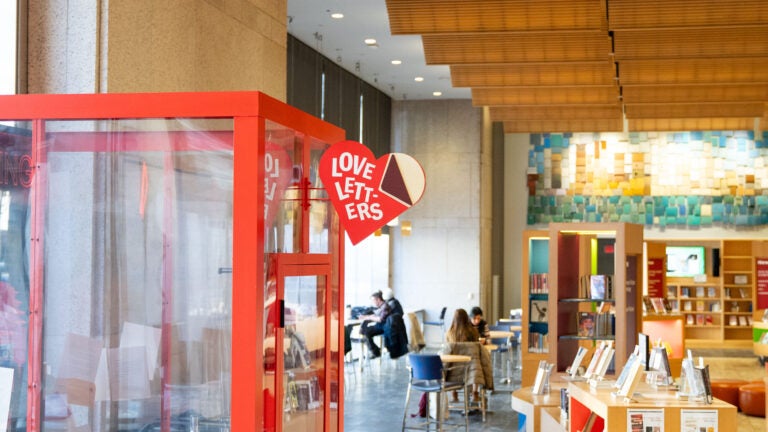
The Love Letters Tell-A-Booth – presented by the Boston Public Library – now stands at the 700 Boylston St. entrance of the BPL. It is available for your questions about your relationship life.
For those who’ve seen it, you know how it works, but for those who don’t:
You go in, pick up the phone, and choose from a set of options. The main goal is for you to leave an anonymous question – feel free to ramble about your relationship quandaries! – and I’ll do my best to address it in the Love Letters column, which appears on Boston.com and in The Boston Globe.
Don’t fret – it’s anonymous. No names will be used (you don’t have to leave one). As of March 18, 2026, anonymous audio may be used on our podcast.
By contributing, you’re giving a gift. If you look back at advice column history (they’ve been around for centuries!), it’s clear that when people share their problems, other people get to feel less alone about their own.
I hope you share questions about friendships, family, in-laws, first crushes, last crushes, marriage, divorce, partnership, communities, and more. You can leave more than one question.
You can continue to check Boston.com/LoveLetters to see if it’s there.
This has been updated to reflect new phone booth terms and conditions regarding voicemail usage.
The phone booth was designed by Luke Van Cleve and constructed by staff of the American Repertory Theater.
Special thanks to Bailey Watroba, Lisa Pollack, and Jake Jacevicius of The Boston Public Library; Michael Begay, Jazmín Aguilera, Scott Golden, Yiqing Shao, Lindsy Goldberg, and Rich Rinker of Boston Globe Media; Rebecca Curtiss with the American Repertory Theater; and Victor Gutierrez and Christopher Swetcky for their contribution.
All voicemails are recorded. Beginning March 18, 2026, by leaving a voicemail, you grant Boston Globe Media Partners, LLC (“BGMP”) permission to use your voicemail recording in connection with Love Letters and in any and all manner and media, and grant BGMP all rights to your recording of every kind and character whatsoever in perpetuity, now known or later developed, for internal and external purposes.
Sign up for the Love Letters newsletter for announcements, hand-picked letters, and other great updates from the desk of Meredith Goldstein



To comment, please create a screen name in your profile
To comment, please verify your email address
Conversation
This discussion has ended. Please join elsewhere on Boston.com