
Wait, Am I the Only American Who’s Not Into Pizza?
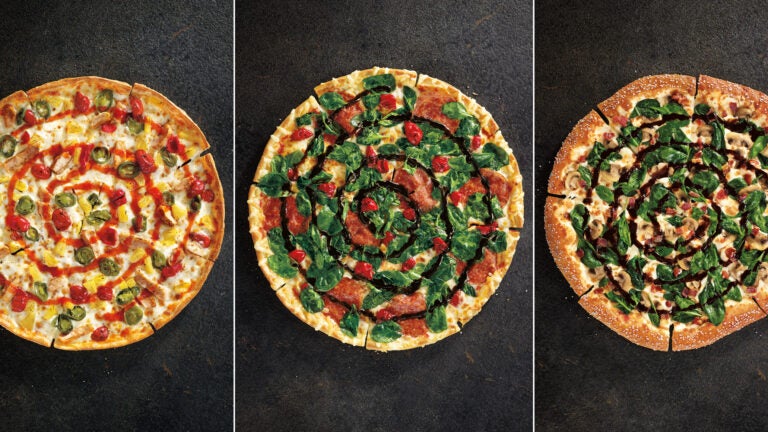
Last week, Pizza Hut rolled out a new menu “The Flavor of Now’’ menu, which includes crust flavors like honey Sriracha and toasted Cheddar, drizzles of sauce (swirled over your already sauce-coated pie), and five new premium toppings—banana pepper, meatballs, salami, spinach, and something called Peruvian cherry peppers, otherwise known as “Sweet Drops.’’
The pizzas have cheeky name, like the “Skinny Beach’’ and the “Cock-a-Doodle Bacon,’’ both of which sound terrible to me. The new revamp is set to appeal to Millennials, who, in theory, buy pizza. Jared Drinkwater, a Pizza Hut VP, told Fast Company, “If you look at the trends in food among young consumers, it’s about flavor exploration. We felt like nobody was doing that in pizza.’’
They also played up the fact that their CEO, David Gibbs, is a New Yorker: “If you live in New York, you’ve been eating pizza your whole life,’’ Gibbs explained to Businessweek.
Of course, if you grew up anywhere in America, you’ve been eating pizza your whole life, too. According to Pizza.com, 93 percent of Americans have eaten pizza in the last month. I have no idea how that number was generated, but I’ll go out on a limb and say that sounds absolutely right.
As I read about Pizza Hut, I wondered aloud in the Boston.com newsroom what the big deal was. After all, this was just pizza. Who cares?
Oh, right, everyone. Everyone in America loves pizza, and cares deeply about how it’s made and what it’s topped with.
Everyone except me.
I’ve always been baffled by pizza. Just mention it and people will express passionate opinions about where to get the best slice, they’ll willingly attend otherwise boring work events, and they’ll suddenly turn into culinary connoisseurs, chastising or praising institutions that dare to push the limitations of the crust-sauce-cheese formula.
It’s not that I dislike pizza. I like it just fine, and I’ve eaten it in meccas like New York and Rome. It’s just that I don’t have any strong feelings about it whatsoever. This article is probably the most consideration I’ve ever given the food. And that seems to genuinely annoy everyone.
Why did I never develop all-American pizza madness? Perhaps it’s because I grew up in Connecticut, where all pizza was either Greek-style or from a mass chain like Pizza Hut, Dominos, or Papa Gino’s. (Or from Pepe’s, which I also don’t care for. Yeah, I know: “BOO! HISS!’’) With options like those, I’d rather have no pizza at all. Seriously. And those crappy pizzas from my childhood set my expectations so low that I’ve become indifferent to all pizza as an adult.
On top of this, pizza never looked as good as it did in the cartoons I watched growing up. If pizza IRL was half as golden, gooey, and delicious as it was on “Daria,’’ I would eat pizza at least a few times a year. But I also know that saying you don’t like something because it doesn’t look like the same way it did on TV—especially on a cartoon—is an very bad defense. I just think childhood expectations count for a lot when it comes to food love.
[fragment number=0]
Along those lines, the recent pizza issue of Improper Bostonian did make me drool—if only for Kristin Teig’s incredible photography. On the cover: Pastoral’s Neapolitan-style pizza, spotted with crispy rounds of salty lemon slices, jalapeños, and bonito flakes, with a mound of pecorino-dusted arugula. Maybe, I thought, if Pastoral’s chef-owner, Todd Winer, could create such a beautiful pie (IRL, as far as I could tell), he could also explain to me what the big deal was.
“I’ve gotten into some heavy conversations with guests at the restaurants about their expectations and their vision of pizza,’’ he told me when I called. “It’s kind of like your family cooking Thanksgiving or your mom cooking a holiday dinner; you remember it one way, and that’s the way it has to be.’’
While we both acknowledged that my indifference to pizza was starting off our conversation on the wrong foot, he patiently tried to reason with me.
“The thing is, there’s no pizza that’s a bad pizza,’’ he said. “There’s only personal preference and what you’re into.’’
Hm. Thing is, my personal preference is no pizza. So I turned to Frank De Pasquale, the restaurateur behind Bricco, Quattro, and Umbria Prime. He tried to hard sell me on the beauty of the Neapolitan pizza technique that Winer also raved about. He told me a story about his trip to Naples, where he first experienced the beauty and method of pizza culture in the rough-around-the-edges Italian seaside city, and it shaped the way he wanted to serve pizza and consume it himself.
While De Pasquale can rationalize things like “wild mushrooms’’ or “touches of speck or prosciutto’’ on his pizza, he said the true way of Naples is two choices: margherita and marinara. Anything else? Expect the worst.
“I remember going [to Da Michele in Naples] with my wife and she asked for four different flavors on the pizza,’’ he said. “The guy started laughing at my wife, in front of me, and said to me in Italian, ’Please take your wife and go somewhere else. The only way we do pizza is the original way.’’’
I asked De Pasquale what he thought of the new Pizza Hut flavors—and he declined to comment. But he later mentioned the idea of items like barbecue sauce and pineapple as toppings and scoffed, “That’s not a pizza. You can call it a pizza, but it’s really not.’’
That seems to be the favorite phrase of pizza afficiandos and plebs alike, “That’s not pizza.’’
OK, then what is?
I’ve had pizza from Da Michele and Pizza Hut, and I’ll just give you a half second to guess which was better. But is it fair to compare apples to syrup-glazed, over-processed, mass produced oranges? No.
So maybe we’re all being a little too hard on Pizza Hut. And maybe Pizza Hut is being a little too hard on itself. And maybe we should all just chill out with our pizza beliefs.
Until then, I’ll have a calzone.






To comment, please create a screen name in your profile
To comment, please verify your email address
Conversation
This discussion has ended. Please join elsewhere on Boston.com