
Can you learn to love the foods you hate?
I've always hated okra. Maybe I could change that.
“Are you going to eat that?”My boyfriend was eyeing the nam prik platter that had just landed at our table at Mahaniyom, a new Thai restaurant that opened in Brookline Village in late February. The platter was stunning: crispy pork belly slices stacked neatly in a row, three bowls of dipping sauces, and a spray of colorful vegetables — lettuce, carrots, green beans — that fanned out from the bowl, ready to be dunked in one of the sauces and devoured like the phenomenal plate of green papaya pad Thai that had come before it. But there, nestled between the carrots and the pork belly, was the okra. It, too, was meant to be wrapped up in lettuce and dipped in sauce, but my decades-long disgust toward okra had brought the meal to a momentary halt. My boyfriend’s question hung in the air: Was I going to eat that?

Nam prik platter at Mahaniyom.
Mahaniyom serves the okra in this dish raw, and as I gingerly picked one up by its pointed end, I was already anticipating the slime that would ooze out of its skin, a characteristic that has kept me at arm’s length from okra for years. But I had forgotten that the vegetable’s fiber-rich mucilage is mostly a byproduct of its pods being cooked, and after dipping the okra into the ground pork sauce and taking a tentative bite, I was startled to find that…I liked it?
Most people have “a food thing” — a condiment they declare ‘garbage,’ a vegetable they’d rather throw at a wall, a dish they’ll only eat when hell freezes over. But I don’t have many. I’ve written about food professionally for the past eight years; as a result, my culinary comfort zone is fairly large. I’ve eaten June bugs at an insect-themed dinner — so nutty! Cow brains — so creamy! I once tried the Japanese delicacy shirako (fish sperm), and wouldn’t hesitate to eat it again.
Yet despite checking in every few years with renewed hope, it has always been difficult for me to get behind okra, a nutrient-packed vegetable that is also known as ochro, or, more elegantly, ladies’ fingers, so called for their slender, pointed shape. (I am not alone in this fight. “Top Chef” judge Tom Colicchio has a very public beef with okra.) Its origins are West African, but it has traversed the globe and can frequently be found in dishes from Southeast Asia and the American South, among other regions. My grandmother, a sweet soul from Georgia with a honey-thick accent, couldn’t rave enough about okra, and would constantly tell me I had to try it just one more time. “Have you eaten it fried?” she asked often.
I hadn’t eaten fried okra in a while, actually. So when the New Orleans-inspired restaurant French Quarter opened downtown last month, I thought: Oh, hell, why not?

Fried okra at French Quarter.
Okra is everywhere on French Quarter’s menu. It can be ordered as a fried starter, served with a side of scallion aioli. It’s found swimming in a bowl of chicken, andouille, and shrimp gumbo. It’s stewed in a Creole vegetable trio, and offered as a side with tomatoes. The fried okra I ordered arrived looking like popcorn shrimp in a paper cone; a bottle of Crystal hot sauce was plunked down next to me. I popped a small one in my mouth. ‘Not bad,’ I thought. I popped a bigger one in. ‘There it is,’ I sighed, the vegetable’s signature slime seeping through the fried batter. I doused the okra in Crystal, I dunked it in aioli, I followed each bite with a swig of my Sazerac cocktail — and still, it wasn’t enough to mask how deeply I despised what was going on in my mouth.
OK, grandma. Now what?
I’ve conquered foods I didn’t immediately like before. It took years of grimacing after eating olives to actually learn that I loved most olives when plucked from a pool of good olive oil and salt. I hated Bloody Marys until one fateful brunch in New York City, when my sister nudged me to try a particularly spicy glass of the stuff, and I’ve never looked back. When I asked the great big world of Twitter what foods were on their “over my dead body” list, the responses were all over the map.
Ham. Baklava. Oysters. Avocado (and, tangentially, guacamole). Honeydew melon. Beets. Lettuce (without dressing). Brussels sprouts. Mushrooms. Lentils. Yogurt. Cream of Wheat. Goat cheese. And, yes, olives and Bloody Marys.
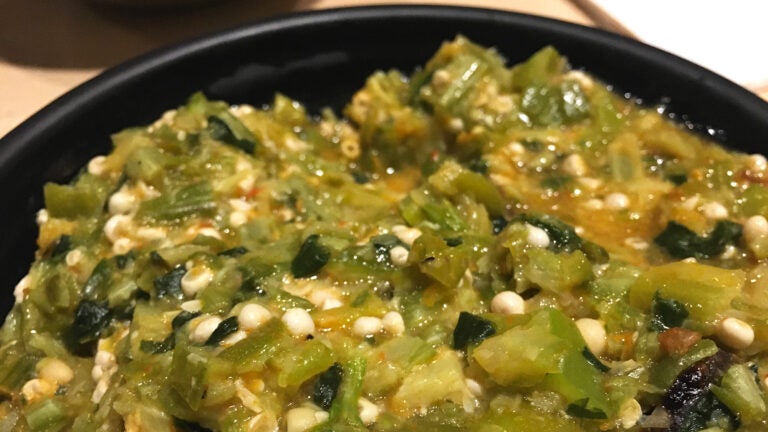
Here’s the thing: I hate hating food. It makes me, perhaps irrationally, feel like I’m not trying hard enough. And so one recent night, I stopped by Suya Joint in Roxbury, an African restaurant specializing in Nigerian cuisine. I was here for the okra stew, a bowl packed with chopped pieces of okra that have been cooked down with slices of fish and your choice of goat, beef, and chicken. It comes with a softball-sized hunk of fufu, a starchy dough made with pounded yam, whole wheat, cassava, corn, dried yam, or white rice. The fufu is meant to be ripped off and used as a utensil, moving the stew from bowl to mouth in one deft motion.
As it turns out, this is the kind of okra I was missing in my life. Yes, the stew left slimy trails as I lifted it with my hands from the bowl, but there was a true synergy to this dish: salty chunks of beef permeated the soup, scotch bonnet peppers left behind a memorable heat, and the okra rendered itself the glue, holding everything together while serving as its own earthy component. “This is fantastic,” I told the server, and she mentioned that they were introducing seafood okra stew on the weekends. “I’ll be back for that,” I said, a phrase I never thought I’d utter in relation to okra.
I don’t think everyone needs to overcome their own food aversion; the world is chaotic enough, and if we can’t spend our days eating the things we enjoy, well, we might as well start drinking Soylent. But first impressions — and even your own memory — can be misguided. Those oysters you tried and hated five years ago? Maybe order them fried or baked. The mushrooms? Perhaps there’s a new preparation or an unexplored cuisine waiting to show you the light.
Maybe, sometimes, you should listen to your grandma.




To comment, please create a screen name in your profile
To comment, please verify your email address
Conversation
This discussion has ended. Please join elsewhere on Boston.com