
Sign up for the Today newsletter
Get everything you need to know to start your day, delivered right to your inbox every morning.
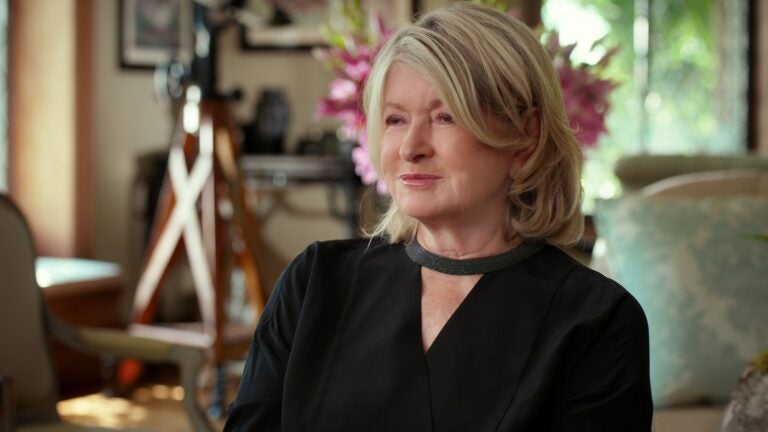
LOS ANGELES — Most business titans spout niceties — insipid, banal, stale — when speaking to reporters on the record. It can be impossible to get them to say what they really think, and if they accidentally let something colorful slip, a saw-toothed publicist inevitably arrives to try to scrub it away.
But not Martha Stewart. As a media savant, she may understand that startling candor cuts through the clutter and gets her heard. Or maybe, at 83, she just has no more you-know-whats left to give.
Even so, I was not quite prepared for a recent phone interview with her. I called to discuss her experience with Oscar-nominated filmmaker R.J. Cutler, whose “Martha” documentary arrived on Netflix on Wednesday after a run on the fall festival circuit. I figured our chat would last 10 minutes. She’d say a positive thing and a negative thing and go back to making TikToks with Snoop Dogg.
Out came roughly 30 almost uninterrupted minutes of sharp critique. “R.J. had total access, and he really used very little,” she said, referring to her archive. “It was just shocking.”
After a couple of failed attempts to interject a question, I decided it was best to just get out of her way. Below are some of the things she’s sore about (some lightly edited for clarity).
Cutler declined to comment on specific points. “I am really proud of this film, and I admire Martha’s courage in entrusting me to make it,” he said. “I’m not surprised that it’s hard for her to see aspects of it.”
Over his 31-year film career, Cutler has examined political figures (“The World According to Dick Cheney”), pop stars (“Billie Eilish: The World’s a Little Blurry”) and magazine editors (“The September Issue”). Never before has a subject of one of his films publicly attacked his work.
“It’s a movie, not a Wikipedia page,” he said of “Martha.” “It’s the story of an incredibly interesting human being who is complicated and visionary and brilliant.”
“Those last scenes with me looking like a lonely old lady walking hunched over in the garden? Boy, I told him to get rid of those. And he refused. I hate those last scenes. Hate them.
“I had ruptured my Achilles tendon. I had to have this hideous operation. And so I was limping a little. But again, he doesn’t even mention why — that I can live through that and still work seven days a week.”
“I said to R.J., ‘An essential part of the film is that you play rap music.’ Dr. Dre will probably score it, or Snoop or Fredwreck. I said, ‘I want that music.’ And then he gets some lousy classical score in there, which has nothing to do with me.” (Cutler added Snoop Dogg’s “Beautiful” to the end credits after Stewart saw an unfinished cut of the film.)
“He had three cameras on me. And he chooses to use the ugliest angle. And I told him, ‘Don’t use that angle! That’s not the nicest angle. You had three cameras. Use the other angle.’ He would not change that.”
“My magazine, my Martha Stewart magazine, which you might say is traditional, was the most modern home magazine ever created. We had avant-garde photography. Nobody ever showed puff pastry the way I showed it. Or the glossaries of the apples and the chrysanthemums. And we prided ourselves so much on all of that modernism. And he didn’t get any of that.”
“There’s not even a mention. And these grandchildren are utterly fantastic. My daughter was very against the children being included. But I could have talked about them, and I did. I’ve taken them to the most unusual places in the world, and they’re only 12 and 13. My love of travel wasn’t mentioned. My trip up Kilimanjaro wasn’t mentioned!”
“He would be dribbling on the table. That was the fun part, all of these stories. R.J. didn’t get any of that in the movie. Can you imagine?

“It was not that important. The trial and the actual incarceration was less than two years out of an 83-year life. I considered it a vacation, to tell you the truth.
“The trial itself was extremely boring. Even the judge fell asleep. R.J. didn’t even put that in. The judge was asleep at the bench. I wrote it in my diary every day.”
“I love the first half of the documentary. It gets into things that many people don’t know anything about, which is what I like about it.” (One scene she singled out: While in Europe on her honeymoon, she left her husband at the hotel and went alone to the Florence cathedral, becoming so overwhelmed with emotion that she kissed a stranger. “I wish we all could experience such an evening,” she says in the film.)
“So many girls have already told me — young women — that watching it gave them a strength that they didn’t know they had. And that’s the thing I like most about the documentary. It really shows a strong woman standing up for herself and living through horror as well as some huge success.
“That’s what I wanted the documentary to be. It shouldn’t be me boasting about inner strength and any of that crap. It should be about showing that you can get through life and still be yourself.”
Get everything you need to know to start your day, delivered right to your inbox every morning.
This article originally appeared in The New York Times.


To comment, please create a screen name in your profile
To comment, please verify your email address
Conversation
This discussion has ended. Please join elsewhere on Boston.com