
Ten things you might not know about the city of Boston
-

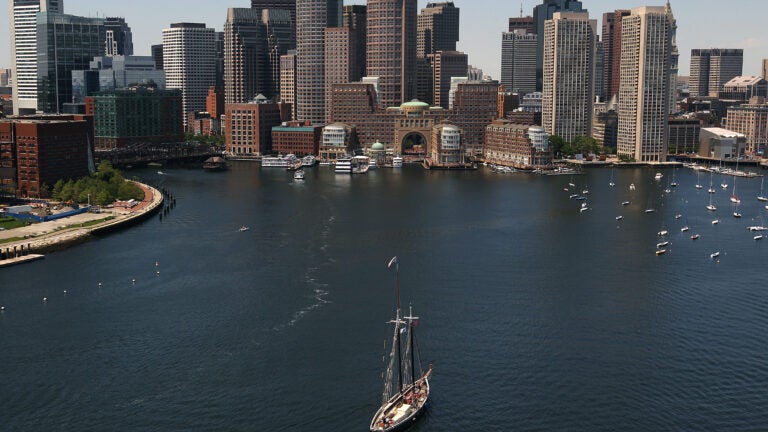
Students from around the globe, welcome to Boston. During your time here, you’ll come to recognize that this great city possesses many myths in addition to ingrained characteristics that fill Bostonians with pride. It may take some getting used to, but you’ll soon learn that the T doesn’t run all night and that Cheers isn’t exactly “Cheers.” Beyond that, here are 10 more things you might not know about Boston.
-
First of all, do you understand how many of you there are? Really? In any given year, there is an average of 250,000 college students in the greater Boston area. Yet, during the summer, only about 600,000 people reside in city limits. That’s like taking the entire city of St. Petersburg, Fla., and dumping it directly into Boston. Any wonder why Labor Day weekend is referred to as the “Student Invasion?’’
-

Think the John Hancock Tower is little more than a dominating presence on the Boston landscape. Please. The glass building was also the site of the world record for catching grapes in 1988, at a distance of 788 feet. Clearly you’ll want to read up on Paul Tavilla, who bills himself as “the true legitimate world record holder for catching grapes at a distance.’’ Tavilla has also honed his craft Dedham, Fort Lauderdale, Fla., and Tokyo. A true living legend. Meet him at thegrapecatcher.com.
-
“Say Hello to Someone from Massachusetts” by Lenny Gomulka is the official Polka of Massachusetts. Be proud, Boston. Be proud.
-
Since it’s the birthplace of the Revolutionary War, it’s no surprise that Boston boasts a lot of “firsts.’’ The first sewing machine was built here in 1845, the first public beach, Revere Beach, is just over the Tobin Bridge, and we also built the first subway system. But did you know, the first American lighthouse didn’t originate in Maine, on Cape Cod, or the islands, but in Boston Harbor? The original Boston Light, the lighthouse built on Brewster Island, was first built in 1716.
-

Speaking of firsts, the first-ever patent on a living animal took place at, no surprise, Harvard University, where a pair of med school scientists created the OncoMouse, a form of lab rat that has been genetically modified for cancer research. They would be sold to DuPont labs and were hailed as a revolutionary breakthrough in the late-80’s.
-

Maybe you weren’t aware, but the Boston University Bridge on Commonwealth Avenue is the only place in the world where a boat can sail under a train passing under a car driving under an airplane. If you’re new to the area, it’ll take you no time at all to also understand that the Mountfort Street turn onto the bridge isn’t normally a picnic.
-
Looking forward to Friday afternoon happy hour? Yeah, forget it. You might find a meal or beer deal here or there, but it’s against Massachusetts law to hold, or call any period of the day, “Happy Hour.’’ As for the Beacon Hill Pub (seen, at left, in the dead of winter – oh, yeah, get ready for that too), you’re on your own. Proceed with caution.
-
Be glad you didn’t go to school here 300 years ago, or you’d never get to go home for the holidays at the end of the semester. From 1659 to 1681, it was against the law to celebrate Christmas in Boston because the Pilgrims thought it was debauched. Today, good luck escaping its presence at most retail outlets before the end of September.
-
The Museum of Science, Museum of Fine Arts, the Isabella Gardner Museum are all fine cultural destinations in town. But do any of them have death masks? You’ll find that and much more at the Warren Anatomical Museum, which “seeks to continue in the tradition of promoting the collection for the purposes of medical education in all forms whenever possible, as well as expand its scope to provide public programming and educational resources to the larger community.’’ The museum’s collection contains some 15,000 artifacts and cases including: “anatomical and pathological preparations; various wax, paper mache, and dry preparation anatomical models; photographs, prints, paintings, and drawings; medical instruments and machines; and other medical memorabilia.” Sounds terribly geeky, but terribly fun.
-

At 90 feet below the surface, the Ted Williams Tunnel is the deepest in North America. How much did it cost, you ask? Um, a lot. We’ll leave it at that.




To comment, please create a screen name in your profile
To comment, please verify your email address
Conversation
This discussion has ended. Please join elsewhere on Boston.com