
Puffins flock home to Maine islands
-

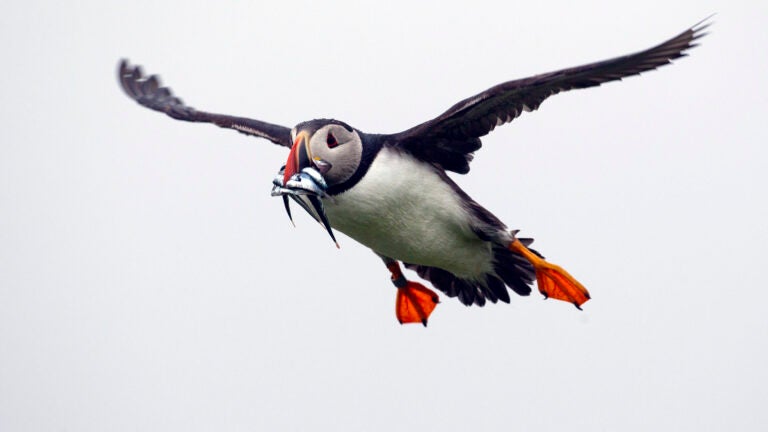
The cute and comical seabirds called puffins have returned to several Maine islands and are finding plenty of food for their young chicks unlike last summer when many starved. Young puffins died at an alarming rate last season because of a shortage of herring, leaving adults to try to feed them another type of fish that was too big to swallow. Some chicks died surrounded by piles of uneaten fish. – By The Associated Press
-

This summer, the chicks are getting plenty of hake and herring, said Steve Kress, director of the National Audubon Society’s seabird restoration program and professor at Cornell University. But researchers remain concerned. – AP
-

With colorful beaks, puffins look like a cross between a penguin and a parrot. They spend most of their lives at sea, coming ashore only to breed each spring, drawing camera-toting tourists by the boatload before the birds depart late in the summer. – AP
-

Feld biologists rowed to shore from a moored boat at Eastern Egg Rock, a small island five miles off the Maine coast. Bird blinds used for monitoring puffins stand above the water line at right.
-

Occupancy of puffin burrows on Matinicus Rock and at Seal Island, the two largest U.S. puffin colonies, are down by at least a third this season, Kress said. That likely means many birds died over the winter and others were too weak to produce offspring this season, he said. – AP
-

A puffin walked next to a decoy of a razor billed auk on Eastern Egg Rock.
-

The puffins were nearly wiped out a century ago.
-

Because puffins are less adaptable than other seabirds, they’re more vulnerable to environmental changes and serve as a good indicator of the health of oceans and the availability of certain types of fish, Kress said. – AP
-

There’s no guarantee that there won’t be more die-offs in the Gulf of Maine as there have been elsewhere, including in Norway and Scotland’s Shetland Islands. ‘‘It could happen here. We will learn. The puffins will teach us about the oceans and what’s happening to them,’’ Kress said. – AP
-

An Atlantic puffin with a beak crammed with hake made its way to a burrow to feed its chick.
-

Scientists say the comical-looking seabirds have been dying of starvation and losing body weight, possibly because of shifting fish populations due to warming ocean temperatures.





To comment, please create a screen name in your profile
To comment, please verify your email address
Conversation
This discussion has ended. Please join elsewhere on Boston.com