
Newsletter Signup
Stay up to date on all the latest news from Boston.com
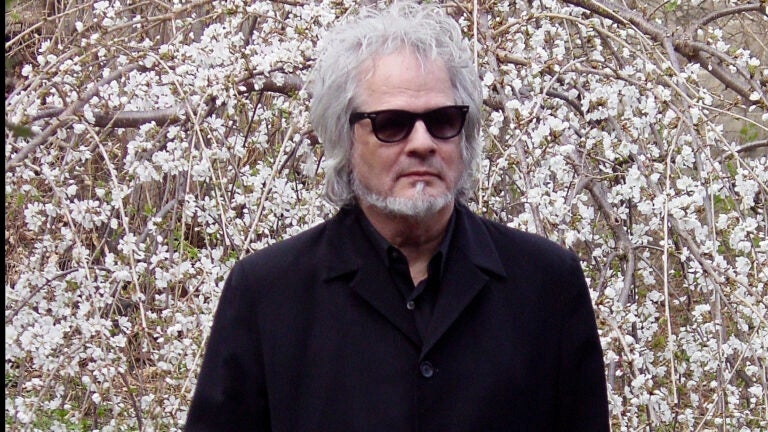
When Al Kooper picks up the phone in his Somerville home, the first thing I hear is a dog barking.
“That’s the mailman,” Kooper explains with a laugh. “Both of you were on time.”
Nilly, Kooper tells me, is a mutt. Nine years old. Barks at everything. (“I’m surprised this call is bark-free,” he says at the end of our bark-free conversation.)
Nilly is also a canine commentator, heard weighing-in at the end of each KooperKast — 5- to 10-minute mini-podcasts where Kooper answers fan questions — about co-writing with Blind Willie Johnson, about Robbie Robertson, “about Al being a mensch.”
Talking to him, I’m reminded a bit of Ed Asner, at times. Maybe a splash of Larry David. An inertly hilarious matter-of-factness to answers that make perfect sense to Al Kooper. Example:
Q: You originally came here to teach at Berklee. But what made you want to stay?
A: Well, I moved here.
Q: Right, but you could’ve moved away after you taught.
A: Oh no, I couldn’t. I have so much stuff it’s ridiculous.
Kooper has lived in Somerville since “’90-something. ’94?” he thinks. He’s lived here — with his wife of 22 years, Susan — longer than he’s lived anywhere save for growing up in Queens, he tells me.
“I’m happiest at home. I have a wonderful wife and a wonderful dog. What else would you want?”
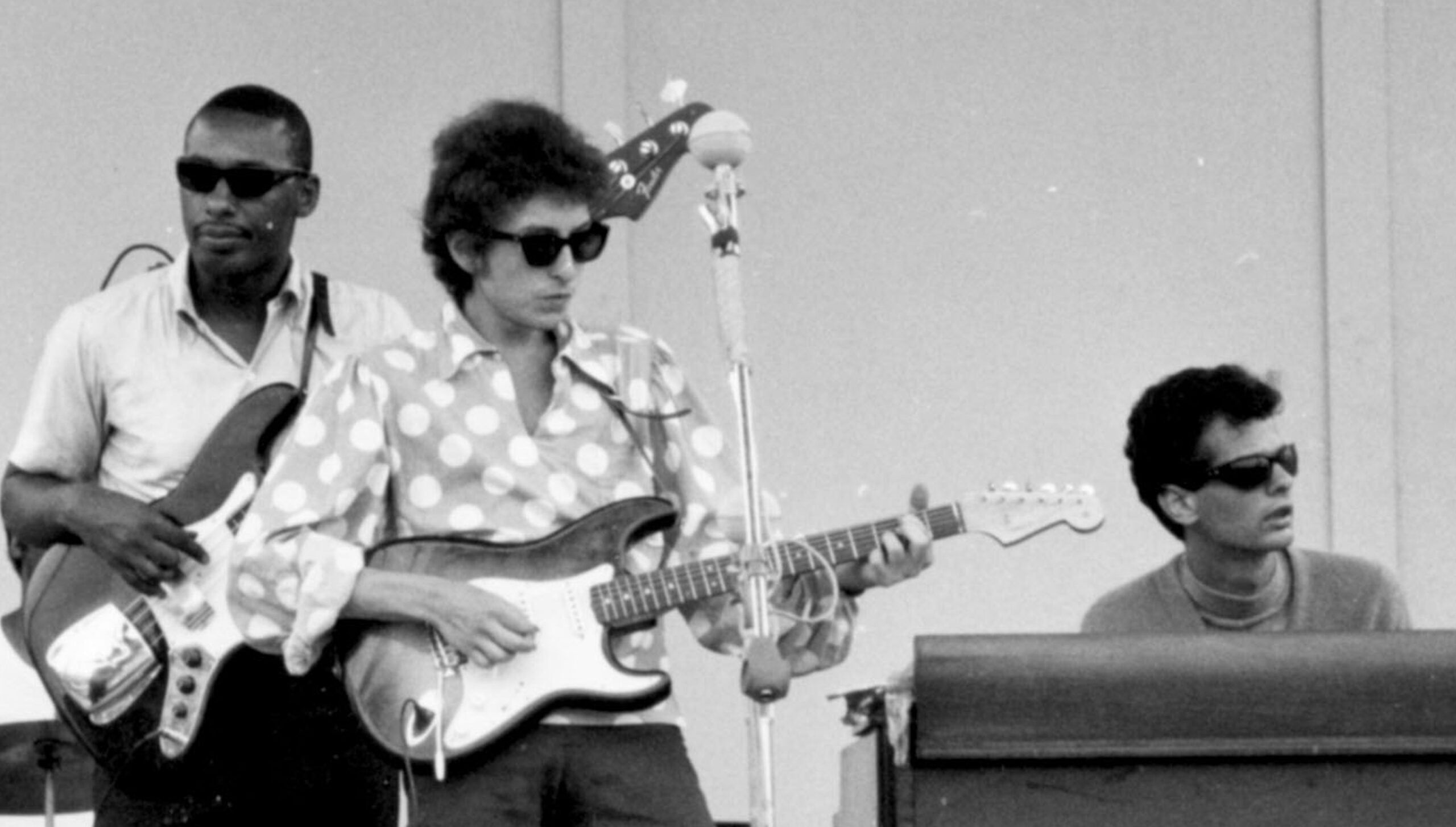
Like the Forrest Gump of 20th century rock, Kooper pops up everywhere. He famously played the Hammond organ on Bob Dylan’s seminal “Like a Rolling Stone.” He was on stage with Dylan when he went electric in ’65. Played on “Blonde on Blonde.” Discovered Lynyrd Skynyrd. Recorded with the Rolling Stones, Tom Petty, The Who. Produced three Beatles solo works. Played with the Blues Project and Blood, Sweat & Tears. His music has been sampled by Jay-Z and the Beastie Boys. As a teen in Queens, he joined the Royal Teens, just after they recorded “Short Shorts.” … I could go on.
For many rock fans, Kooper’s 2023 Hall of Fame induction was long overdue. Due to health reasons, he said, he did not attend the ceremony, taped this fall. The 79-year-old accepted the award from his home. You can catch highlights of the ceremony — other members of his class include Willie Nelson, Kate Bush and Missy Elliot — on ABC Jan. 1. I called to talk all things Kooper.
Al Kooper: For a while. Then I said, “Well, that’s enough.”
Some kind of music something.
Oh, I was very surprised.
Probably a call or an email.
It was a good laugh.
Because nowadays, I’m home. I don’t do anything. I step back and look at myself and I say: This is unusual. [laughs]
No. Not off the top of my head.
Well, my mom played the radio and my father played classical records and a little jazz. That’s what I grew up on. And the radio won.
Oh, yeah. They used to have one headphone — it wasn’t even a headphone — that stuck in your ear. In New York, all the good stations were at the end of the dial. I didn’t go much under 100. The disc jockeys were fantastic.
We went to [my parents’] friends’ house. There was a piano there. I’d never [played]. They went somewhere else in the house, and I stayed at the piano. I said, “This is fabulous.” I think I could play a song the first time: “The Tennessee Waltz.” On the black keys. [laughs]
Oh, yeah. But I switched to guitar. I saw an ad in a Sears Roebuck catalog for a solid-body guitar with a cutaway. I said, “This is the greatest thing I’ve ever seen.” It was $35. So I didn’t have to push my parents too hard. That was my first guitar. It was a Danelectro.
Oh, it just was great. Because A, it was a solid-body, so it was very rock and roll. I loved that. Then of course, I had to have an amplifier. More money from my parents. I played in a local band that I started with my friend. Then I used to hang around the music business in midtown Manhattan. Some manager pulled me up and put me in one of his bands. It turned out to be the Royal Teens, which was a big band. I started going on the road, much to my parents’ chagrin. That was the beginning. Once I did that, I wasn’t interested in anything else.
I was always writing, but I was terrible at first. Then I got better and got signed to a publisher. He put me with these two other guys who wrote lyrics together. The three of us came in every day to a little room with a little piano and fake white cork bricks on the wall. We wrote songs all day for a living. [I was] probably 16, 17. My parents couldn’t argue because somebody was paying me. I got a job before I had to go through all that college garbage. And it was a much better education.
I think the whole key was ambition. I was very ambitious. A friend of mine, a record producer, Tom Wilson, invited me to a Dylan session to watch. I ended up playing on it. It was “Like a Rolling Stone.” That’s the day I became an organ player.
The whole thing is unbelievable.
Well, they took a break. Everybody walked out for a few minutes to smoke cigarettes. I went into the studio and sat down at the organ and fortunately, it was turned on. Because it’s very difficult — it’s like a four-step process turn on a Hammond, and you could never guess how to do it. It was already on and I went “Oh, this is fabulous.” They came back from break and I was sitting at the organ. They said “OK, this is Like a Rolling Stone take 1 — Hey! what are you doing out there?” Everybody laughed, including the producer. So he just let it go. And I think it was Take 4 that was the keeper but they kept going to Take 10. And that’s when I became a professional organ player.
Yeah, he took me and Robbie Robertson to Nashville. Matter of fact, we shared a room. We got along great. We were really good friends. So it was fun for us. We go back to the room at night— it was a pretty small room, it had two little beds in it — and we just stayed up laughing all night. The whole Nashville experience was amazing. I never saw anything like that. They were really amazing musicians. They took me in. They were really nice to me.
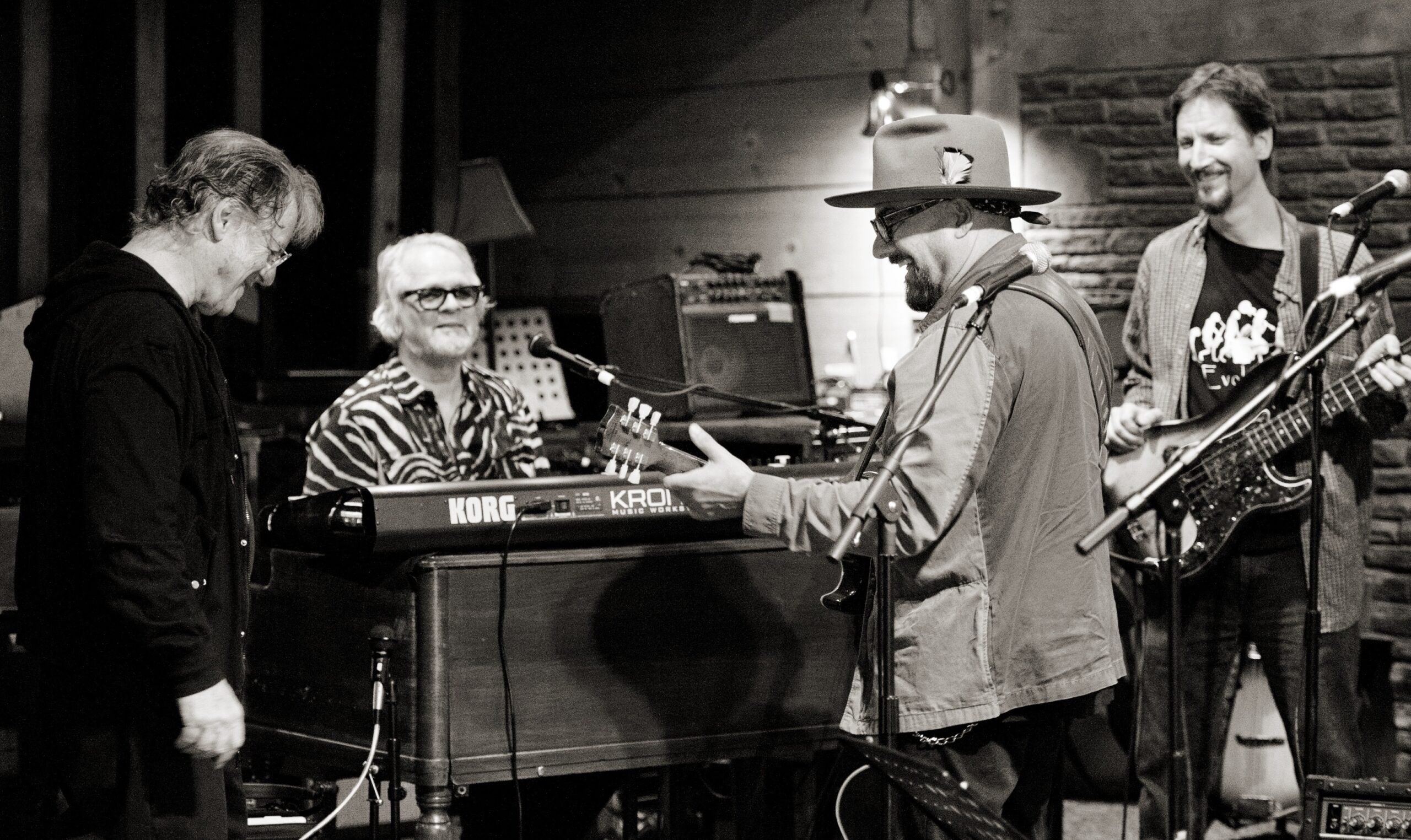
That track was done in New York. They hired this studio guy Paul Griffin. He was amazing. When we did “Sooner or Later,” I could see his hands [from where I was, playing organ]. His playing was so ridiculous, I could hardly play. Some of the greatest piano-playing I’ve ever heard in my life to this day. Ridiculous piano-playing. I’ve never been able to get there.
In a bar.
Atlanta. I moved to Atlanta for some reason I can’t remember.
But it was musical. I found a bar run by a guy I went to camp with when I was a kid. I met him in the street; we hadn’t seen each other since we were little. He said, “I have a club. You’re welcome to come on my tab.” I said, “Boy, that’s great, because I don’t know anything about where to go.” So I did.
Yeah. I’d go there every night [and hear them]. By the fourth night, I offered to produce them. They accepted. There you go.
I just thought they were great. They had three guitars, which was unusual, and they knew what to do with them. There was very little that I could add to what they did. It was pretty perfect. And that was unusual for me. So I didn’t take that for granted.
That was an after-thought. I played piano and organ on it. They called me to do the session — and you can’t turn that down. [Then] I asked if they could send me the tape. I wanted to put French horn on the intro. They sent me the tape and I put the French horn on the intro.
I worked with George, primarily. We got along very well. Terrific guy. Really sorry he’s gone.
Well, you know, it was Dylan! [laughs] What can I say? At that time, we spent a lot of time together and I learned a lot. I went on the road with him for a while.
Oh, I don’t leave the house.
I don’t think I have a favorite. The whole thing is mind-boggling. That’s why I wrote a book. I wanted to remember it. If I didn’t write the book, I wouldn’t have remembered everything. So I’m glad I did.
I can’t remember. All I know is it’s out there. It’s still for sale.
I have a finished box set. But I think it’s probably best sold when I pass.
Just because it’s a good combination of everything that I did. If I do anything else, I can add to it.
I don’t look forward to doing that.
I’m too old to sell myself.
Interview has been edited and condensed.
Lauren Daley can be reached at [email protected]. Follow her on Twitter/X @laurendaley1.
Stay up to date on all the latest news from Boston.com


To comment, please create a screen name in your profile
To comment, please verify your email address
Conversation
This discussion has ended. Please join elsewhere on Boston.com