
Why don’t more women play Boston Calling?
Eight out of the 23 acts at Boston Calling this weekend include female members. It looks OK when you circle the names on the lineup, and think, “Not bad!’’
Then, take a step back. Because that means two-thirds of the groups are exclusively male. Such is the sad state of festivals: Only one-third of the acts include women, even fewer stand at the mic, and that passes for good.
Over the past few years, music festivals have grabbed headlines for their dearth of female artists. In January, Slate reported that only two female headliners (Björk and Portishead) have been given the top billing spot in 16 years of Coachella’s history. Lollapalooza, Download, Outside Lands, and others have fallen under the same scrutiny.
To highlight the problem, various outlets have made infographics that only included acts with women members. Here’s one of them:
[fragment number=0]
I’m not arguing for a quota of women, or for the end of male artists. I’m genuinely curious: What gives?
Trevor Solomon, booking director for Boston Calling, said that the imbalance isn’t intentional, or even desired.
“In fairness to the industry, everyone wants to book what they can,’’ Solomon said. “They just want to put on the best festivals they can.’’
The booking process involves a complicated metric of who’s touring, who’s promoting new albums, and who’s particularly hot on the charts.
This is the first Boston Calling lineup that Solomon arranged. Last fall, the gender difference was even more pronounced. Headliner Lorde’s presence wasn’t enough to make up for the fact that only three other acts out of 22 included women.
One of these acts was the band San Fermin. Charlene Kaye, lead vocalist for the band, said that she has been continually disappointed in the poor representation of female-led bands, citing Coachella’s history of the problem as one example.
“The idea that women are less capable of entertaining large audiences is ridiculous and medieval to me, but it seems like the issue will continue until either festival directors change their outlook, or women become equally as ubiquitous as men are in rock, electronica, and other non-pop genres,’’ said Kaye.

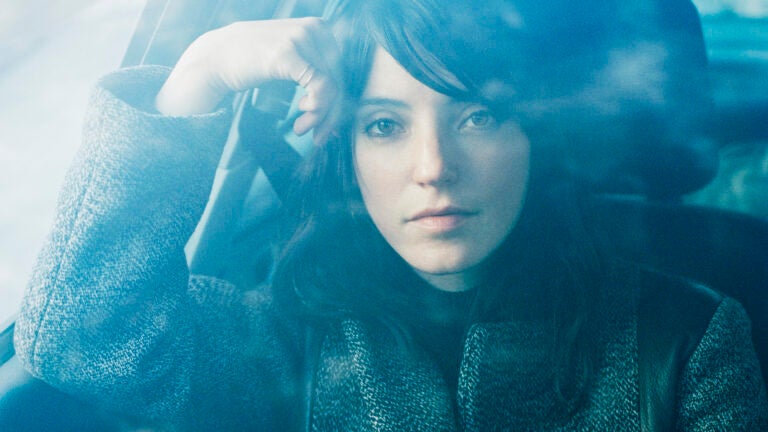
Charlene Kaye of San Fermin
Prior to fall 2014, Boston Calling bills were closer to the ratio of this weekend: Between one-third and one-half of past lineups included women.
Nicole Barsalona, founder of management company 525 Entertainment, and boardmember of the non-profit group Women in Music, said the key to tipping the balance is getting buzz around female artists. She said the biggest reason for the gender disparity is that there are just fewer women in the alternative music scene.
“Bonnaroo, Coachella, Boston Calling, these festivals lend themselves to indie rock bands on multiple stages to engage audiences,’’ said Barsalona. “You just don’t see as many female-fronted bands these days, or even male-fronted bands with women in them in the indie rock space.’’
Solomon said that he tries try to mix it up as much as possible.
“I’m always open to the conversation. I think that if you could put a woman in the festival and make it more diverse, awesome. You want to do that,’’ said Solomon. “Having a day where it’s Tove Lo, Marina [and the Diamonds], and St. Vincent all in the same day is all pretty awesome. It only helps the festival.’’
All of these artists are performing on Saturday.
Solomon and Barsalona seemed to agree that it’s more a problem of availability than discrimination, at least in terms of festivals themselves.

Tove Lo is one of the solo female acts performing on Saturday.
Still, festival culture is a contributing factor. Barsalona said she’s had clients get to venues with disgusting facilities, a non-issue for men who can simply go to the bathroom outside. But the deeper problem lies in the barriers in the industry as a whole.
“It’s a male-dominated industry, no doubt,’’ said Barsalona.
Kaye said that the lifestyle is grueling and is not for everyone.
“I always feel a distinct kinship and respect for the other powerful lady performers I’ve met and befriended on the road,’’ she said. “It’s not for the faint-of-heart, especially at an indie level where we’re still touring in a van.’’
While the shows themselves are great, 80 percent of the day is not so glamorous, according to Kaye. She doesn’t sleep much, her surroundings and comfort levels are always in flux, and the physical labor of loading in, setting up, tearing down, and packing up can be draining.
“That’s not a gendered issue, but there is a certain spitfire shine about the women I’ve met on the road. We’re always around dudes, so a lot of the time it feels natural to connect and want to support each other,’’ said Kaye.

The Lone Bellow, performing Sunday, consists of Brian Elmquist (L), Zach Williams (C), and Kanene Donehey Pipkin (R).
This kind of support is at the heart of Women in Music’s work. Barsalona also said that visibility for alternative female artists is key.
Barsalona said that, while the situation is not ideal, it is improving. The popularity of powerhouse artist Florence and the Machine and up-and-coming bands like Chvrches and Courtney Barnett indicate that there are more women than ever before.
“The more women we see fronting bands, even if it’s not all female, the better. Having a woman at the microphone will really help women see that they can make it in that space,’’ Barsalona said.
Mega pop stars like Beyoncé, Katy Perry, and Taylor Swift are good examples of how female success in music can look, but they’re not the only versions, according to Barsalona. Their splashy success can make young women think they need to position themselves only as pop stars or singer/songwriters.
Kaye said that there’s nothing wrong with younger female artists looking up to pop musicians, as long as that’s who they actually identity with.
“The problem is thinking that the only path to success is molding yourself after any one person to be successful—minimizing the things that make you unique, or compromising your image or tastes for the purpose of being accepted in the zeitgeist,’’ Kaye said.
She said the Internet has helped to democratize the industry a bit by giving people the tools to upload their work to Sound Cloud and “find their tribe,’’ rather than having to go through a major label.
“Embrace your esoteric tastes, embrace that weird band you love that nobody else thinks is cool, and don’t ever let your gender be a constricting factor in how you approach your music career,’’ Kaye said.



To comment, please create a screen name in your profile
To comment, please verify your email address
Conversation
This discussion has ended. Please join elsewhere on Boston.com