
Berklee Musicians Irked by Hotel’s ‘Unpaid’ Gig
A manager said the ad was ‘incorrectly worded,’ and the hotel has since removed it.
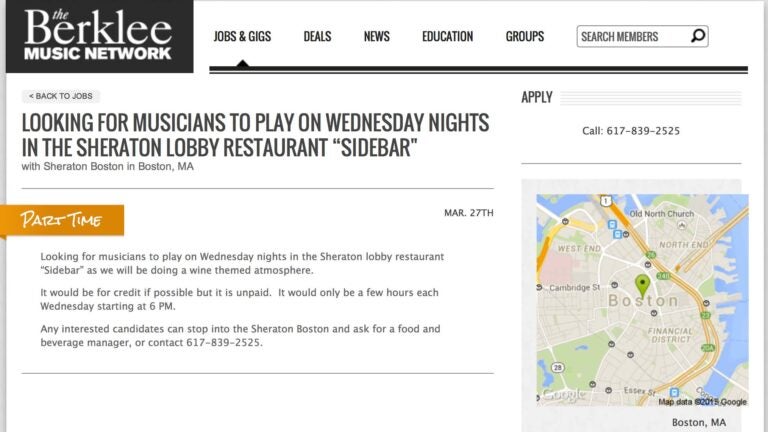
Guests spending the night at the Sheraton Boston Hotel will find ample accommodations for an enjoyable stay, well-appointed suites, an indoor pool, close proximity to the Prudential shops, and perhaps an evening of drinks while listening to live music in the hotel’s SideBar & Grille. As with any reputable hotel, each of these amenities will be delivered by a paid staff of dedicated professionals, and all for the reasonable price of a few hundred dollars a night.
All of them except one, at least according to a recent listing (now removed) posted by the hotel to the Berklee Music Network Jobs & Gigs board:
“Looking for musicians to play Wednesday nights in the Sheraton lobby restaurant ‘Sidebar’ as we will be doing a wine themed atmosphere. It would be for credit if possible but it is unpaid. It would only be a few hours each Wednesday starting at 6 PM.’’
For anyone who has spent time as a working musician, the advertisement of an unpaid “job’’ probably won’t come as a surprise, but it doesn’t make it any less galling each time. That was true for a group of dozens of Boston area musicians, who spent Sunday fuming over what they perceived as yet another effort to minimize the value of their labor in an increasingly hostile marketplace.
SideBar’s manager, Jonathan Sobel, said the ad was a mistake Monday after he was made aware of the complaints online. “We had a little bit of trouble in the wording of the post,’’ he told me. “Many people called, and I reassured them that the ad was incorrectly worded in the posting. We’ve always paid for musicians to work at the hotel, and we always will … I think it ruffled some feathers in the community, and we were not trying to do that.’’
For their part, hotel management had Berklee remove the ad Tuesday morning. However, the musicians’ greivances had already been aired.
Boyan Hristov, a Berklee graduate, first posted the listing Sunday to his Facebook page, where it attracted the attention of the local music community. He found the offer insulting on principle, he told me. “Who works for free? Hint: No one. Why should a musician do it?’’
While he does see unpaid gigs listed on the Berklee boards from time to time, “there’s usually some sort of return, and it’s usually within reason,’’ he said. “Sheraton can definitely afford whatever they want, including high-quality entertainment.’’
The wealth of the employer in question is something that many of the critics found particularly irksome. Starwood Hotels and Resorts Worldwide, Inc., which operates the Sheraton, along with around 1,160 other hotels around the world, does about $6 billion in sales, according to Forbes.
Some likened the gig to any other sort of internship in a creative field, where would-be journalists, and film professionals, for example, are often tasked with working for free for a time (although numerous lawsuits against publishers and film companies have sprung up in recent years over just this issue). And while this offer did mention it could be used for school credit, some found that hard to swallow.
“It’s true other professions offer unpaid internships. People often do internships in the business world, perhaps for a foot in the door of a company they want to work for or perhaps a strong mentoring program in their field of study,’’ said Joe McMahon, another Berklee graduate and working musician. “What’s a pianist going to learn from a waiter? What’s a drummer going to learn from the concierge?’’
“They are just exploiting young musicians and devaluing the music,’’ he added. “This isn’t a ‘I’m playing my original music to get exposure gig,’ which is fine, you have to start somewhere, and work your way up. This is a general business gig. Business means money exchanges hands.’’
“It’s a shame this came through a Berklee gig board,’’ Hristov said. “Putting a value of zero for your students’ work teaches them nothing.’’
Peter Spellman, the director of Berklee’s Career Development Center, explained that it’s not quite so cut and dry an issue as the angered alumni might think. He says it’s not unheard of for people to post opportunities for little or no pay on the site, and he’s seen this type of response flare up before over the years whenever it happens.
“I totally support musicians being paid and being paid well,’’ he said, adding that whenever employers call his office for rates, they always quote $100 per musician, per hour. “But employers are able to post without speaking to us as well. We always try to be vigilant about making sure we’re respecting musicians’ wages, but you know this is a musician-rich city—Boston—with lots of people looking for gigs any way they can get them.’’
That, in part, is why so many employers in high-demand fields, from writing to photography to music, often feel like they can offer gigs with no compensation save the vaunted “exposure.’’ The truth is, many people will actually do the work for free.
But there’s an added wrinkle when it comes to Berklee students in particular. Spellman explained about 30 percent of them are international students, and it’s illegal for non-citizens to take paying gigs while they’re in the country studying.
“That really limits a musician’s opportunities, but if they can find an opportunity that’s related to their major that they’re not paid for, they’re able to do it,’’ he said. “They’re looking to build up their credentials, hone their performance chops anyway they can, and this is an opportunity where they can do that. That’s a very big factor.’’
That’s partly why Spellman is reluctant to bar any unpaid gig offers outright.
“I feel like for a lot of American musicians on the scene, it’s an onerous gig,’’ he said of the initial Sheraton offer. “But for those who are just trying to get some experience performing in the states, it’s a possible outlet. Not to mention too, the original posting actually made reference to this being an opportunity possibly for credit.’’
While students regularly take on internships for credit at Berklee, working in recording studios, or the business side of the music world, a performing internship is quite rare, Spellman said.
“While I totally support musicians being paid money, the value doesn’t have to be money necessarily,’’ he said. “I know this kind of gig runs counter to musicians who went to Berklee, and paid a lot of money, and see downward pressure on musicians’ wages, that they see this and want to scream, I totally get that. On the other hand, I feel like we can’t really play the role of an arbiter of determining what a gig should pay, setting a minimum price. Musicians have to be free to make their own determination on these things. We try to train them in how to assess opportunities, so they’re getting value out of what they’re doing.’’



To comment, please create a screen name in your profile
To comment, please verify your email address
Conversation
This discussion has ended. Please join elsewhere on Boston.com