
Newsletter Signup
Stay up to date on all the latest news from Boston.com
Growing up in Springfield, the youngest of eight, little Ruth E. Carter would steal art supplies from her brother’s room.
She loved “drawing, sketching, smudging pastel chalk on paper,” until, one day, she discovered her mother’s Singer sewing machine.
“It was the beginning of my journey,” she told Boston.com in a recent phone interview. “I didn’t want to build clothes — I wanted to create garments of art. It opened up a world for me.”
Since then, her artistic vision and her passion for wearable art has brought to life favorite and iconic film characters — from Marvel’s “Black Panther” and “Black Panther: Wakanda Forever” to “Do the Right Thing,” “Malcolm X” “Amistad,” “Dolemite Is My Name,” and “Oldboy,” to name just a handful.
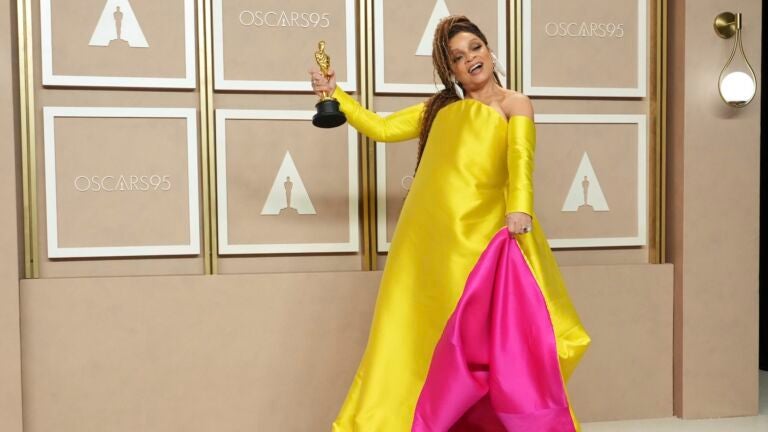
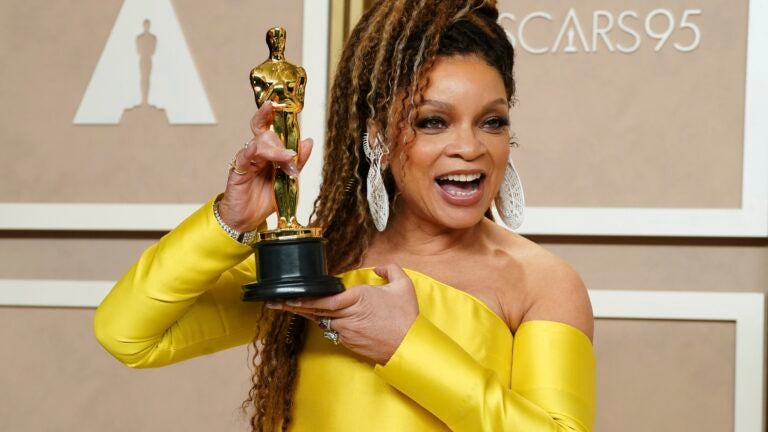
Carter became the first Black woman to win two Oscars with her win in March for “Black Panther: Wakanda Forever.” She also made history in 2018 when she took home the same award for “Black Panther” — the first Black person to win that category.
Now, for her “extraordinary history-making contributions to cinema,” Carter will become the first Black recipient of the Coolidge Theater’s Coolidge Award. As the theater states, Carter has “shaped the story of the Black experience on screen.”
She’ll receive the award in an 8 p.m. ceremony in Brookline Sunday. There will also be a 1 p.m. screening of “Black Panther,” followed by a Q&A and a book-signing with Carter on her 2023 retrospective book: “The Art of Ruth E. Carter: Costuming Black History and the Afrofuture, from Do the Right Thing to Black Panther.”
(Also, fellow Marvel fans, rejoice: Carter is also working on the upcoming “Blade.”)
I called Carter, 63, recently to talk Marvel, Spike Lee, Springfield roots — and her connection to “Seinfeld’s” George Costanza.
Ruth E. Carter: When I saw the past illustrious honorees [including Meryl Streep, Werner Herzog, Jane Fonda, Michael Douglas, Julianne Moore], I saw how important this award was. Being the first Black person to receive it, I’m honored. These firsts are becoming more and more part of our lens on how this country was born, how we all participated, and should be honored. That’s where I went with it.
I was intrigued, just as I was with my mom’s sewing machine. He gave me the key to the costume shop [which had] everything I needed. Because of acting, I knew how to break down a script, how to do a character arc. I did that for every character, and created my own relationships with them though the colors I chose for each costume. It fused [my love of] art and my love for this tactile universe in cloth. I also understood the aging process early on — how you could build a garment, but it still wasn’t ready to perform until you added a story.
Absolutely. Otherwise, it really does say nothing. Sometimes it’s a matter of having a conversation with the actor [about their character]: What happened earlier in this day? Did you take the train? Did you work out? Did you go to work? What kind of work do you do?
And depending on that subtext — and this is the story that nobody sees; this is the story that we feel — I might mark the knees, the elbows, the armpits. I was trained as an intern to understand how to mix paint to look like sweat [so it lasts] for the length of a show. It has to be a tonal thing. I heavily got into that process. That was my jam.
It was Stage West at the time, [later] called City Stage. I looked at different theater internships, but that one intrigued me because they offered free housing. But I knew that was just the beginning. I needed to go further.
Yeah, I basically went to AAA and they highlighted my trip from Massachusetts to New Mexico.
Yes. My mom was like, “You’re not doing that, are you?”
[laughs] I’m like, “Yeah, I am.” I had a Volkswagen Rabbit, I packed up my worldly belongings, and drove cross-country. My brother told me: “When you drive across the desert, turn the heat on so your car doesn’t overheat.” So I drove across the desert with the heat on, all the windows down.
[laughs] I don’t even know if that’s true!
It does! [laughs]
Things were happening in the film industry. Things were changing. Robert Townsend had “Hollywood Shuffle.” Keenen Ivory Wayans was writing comedy with his brother Damon. There was an energy. I was still thespian to the core. Spike went to see a dance performance I designed.
I immediately quit my job and started working on it. [laughs] I didn’t know: “Oh, wait a minute, you have to have a contract.”
In theater, you have aesthetic distance — you lose detail when it goes from the stage to the eye, so everything had to be painted out big. Here, I was working the opposite, film enlarged things 600 percent, so details were more important. I didn’t get that at first. So everything I did was just outlandish. [laughs] But fortunately, “School Daze” was a film where you could be outlandish.
Spike kept hiring me; then Robert Townsend and Kenan kept hiring me. I could count on half a hand how many costume designers of color there were. We were not behind the camera. Spike’s philosophy was we needed representation behind the camera. He promoted that. He promoted me as a department head.
I got nominated for [an Oscar for Costume Design] for “Malcolm X” — once Hollywood started to take notice, I started getting interviews for studio films. I started to realize that I did have a space here. I was creating a space for myself. I did a pilot for “Seinfeld.” I did the pilot for “In Living Color.”

I went to Jerry’s apartment and picked his clothes from stuff he had. He was extremely neat. His socks were rolled. All the jackets were hanging in the same direction.
Then George, he [Jason Alexander] wanted to wear glasses for his character. All I had were samples from “Malcolm X.” The wire-rim glasses he ends up with were glasses from “Malcolm X.” He was like, “Yeah, I like this style.”
[laughs] Yeah. We ended up buying him his own. But those were part of my kit.
We knew the tribes were visually stunning, so we studied the tribes. Wakanda had an aesthetic you could see in the comics — it was a melting-pot of different tribes. You could glean a lot of inspiration from the comics, but the comics lacked detail.
I had a team of illustrators, costume curators looking up tribes, putting boards together for inspiration. So this roadmap started to come together. The Dora Milajea [Black Panther’s female bodyguards] in the comics, were overly sexualized. [Director] Ryan Coogler said: I need them to be in uniform. They protect the king. They need to look serious. That’s how we approached it.
There are thousands of tribes across Africa — we only examined 12. And that was a lot. The Jabari tribe, in the comics, follow the silverback gorilla as a mascot, but it was done very derogatory in the comic. So we kept the idea, with the silverback being the thing for the Jabari. The wood was added from the Dogon tribe of Mali. The Dogon do incredible carvings. They have this celebration of the solstice where they wear raffia skirts, tall masks. So we took the silverback gorilla [theme] from the comics, and added it to the philosophy of the Dogon, and carved their armor out of wood. It was an amalgamation.
Then [there’s] their technology that creates the Afrofuture. They’re honoring their past, they’re living in the present, and they have a futuristic technology. So those were the elements we kept in mind as we created these worlds.
Yes. That character balked against tradition. So I created her clothes to say: I’m not wearing all that traditional stuff. When she gets to Warrior Falls, she says: Can we get a move on? This corset is uncomfortable. She wants to get back to the lab. That’s the ongoing theme of her character, which was wonderful to work with.

I loved Malcolm X, because I was able to explore so many eras and take one person on a full life-journey.
I loved Tina Turner [“What’s Love Got to Do With It]” when I was able to create costumes for Angela Bassett. The gold dress with the beads — I really studied Tina’s dress when she wore it, how many layers of beads, the exact gold color. I remember giving Laurence Fishburne an Ike Turner jumpsuit that had a belt Ike really had that we [replicated] — two hands clasping together as the buckle. Crazy fabulous ’60s style, pop art. I could go on and on. I have favorites from “Wakanda Forever,” “Black Panther.”
Marvel gives you a sketch. But I had a hard time imagining that suit in Africa — how is he going to be walking around in this tight black suit? I said we need something on it that makes it African. Everything around him feels Wakandan— why wouldn’t the suit feel Wakandan?
I looked at the Superman suit, saw how his steel muscles emanated. I looked at the Black Panther suit they made for “Captain America: Civil War” — they indicated a little texture to the top layer. I thought there’s our opportunity: we’ll do a top layer that feels like Ankara. Once I added that Okavango triangle, and made the top layer thin enough to see the vibranium muscles underneath, I felt like I had the story of Wakanda.
Lauren Daley can be reached at [email protected]. She tweets @laurendaley1.
Stay up to date on all the latest news from Boston.com





To comment, please create a screen name in your profile
To comment, please verify your email address
Conversation
This discussion has ended. Please join elsewhere on Boston.com